
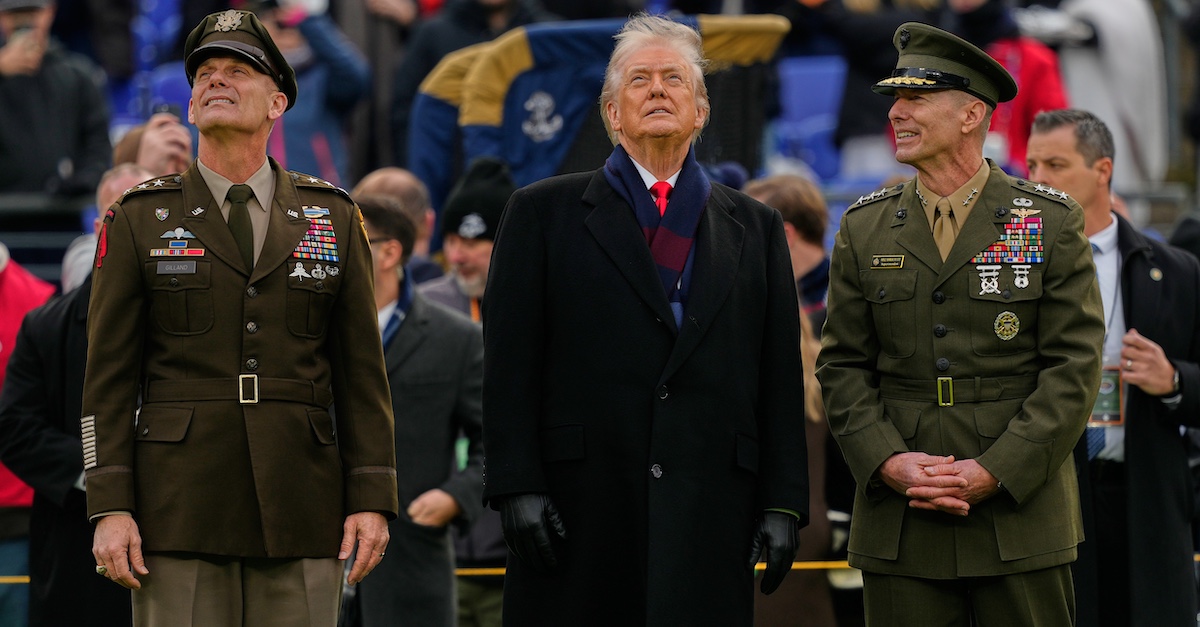
President Donald Trump stands with Lt. Gen. Steven Gilland, Superintendent of the U.S. Military Academy at West Point, left, and Lt. Gen. Michael Borgschulte, Superintendent of the U.S. Naval Academy, before the start of the 126th Army-Navy NCAA college football game at M&T Bank Stadium, Saturday, Dec. 13, 2025, in Baltimore (AP Photo/Julia Demaree Nikhinson).
A federal judge preliminarily blocked the U.S. Military Academy from censoring a civilian law professor and similarly situated academics both inside and outside the classroom, finding it "plausible" one of President Donald Trump's executive orders spawned unconstitutional policy.
Senior U.S. District Judge Cathy Seibel, a George W. Bush appointee, wrote Tuesday in the U.S. District Court for the Southern District of New York that Department of Law and Philosophy Professor Tim Bakken was "likely to succeed on the merits" of his First Amendment claims, bringing to mind multiple other rulings that reached substantially similar conclusions about various Trump administration's actions.
In this case, Bakken recounted that Trump's Jan. 27, 2025, executive order 14185, barring "un-American, divisive, discriminatory, radical, extremist, and irrational theories," like those that say "America's founding documents are racist or sexist," was issued just two weeks before the "Dean's Policy and Operating Memorandum No. 03-24 came into effect at West Point."
The so-called "Academic Engagement Policy" was instead focused on disengagement, by requiring faculty to "obtain approval from department heads" before engaging with externally focused "journal publications, conference presentations, media interviews, podcasts, opinion editorials, blog posts, social media posts, etc." that are "within faculty members' disciplinary areas of expertise while on duty or when using any USMA affiliation or branding."
Bakken claimed that he subsequently raised concerns at a faculty meeting that the policy was "an unconstitutional restriction on speech," and that Col. Julia Coxen — a nonparty to the case — "advised Plaintiff that DPOM 03-24 was an effort by senior military officers at the Academy to 'show to the new administration 'radical compliance' as a way to protect their positions.'"
Months later, the lawsuit alleged, Bakken again raised objections. When he did, he was allegedly "angrily" told that he "must obey the regulation."
"Again, Plaintiff opined that the policy was unconstitutional, but the Deputy Department Head, Defendant Berry, angrily 'admonished that Plaintiff must obey the regulation' and told him after the meeting that he should file a class action lawsuit to challenge it," court documents said.
Having accepted the challenge, Bakken scored a preliminary win for himself and "civilian faculty members of USMA" more broadly against the "Academic Engagement Policy" and an "informal policy" instituting a "total ban" on professors sharing opinions dubbed the "Classroom Directive."
The judge agreed that the professor's "need for judicial review" was "particularly acute" and slammed the government's claims of "real harms" as "weak justifications."
"At worst the Academic Engagement Policy reflects an effort to control the content of USMA professors' speech in a way that censors their academic writing and research where the Government disagrees with its message and seeks to align their scholarship with the preferred views of the current administration," Seibel said. "Even considering West Point's unique role compared to other public universities, Plaintiff is still likely to succeed on the merits of his challenge to DPOM 03-24."
The judge also called it "plausible" that the "Classroom Directive" and Trump's executive order were linked, writing that the DOJ left the allegation "unaddressed."
"[N]o real justification for the Classroom Directive has been provided. And it is nonsensical if the mission is to prepare the nation's future military officers. For genuine strength and leadership to result, cadets must be exposed to a variety of viewpoints and trained to think critically about them. West Point cadets are already, by definition, smart, tough and patriotic," the judge remarked. "They are not snowflakes who will somehow be harmed by learning about controversial issues or competing viewpoints. They will not somehow be weakened in their future defense of our country if their classroom discussions are robust and open."
Editor's note: the lede was corrected post-publication to note the May injunction was preliminary, not permanent.
Follow Law&Crime:


Comments