
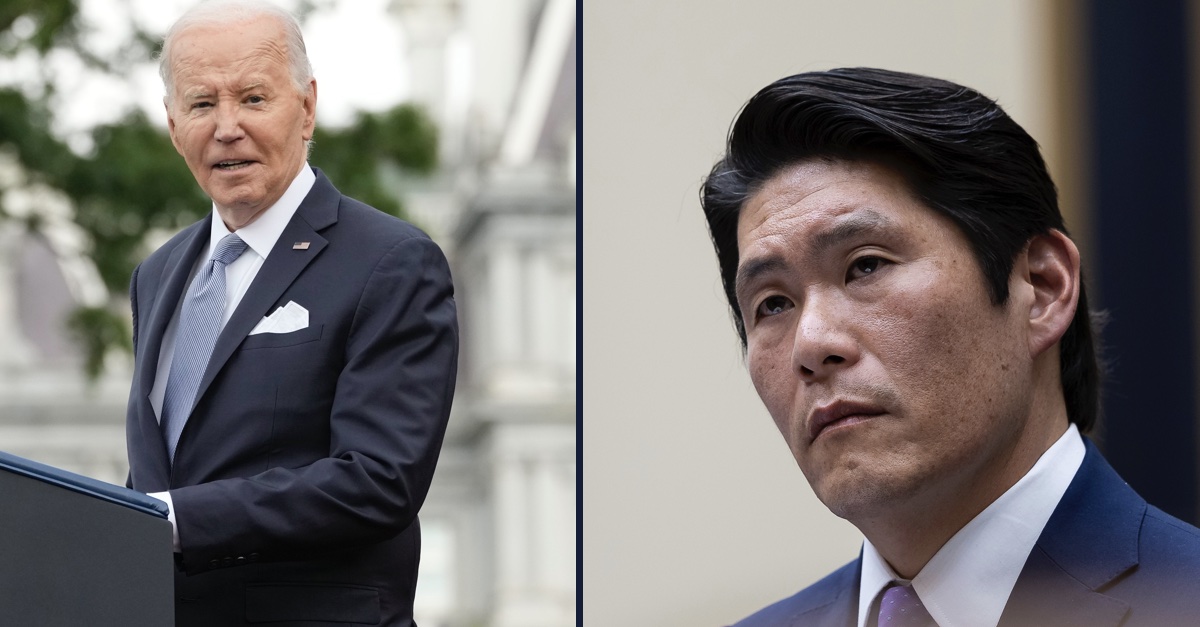
President Joe Biden (left) speaks on May 23, 2024. (AP Photo/Jacquelyn Martin); (right) special counsel Robert Hur testifies before the House Judiciary Committee on March 12, 2024. (Francis Chung/POLITICO via AP Images)
To stop members of Congress and a conservative group from obtaining audiotapes of his ghostwriter sessions, former President Joe Biden went to court late Tuesday and accused the Trump administration's DOJ of making a "nakedly political" decision to stop defending his "privacy interests."
In the latter days of Biden's lone term in office, the DOJ led by U.S. Attorney General Merrick Garland took the position that the Heritage Foundation had no leg to stand on when seeking — through Freedom of Information Act (FOIA) litigation — recordings and transcripts of conversations he had with his memoir's ghostwriter, Mark Zwonitzer, in 2016 and 2017.
As Law&Crime has reported, Garland's DOJ said the threat of "deepfakes" meant releasing special counsel Robert Hur's tapes of Biden's interview about classified documents he retained was a nonstarter. Axios made those tapes public a year ago.
The once "deleted" but recovered Zwonitzer tapes also factored into Hur's probe of documents on U.S. "military and foreign policy in Afghanistan."
Chapter 17 of Hur's report, for instance, addressed the decision not to charge Zwonitzer for obstruction, given that he had "deleted digital audio recordings of his conversations" with Biden after learning of the special counsel's appointment but before the FBI reached out to him.
"The recordings had significant evidentiary value" for the willful retention of classified documents investigation, Hur wrote. "But Zwonitzer turned over his laptop computer and external hard drive and gave consent for investigators to search the devices. As a result, FBI technicians were able to recover deleted recordings relating to Promise Me, Dad."
In short, not only were there "verbatim transcripts" of these conversations in absence of audio, the deleted audio was also recoverable as a consequence of Zwonitzer's candor.
Yet in a motion and memorandum filed late Tuesday, Biden insisted the public should not be able to hear that audio.
"The Heritage Plaintiffs have no legal right to the recordings or transcripts of President Biden and Zwonitzer's private conversations, which the Department obtained in the context of law enforcement proceedings," the memo said. "The Department itself has explained as much, in no uncertain terms. In the Department's own words, release of President Biden's sensitive, private conversations 'would constitute a severe invasion of privacy with little to no meaningful or cognizable counterbalancing public interest.'"
Biden additionally claimed that if U.S. District Judge Dabney Friedrich, a Donald Trump appointee, orders the materials' release, that would "inhibit law enforcement in the future, thereby threatening public safety."
"The Department is now abandoning the core tenets of American justice and forsaking its duty to protect law enforcement files. The law has not changed, but nonetheless, the Department has reversed course," the filing added, urging the judge to let Biden intervene and protect "undoubtedly enormous" privacy interests at stake.
While the Heritage Foundation has claimed that Biden has been engaging in "unfair" and belated delay tactics, the former president argued his legal team only just learned one week ago about the Trump administration's "final decision" to do a 180.
"President Biden is entitled to intervene as of right because his motion is timely, he has a legally protected interest in the action, the Department's proposed release threatens to impair his interest, and neither of the existing parties adequately represents that interest," court documents said.
When Hur released his report on the classified documents investigation, the special counsel said there was evidence Biden "willfully retained and disclosed classified materials" but concluded a jury wouldn't convict a "sympathetic, well-meaning, elderly man with a poor memory." Additionally, DOJ policy ruled out charging a sitting president and the alleged facts were not as serious as those Trump faced in his since-dismissed Mar-a-Lago classified documents prosecution, Hur said.
"Unlike the evidence involving Mr. Biden, the allegations set forth in the indictment of Mr. Trump, if proven, would present serious aggravating facts," the special counsel's report stated. "Most notably, after being given multiple chances to return classified documents and avoid prosecution, Mr. Trump allegedly did the opposite."
Follow Law&Crime:



Comments