
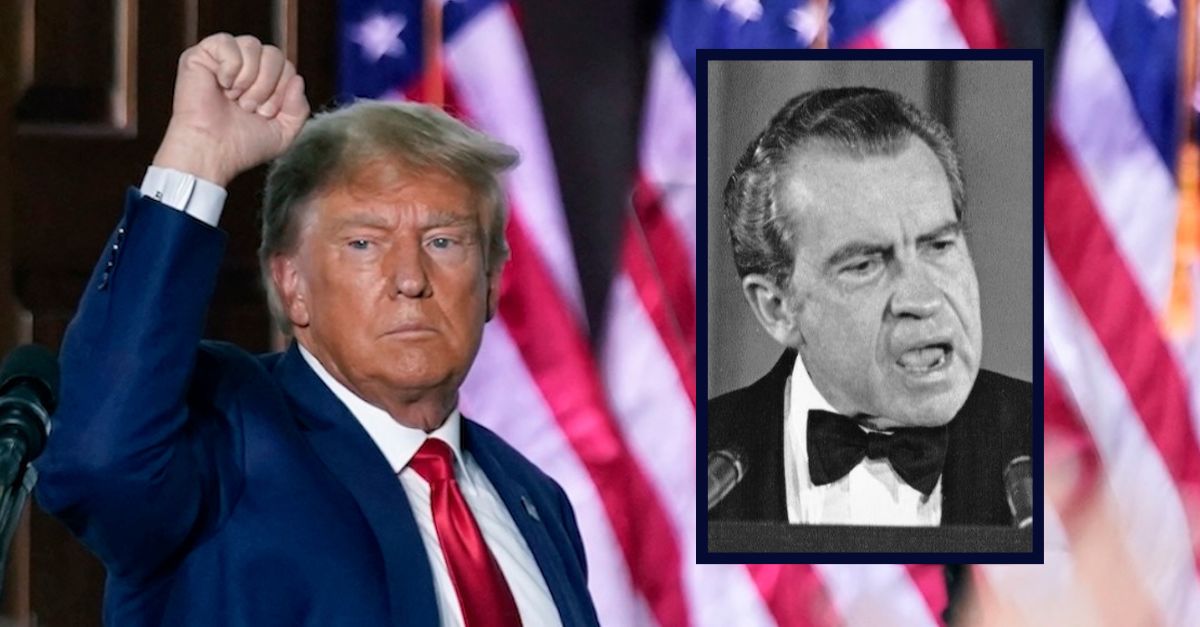
Main: Then-former President Donald Trump gestures after speaking at Trump National Golf Club in Bedminster, N.J., Tuesday, June 13, 2023, after pleading not guilty in a Miami courtroom earlier in the day to dozens of felony counts that he hoarded classified documents and refused government demands to give them back (AP Photo/Andrew Harnik, File). Right inset: President Richard Nixon tells a group of Republican campaign contributors, he will get to the bottom of the Watergate scandal during a speech on May 9, 1973 in Washington (AP Photo/John Duricka, File).
A federal judge quoted George Orwell's "1984" at the start of an opinion ordering the White House Office and various officials to comply with the Presidential Records Act (PRA), a win — for now — for the two groups raising a challenge.
Senior U.S. District Judge John Bates, a George W. Bush appointee, ruled Wednesday that the American Historical Association (AHA) and American Oversight "established a substantial risk" that the Trump administration is "no longer fully complying with the Records Act," based on the government's own declaration that it didn't have to do so.
The PRA, enacted in the aftermath of Watergate and Richard Nixon's failure to challenge the Presidential Recordings and Materials Preservation Act, gave the United States "complete ownership, possession, and control" over presidential records, requiring that the chief executive "adequately" document "activities, deliberations, decisions, and policies that reflect the performance of the President's constitutional, statutory, or other official or ceremonial duties" for their submission to the National Archives (NARA) and, by extension, the American people.
In April, the DOJ's Office of Legal Counsel (OLC) issued an opinion stating that Trump "need not further comply" with the PRA because it is "invalid in its entirety" and "unconstitutional." The memo referenced Trump's dismissed Mar-a-Lago classified documents prosecution and slammed "attempts […] to subject a former President to criminal liability for his handling of presidential records that, for most of this Nation's history, would have been subject to his complete discretion."
Plaintiff "historians, researchers, and educators," along with American Oversight, a left-leaning nonprofit legal group, responded by saying they "rely heavily on access to historical records about the inner-workings of the federal government to undertake their missions," and that the executive is not free to simply nullify the PRA and override Supreme Court precedent on a whim.
Bates agreed that at the preliminary injunction stage, the plaintiffs "have established a substantial risk that the government is no longer fully complying with the Records Act, at least with respect to three categories of records: electronic records created on personal rather than official devices, records created by the President or Vice President themselves, and records the President discards."
"That risk amounts to informational injury for these plaintiffs because they have regularly sought access to presidential records under the Freedom of Information Act and plan to continue doing so. And plaintiffs likely have a cause of action under the Constitution and to enjoin violations of federal law because the government—which has concluded that the Records Act is unconstitutional—is necessarily acting under its Article II powers rather than any statutory authority in promulgating new records guidance," Bates reasoned, before stating on the merits that the PRA "is likely constitutional."
"It was validly enacted by Congress under the Property Clause because Congress may prospectively designate presidential records as federal property and then regulate that property. And it is also a valid exercise of the Necessary and Proper Clause as it promotes the accountability and efficiency of Executive Branch operations," he added.
The judge said that although the groups "may lack standing or a cause of action with respect to NARA, the Archivist, DOJ, and the Attorney General because they have identified neither present injury traceable to those defendants nor final agency action," they were still entitled to relief forcing the "remaining federal defendants" other than Trump and Vance to "comply with the Records Act and not rely on the OLC opinion and the 2026 Records Guidance."
In case it was not clear to whom the order applied, the judge specified in a footnote in his accompanying order that it applies to the White House Office, Trump's chief of staff Susie Wiles, and Stephen Miller, among others:
The Enjoined Defendants subject to this order are: the White House Office, Chief of Staff to the President Susie Wiles, Director of the Office of Records Management Philip Droege, the National Security Council, Executive Secretary of the National Security Council Catherine Keller, the Homeland Security Council, Homeland Security Advisor Stephen Miller, the Council on Economic Advisers, Chair of the Council of Economic Advisers Pierre Yared, the Executive Residence, White House Chief Usher Robert Downing, Chair of the Intelligence Advisory Board Devin Nunes, the Office of Administration, Director of the Office of Administration Joshua Fisher, the Office of the Vice President, Chief of Staff to the Vice President Jacob Reses, the U.S. DOGE Service, and Acting Administrator of the U.S. DOGE Service Amy Gleason.
The judge set the order to go into effect on the morning of May 26.
In response to the ruling, American Oversight emphasized that the Trump administration has been ordered to "preserve and not destroy or delete presidential and vice presidential records" under the PRA and must provide an update on May 28 detailing its compliance.
"Today's ruling is an important victory for presidential accountability and for affirming what decades of law and practice already established — the constitutionality of the Presidential Records Act. The court recognized the serious danger posed by the administration's attempt to cast aside longstanding federal law governing presidential records and replace it with a system dependent largely on presidential discretion and public trust," American Oversight Chioma Chukwu said in a statement. "This case has always been about something larger than records management. It is about whether a president can treat government records as personal property — deciding for himself what will be preserved, what will be disclosed, and what can simply be destroyed."
AHA Executive Director Sarah Weicksel separately said Bates reaffirmed that the "essential place of presidential records in documenting our nation's history and a core principle of the Presidential Records Act: that these records belong to the American people, not to any one individual."
Follow Law&Crime:


Comments