

Left: Attorney Alan Dershowitz returns to the courtroom after a break during former U.S. President Donald Trump's at Manhattan Criminal Court on Monday, May 20, 2024, in New York (Michael M. Santiago/Pool Photo via AP). Right: Justice Clarence Thomas looks on during the 60th Presidential Inauguration in the Rotunda of the U.S. Capitol in Washington, Monday, Jan. 20, 2025. (Chip Somodevilla/Pool Photo via AP).
Alan Dershowitz vowed to take his thus far failed defamation case against CNN all the way to the U.S. Supreme Court to challenge the landmark 1964 precedent set by New York Times v. Sullivan, a gambit that would change defamation law as we know it, and to the delight of Justice Clarence Thomas, if the court takes up the case and it succeeds.
Attorney Jay Sekulow, like Dershowitz, defended President Donald Trump at his first impeachment trial, which scrutinized Trump's Ukraine aid impoundment but ended in his acquittal. Now, more than five years later, Sekulow and the American Center for Law and Justice are defending the famed criminal defense attorney and Harvard Law School professor emeritus for what he said during the Trump trial.
The petition for a writ of certiorari has officially been in the cards since November, when Dershowitz sought an extension from Thomas to file. The justice, who handles cases from the 11th U.S. Circuit Court of Appeals, granted that extension. Dershowitz then filed the petition on Dec. 29, following through on his September remarks to Law&Crime.
In the petition, which follows the federal district court's dismissal of his case and the 11th Circuit's affirming of that dismissal, Dershowitz made clear that he believes SCOTUS should seize the opportunity to overturn Times v. Sullivan, which established the "actual malice" standard for public officials and public figures alleging defamation.
The questions presented included whether the "actual malice standard established in Sullivan, or as extended by its progeny, should be discarded altogether or at least as to private citizens who are public figures" and whether SCOTUS should "modify Sullivan's clear-and-convincing and burden-of-proof evidentiary standards."
Dershowitz additionally asked the justices to resolve a circuit split, answering whether a "defendant's systematic omission of qualifying and limiting language from a plaintiff's recorded statement constitutes proof of actual malice" under Sullivan "sufficient to survive summary judgment, as the Second, Third, Fifth, and Ninth Circuits have held, and contrary to what the Eleventh Circuit held below."
As forecast, Dershowitz repeatedly cited the concurrence of U.S. Circuit Judge Barbara Lagoa, a Trump appointee who agreed that precedent meant the $300 million suit had to be dismissed while also saying that CNN had "simply lied" about Dershowitz on air.
Dershowitz's tossed suit claimed the network "falsely" portrayed him as "a constitutional scholar and intellectual who had lost his mind" by misleadingly editing his impeachment defense of Trump to make it seem as if he had said the president could have an illegal motive and still avoid impeachment.
During the trial, Sen. Ted Cruz, R-Texas, asked Dershowitz if it mattered whether there was a quid pro quo, after it was alleged that Trump abused his power by corruptly withholding military aid to Ukraine on the condition that its president announce an investigation into Joe Biden ahead of the 2020 election.
"The only thing that would make a quid pro quo unlawful is if the 'quo' were in some way illegal," Dershowitz began to answer, naming as "three possible motives" for seeking the "quo" the public interest, political self-interest, and financial self-interest.
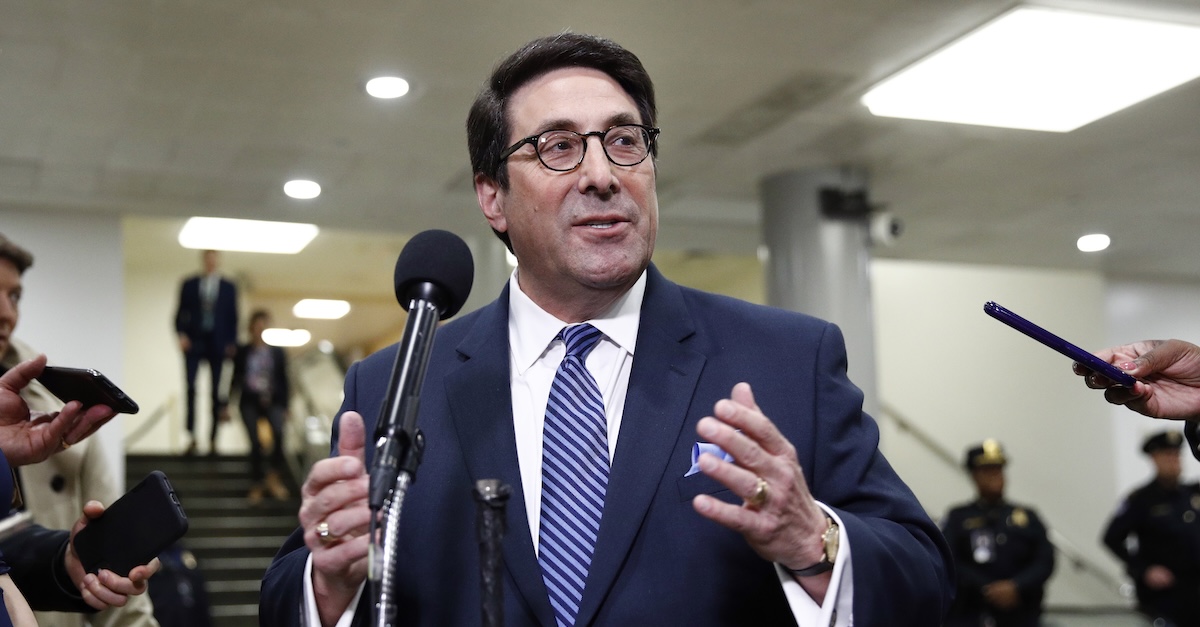
Left: Personal attorney to President Donald Trump, Jay Sekulow, speaks with reporters after Trump was acquitted in an impeachment trial on charges of abuse of power and obstruction of Congress on Capitol Hill in Washington, Wednesday, Feb. 5, 2020. (AP Photo/Patrick Semansky).
On "public interest," Dershowitz told Cruz that "[e]very public official that I know believes that his election is in the public interest, and mostly you're right — your election is in the public interest — and if a president does something which he believes will help him get elected — in the public interest — that cannot be the kind of quid pro quo that results in impeachment."
Dershowitz alleged in his complaint that CNN's selective editing and quote selection put forth a "one-sided and false narrative that Professor Dershowitz believes and argued that as long as the President believes his reelection is in the public interest, that he could do anything at all – including illegal acts – and be immune from impeachment."
While the suit survived a motion to dismiss, with a federal judge agreeing in May 2021 that CNN had "presented an official proceeding in a misleading manner," the case nosedived at summary judgment.
The case didn't fare better at the 11th Circuit, except for Lagoa's statement quoting the late Senior U.S. Circuit Judge Laurence Silberman that Times v. Sullivan "has no relation to the text, history, or structure of the Constitution."
In Lagoa's view, the precedent has caused "harm" to First Amendment "jurisprudence," and Dershowitz's case was a prime example.
"In some instances, [CNN] blurred the line between fact and commentary, and in others, they simply lied about what Dershowitz had said," the circuit judge wrote, adding that the "only thing standing between Dershowitz and justice is Sullivan."
Picking up where Lagoa left off, Dershowitz, who five decades ago defended the First Amendment rights of neo-Nazis to march in the streets of Skokie, Ill., now argues at the highest court in the land that free speech protections for the press as articulated in Sullivan have "devolved into near-absolute immunity for media defendants, even when they profoundly misrepresent verifiable public statements" — even creating a "license to lie."
"Under the common law, the media already can perform aggressive reporting without liability for good-faith mistakes, under common law privileges. That freedom would remain fully protected without Sullivan," the petition said. "Truth would still remain a complete defense. Strict liability would still be precluded. To the extent media organizations have relied on Sullivan as a license to lie, they have relied on a constitutional error and injustice."
In response to Law&Crime's question about whether overturning Times v. Sullivan and its progeny would open the door to "libel warfare," as critics warn, Dershowitz emphasized that his petition raises other outcomes "short" of that.
"We present a series of options short of overruling Sullivan: limiting it to government officials, as it originally was; changing the malice burden to preponderance; leaving malice to [a] jury," he said. "These changes should create a fairer balance."
Nonetheless, the petition does contemplate discarding Sullivan "altogether."
Time will tell if the Supreme Court sees this case as the ideal vehicle to deal a "devastating" blow and "open up those libel laws."
Follow Law&Crime:


Comments