
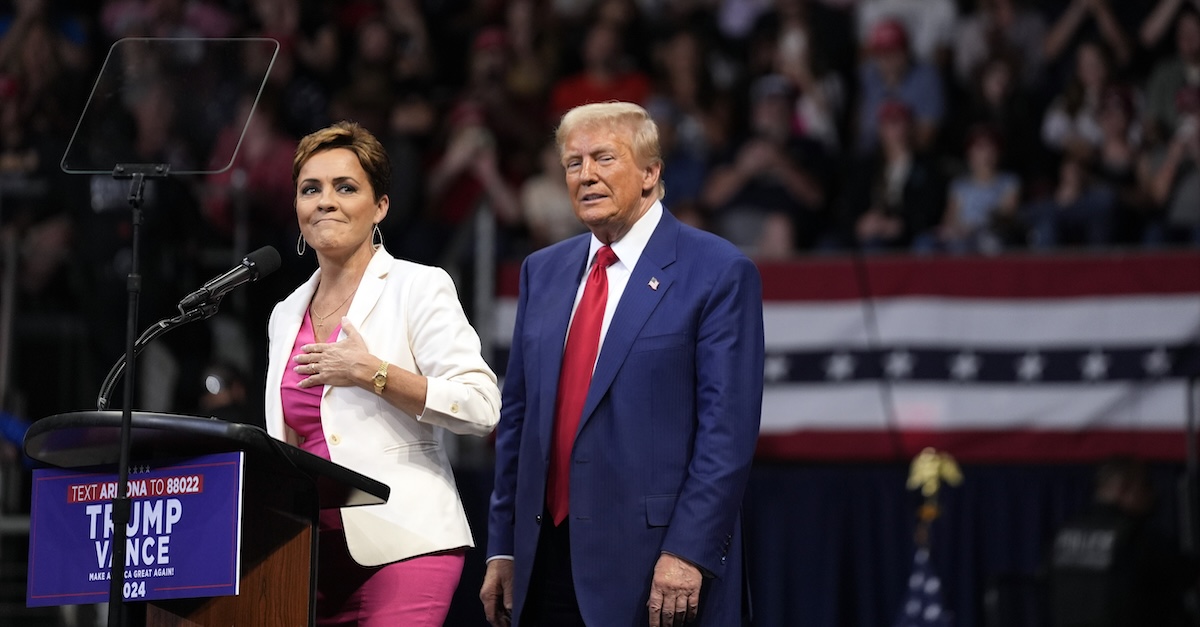
Republican presidential nominee former President Donald Trump listens as Arizona Senate candidate Kari Lake speaks at a campaign rally at the Findlay Toyota Arena Sunday, Oct. 13, 2024, in Prescott Valley, Ariz. (AP Photo/Evan Vucci).
A DOJ lawyer remembered for defending the Trump administration's unprecedented lawsuit against an entire federal court and its judges spent the morning trying to convince a noticeably skeptical D.C. Circuit panel to give Kari Lake a win on appeal.
At issue is Senior U.S. District Judge Royce Lamberth's decision to permanently block the ouster of Voice of America Director Michael Abramowitz. The Ronald Reagan-appointed judge has repeatedly frustrated Lake's teardown of the U.S. Agency for Global Media, voiding actions she took — including firings — while claiming to have the authority of the acting CEO.
And on Thursday, the DOJ took the apparently uphill position that Chief U.S. Circuit Judge Sri Srinivasan and U.S. Circuit Judges Cornelia T.L. Pillard and Florence Y. Pan should find the district court had no business weighing in on the merits to begin with.
In its brief, the DOJ called Lamberth's injunction "flawed" for "three independent reasons," the first being that the judge lacked jurisdiction. The government has maintained that Abramowitz, by virtue of his office, had to file an administrative dispute with Merit Systems Protection Board (MSPB).
The Civil Service Reform Act "channels such claims to an agency adjudicator," the brief argued.
Beyond that, "restrictions" on the executive's ability to fire Abramowitz are "unconstitutional," and the director's reinstatement was "ahistorical," the DOJ asserted.
Pan cut to the chase and pressed DOJ attorney Elizabeth Hedges on congressional intent. Surely, the judge said, Congress never could have intended that the VOA director be removed without the approval of a majority on the International Broadcasting Advisory Board, only to automatically "channel" any grievance to the MSPB — ensuring Abramowitz would wait years for that matter to run its course.
The judge, stating that "defeats the entire purpose of the statute," asked Hedges if it sounded like "meaningful review."
"Can you articulate what is the meaningful review? If this gets channeled, Mr. Abramowitz gets removed. It gets channeled. It takes several years," observed Pan, a Joe Biden appointee. "It's really about the timing, right? Because this removal statute says you can't remove him without the approval, and in effect, you will have removed him without the approval for five years, or whatever it is[.]"
In response, Hedges offered up the "short version" of her position, that "Congress didn't say that there's a special way we want this adjudicated."
"That's true of all of these cases!" Pan fired back. "They never explicitly say. We're trying to ascertain congressional intent without their explicit saying 'we want it channeled' or 'we don't want it channeled.' They haven't said in any of these cases what they want."
"I'm just not hearing any response from you that persuades me that Congress could possibly have intended that this be channeled such that the whole purpose of the statute is defeated," she said.
Hedges answered that if Abramowitz simply challenged his firing and "prevailed" before the MSPB he "would have probably everything he's seeking here" or could seek relief at the Federal Circuit.
Pillard, a Barack Obama appointee, suggested that was not the case.
Without a court opinion on the merits, Abramowitz could get his job back, perhaps five years from now, and then have the "same Sword of Damocles hanging over him that Congress sought to, you know, hold a little more securely from dropping."
Abramowitz's attorney William Schultz said that was right, and explained the choice to seek judicial relief.
In a brief, Schultz said the D.C. Circuit has made clear that "courts have this exact power" to prevent unlawful action.
Follow Law&Crime:




Comments