
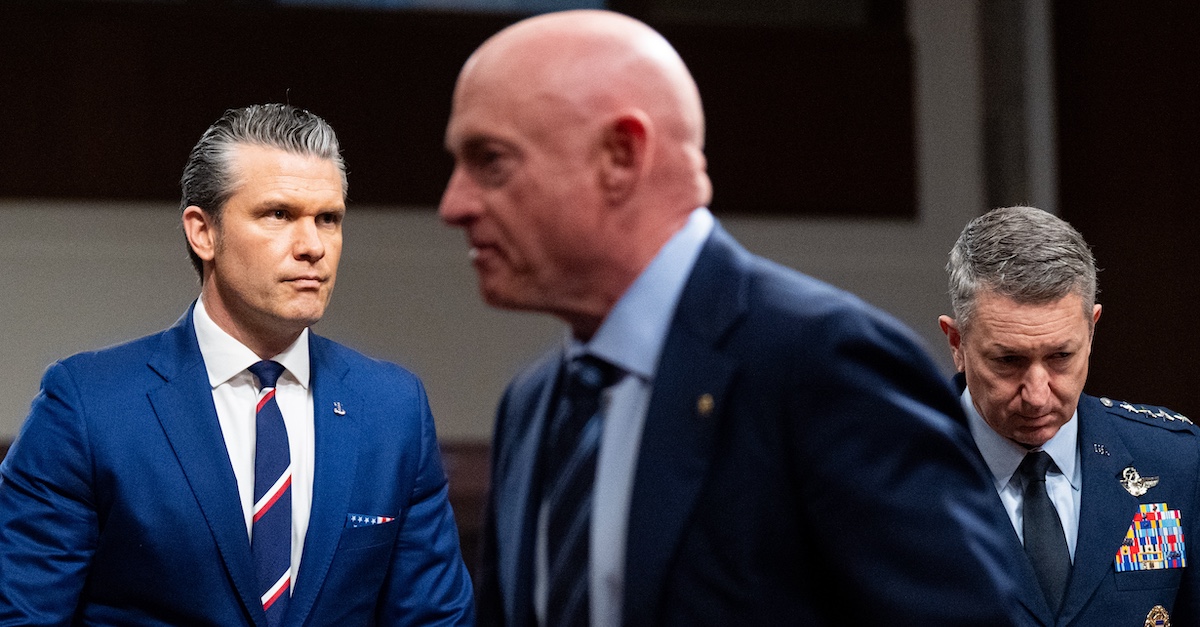
UNITED STATES – APRIL 30: Sen. Mark Kelly, D-Ariz., center, walks past Secretary of Defense Pete Hegseth, left, and Chairman of the Joint Chiefs of Staff Dan Caine before the start of the Senate Armed Services Committee hearing on the Defense Department's budget request on Thursday, April 30, 2026 (Bill Clark/CQ Roll Call via AP Images).
A federal appellate panel strongly suggested Thursday that Defense Secretary Pete Hegseth's mission to punish Sen. Mark Kelly, D-Ariz., for reminding troops they "can refuse illegal orders" is going absolutely nowhere.
On the heels of a ruling in the court below that practically begged Hegseth to stop threatening the First Amendment rights of millions of military retirees to punish his boss' political rival over a video, the D.C. Circuit heard the DOJ's best pitch on Thursday for reviving the disciplinary action.
U.S. Circuit Judges Karen LeCraft Henderson, Florence Pan, and Cornelia Pillard, respectively appointed by Presidents George H.W. Bush, Joe Biden, and Barack Obama, formed the panel, a fact that Law&Crime pointed out after Hegseth finally filed the promised appeal of his loss. Despite technical difficulties with the court's publicly posted audio stream, Pillard and Pan's grilling of a DOJ attorney was enough to glean which way the wind is blowing.
"I mean, this is really basic," Pillard told the government. "You are not disagreeing that the video at issue that is the fulcrum of this case, Senator Kelly never says the words disobey lawful orders, right? I mean, that's uncontroversial. I understand you have a whole theory, but he doesn't say that, right?"
"Not in isolation, expressing —" the DOJ lawyer began to answer, before agreeing the judge was "correct."
In the lead-up to oral arguments, Kelly filed a brief recounting how President Donald Trump accused him and five other Democrats — Rep. Jason Crow, D-Colo., Rep. Maggie Goodlander, D-N.H., Reps. Chris Deluzio and Chrissy Houlahan, D-Pa., and Sen. Elissa Slotkin, D-Mich. — of engaging in "SEDITIOUS BEHAVIOR, punishable by DEATH!" when they appeared in a video in November, condemned lethal military strikes on alleged drug smugglers' boats in international waters, and stated, "you can refuse illegal orders."
The Trump administration not only accused Kelly of "undermin[ing] the chain of command," "counsel[ing] disobedience," and engaging in "conduct unbecoming an officer" warranting a reduction in his retirement rank and pay grade, but U.S. Attorney Jeanine Pirro also launched a criminal investigation into the retired Navy captain and his fellow members of the so-called "Seditious Six." That ended in grand jury no-bills, and Kelly scored his lawsuit win days later in February.
All along, Kelly said "you can refuse illegal orders" referred to the Uniform Code of Military Justice, and Pillard picked up on it.
"He says you have a duty to disobey unlawful orders, right? That is something that is taught at Annapolis to every cadet, right?" the judge asked.
The DOJ shot back that the "only reason" Kelly said what he did was because the sitting senator and astronaut had a "specific intent to influence active duty service members" and that "Captain Kelly was not purporting to give a speech in Annapolis on military law."
"How do we know that?" Pillard followed up.
Because Hegseth said so, the DOJ replied.
"This was the secretary's determination based off a review of a pattern of conduct in a series of public statements," the attorney said. "He determined — that was his inference, his characterization, that the statements were made with the intent to counsel disobedience."
Pillard and Pan dug deeper and suggested the government's case boils down to Hegseth's say-so that Kelly really meant "disobey lawful orders."
"Yes, that is the Secretary's inference. That is what we are arguing. The Secretary has made that inference, and it's one that the district court didn't engage with," the DOJ lawyer stated. "All it needed to know was that Kelly was retired."
Pan quickly panned that line of argument, noting the district court identified the Supreme Court case Parker v. Levy as the ballgame for a reason. In that 1974 case, SCOTUS upheld the court-martial of an active duty Army captain who refused to train Special Forces medics and publicly criticized the Vietnam War.
"[The district court] said, without the benefit of Levy, defendants have no other arguments for how Senator Kelly's speech is unprotected by the First Amendment. So basically, it's kind of back to you you're relying only on Levy. He's saying Levy doesn't do the job for you, and Levy doesn't do the job for you because it applies to active duty service members, but also because, factually, it is so different," Pan said. "I mean, here we have Senator Kelly saying, don't obey illegal orders, and that's completely different what happened in Levy. And we also have the secretary saying that he meant to say the complete opposite of what he did say."
"The secretary says, you are telling people to disobey lawful orders when centrally, explicitly said you don't have to obey illegal orders. I mean, I don't think that we have to accept that as correct or true," she added. "It would be, I think, astounding for us to just credit that unconditionally and not even address it when you rely on Parker v. Levy and Parker v. Levy is factually so different."
When the DOJ said its view is that Levy "recognizes a very longstanding and basic rule that in the military context, the First Amendment is going to operate differently," Pan said that overlooks the "fact that there could and likely is a difference between military retirees and active service members."
Follow Law&Crime:


Comments