
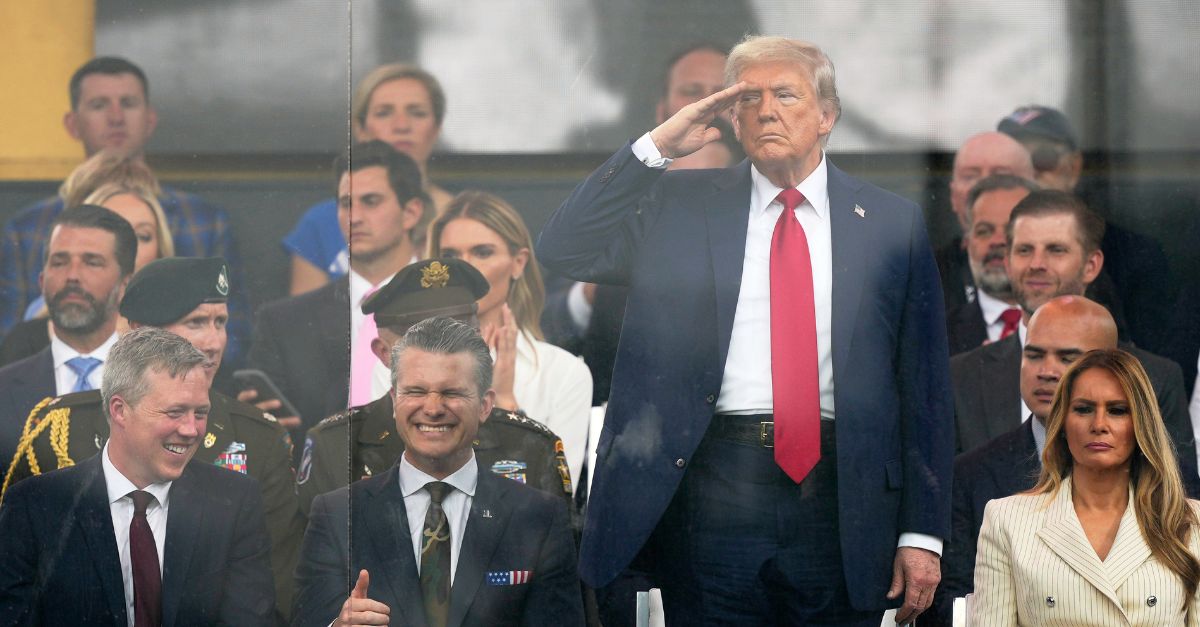
President Donald Trump salutes as he attends a military parade commemorating the Army's 250th anniversary, coinciding with his 79th birthday, Saturday, June 14, 2025, in Washington, as Secretary of the Army Daniel Driscoll, Defense Secretary Pete Hegseth, and first lady Melania Trump, watch. (AP Photo/Julia Demaree Nikhinson).
What happens when the secretary of defense spews "crazy rhetoric" online and then bans a military AI contractor on the strength of a "wrong" risk analysis and a host of "procedural violations?" While two members of the U,S, Court of Appeals for the District of Columbia Circuit discussed ways the thorny "first time" case could still tip in the government's favor, the longest-serving judge on the panel surprised even Anthropic's own attorney by how clearly she called out Pete Hegseth's "spectacular overreach."
U.S. Circuit Judge Karen LeCraft Henderson, a George H.W. Bush appointee who recently faced criticism for her line of questioning during arguments over Hegseth's disciplinary action against Sen. Mark Kelly, D-Ariz., mostly sat quietly early Tuesday as her colleagues U.S. Circuit Judges Neomi Rao and Gregory Katsas, two appointees of President Donald Trump, grilled Anthropic's attorney Kelly Dunbar.
But as soon as Henderson spoke up for the first time and asked if everyone could hear her, considering her remote status, she did not hide her views of Hegseth's challenged "supply-chain risk" designation under 41 U.S. Code § 4713.
Turning to the text of the statute, Henderson declared that "for the life of me" she did not see "any evidence of maliciousness" to justify the designation in the first place.
"I see no evidence of the fact that the word sabotage, maliciously, manipulates, and so forth require a bad actor. I see no evidence of that. I don't see that the department has in any way supported its determination that there is a supply-chain risk with Anthropic, much less a significant supply-chain risk. Is there some evidence that I haven't found that you're a bad actor?" Henderson asked.
Dunbar paused, apparently taken aback by how neatly Henderson's question fit his point.
"No, no, Judge Henderson, to the contrary, I think all available record evidence suggests to the contrary, and I'm happy to talk about, talk about that evidence. I also think the secretary's own actions, I would respectfully submit, Judge Henderson, suggests he doesn't believe it either," he said, alluding to Hegseth's "retreat" from the original premise of how Anthropic jeopardized national security risk with the stance that its AI model Claude "cannot safely or reliably be used for autonomous lethal warfare and mass surveillance of Americans."
"To me, this is just a spectacular overreach by the department," the judge remarked.
"I agree, your honor, and on the statutory point I don't want to fight this line of questioning too much. I would make the point that there are broader and narrower ways to read the statute, but I think your instinct is exactly right, which is that even if the statute could be read broadly to reach unintentional reckless behavior that created a sabotage risk that's not what the secretary alleges here," Dunbar answered.
In the lead-up to arguments, Law&Crime reported that the Defense Department argued that any procedural errors were harmless and Hegseth's determinations reflected his "considered national-security judgment," to which the appellate judges should show deference. Anthropic told the D.C. Circuit that the "textbook retaliation" campaign supported by falsehoods is evidence of exactly the opposite.
"The Secretary's brief confirms that this is a supply-chain risk designation in search of a justification. The Secretary purported to blacklist Anthropic as a threat to national security based in significant part on the factual assertion that Anthropic possesses an 'operational veto' over Claude after it is deployed in the Department's classified systems—a demonstrably false premise that he now abandons," the filing summed up. "Instead, the Secretary falls back to a different justification. He now claims that his 'true concern' is that Anthropic in the future will surreptitiously encode model limitations 'before' Claude's 'deployment' that the Department's testing might not catch."
Katsas and Rao led the charge on these issues.
Rao quickly pointed out that this is the "first time" the statute is "being interpreted by a court," so it was important to be "clear" about "what we're reviewing, and how it's reviewable." As Law&Crime has previously reported, the statute may not actually be reviewable in the first place.
At one point describing the procedural posture at hand as "weird," Katsas later tried to look at the government's case in the "best possible light" — leaving aside "all the crazy rhetoric." He wondered what the point there would be in remanding the case, at which point Hegseth could start the process all over again and end up back before the D.C. Circuit in half a year.
"Forget about the concern about the kill switch in real time. We still have this concern, right? The model is unpredictable. There have been instances where the model of allowing the government to do things it should be allowed to do at least one instance potentially very sensitive where the model is allowing the government to do something that Anthropic might think it should not be allowed to do, and it's undisputed. You not only have the ability to build limits into the model, but by your own admission […] you embrace that," Katsas said. "You say, of course, we're going to build limits into the model, we're not going to sell something that can produce child pornography or nuclear weapons, like that's great, but it causes this concern for the government that it might not work in ways that the government wants it to work."
Dunbar responded that the Pentagon went scorched-earth, when the law requires "less intrusive measures" in a contract dispute like this one, nodding to Henderson's assist.
"I think the means matter here. Even if you thought that the secretary, through ordinary procurement tools, could get to the same result — which is we essentially don't want Claude embedded in a covered system — the question, and certainly this is the less intrusive measures requirement that Congress wrote into the statute that Judge Henderson referenced, is: Does the secretary have other non-blacklisting non-section 4713 designation authorities to achieve that result? Your Honor's recitation of events sounds to me like a scenario where a government purchaser decides a particular product or service isn't the right fit for that agency's mission," the attorney replied. "We would submit that the answer to that again is fairly straightforward."
DOJ lawyer Sharon Swingle defended Hegseth's designation by arguing that the Trump administration made "clear" that Anthropic "has the technical capability to intervene and even prevent the Department of War's use of its AI model for critical military operations" and that the conversation should end there, regardless of the secretary's procedural errors.
"It's undisputed that Anthropic would not agree for its model to be used for all lawful purposes, although the Department of War had deemed that critical for national security, and it's undisputed that Anthropic leadership raised objections to the potential use of its model in an overseas active military operation, even though that was permitted by the existing usage policies," Swingle said, emphasizing that the government is properly concerned that "there will be red lines imposed [by Anthropic] that the department is unaware" of in the future.
When Katsas remarked that "the red line was autonomous, lethal autonomous warfare," the lawyer said she didn't think that was "entirely accurate."
"And domestic surveillance," Katsas added.
"Those were the initial red lines that were identified in the contract negotiations, but those were not the only red lines identified," Swingle replied.
Follow Law&Crime:

Comments