
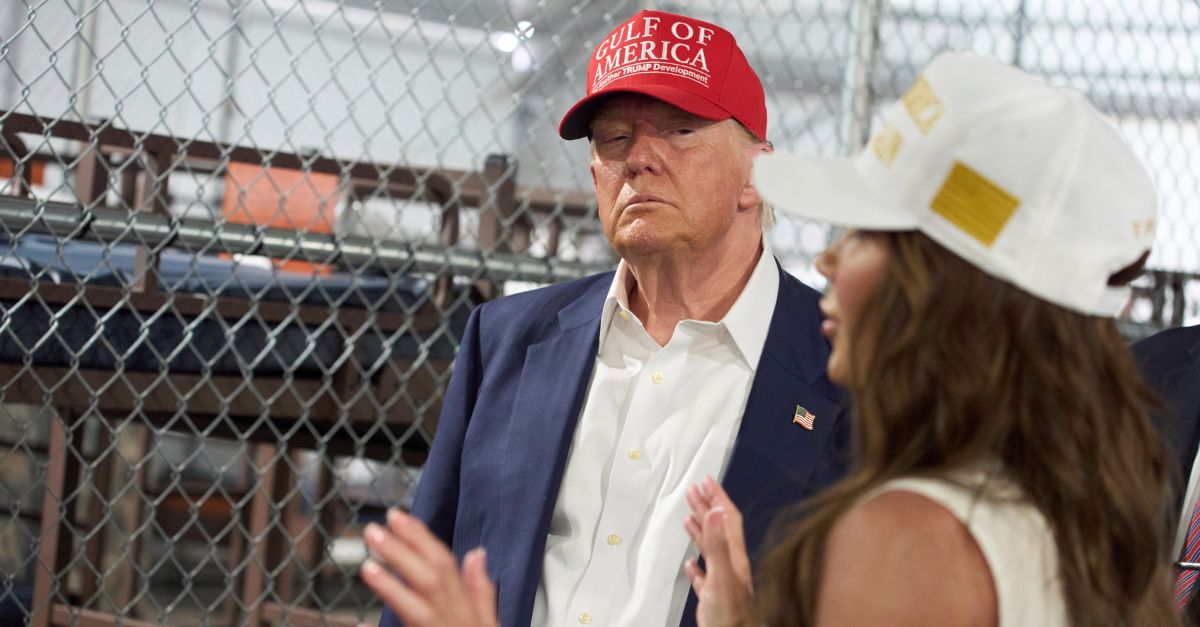
President Donald Trump listens as Homeland Security Secretary Kristi Noem speaks during a tour of "Alligator Alcatraz," a new migrant detention facility at Dade-Collier Training and Transition facility, Tuesday, July 1, 2025, in Ochopee, Fla. (AP Photo/Evan Vucci).
Trump administration whistleblowers exposed a secret DHS and ICE memo revealing the agencies' position that immigration enforcement agents can enter homes without a warrant signed by a judge and arrest people with final orders of removal from the country, leading a top constitutional law expert on the Fourth Amendment to preliminarily conclude the government is "likely wrong" on the law.
While the history of warrantless surveillance of U.S. citizens is well-documented, the Trump administration has been accused of going even further, allegedly "forcibly" barging into Americans' homes without judicial warrants and without consent, to effect the mass deportation of illegal aliens in the name of "restoring safety."
On Wednesday, nonprofit legal group Whistleblower Aid said that two "anonymous" government officials have alleged "a flagrant violation of the Fourth Amendment," a "particularly timely and relevant" claim "given recent news reports of ICE officers breaking into homes, including those of U.S. citizens, without a judicial warrant and forcibly removing the residents" under Secretary Kristi Noem's watch.
DHS Assistant Secretary for Public Affairs Tricia McLaughlin responded to those claims Wednesday by saying there was nothing new to see here, as ICE agents have "administrative warrants" — warrants the Trump administration's immigration officers created and signed off on to deport individuals with a "final order of removal by a federal immigration judge." Notably, that judge is not an Article III federal judge but a "deportation judge" within the executive branch appointed by U.S. Attorney General Pam Bondi.
"Administrative warrants have been used for decades and recognized by the Supreme Court and lower courts," McLaughlin said, in response to Associated Press reporting on the issue. "In every case that DHS uses an Administrative warrant to enter a residence, an illegal alien has already had their full due process and a final order of removal by a federal immigration judge. The officer also has probable cause."
In short, DHS acknowledged that the government has been using I-205 warrants of its creation to enter homes, but claimed that has in "every case" targeted an "illegal alien" with a "final order of removal" from the country. As Law&Crime has previously reported, it has not always been clear that the "final order of removal" the administration claims to have actually exists.
The whistleblowers and their lawyers submitted a complaint to Congress on Jan. 7, stating that DHS and Acting ICE Director Todd Lyons' "secretive memo" from May, a "policy" change largely expressed verbally to agents and kept confidential under pain of potential firing, does in fact break new ground that contradicts "written course material instructing the opposite."
"Although the U.S. Department of Homeland Security (DHS) has not historically relied on administrative warrants alone to arrest aliens subject to final orders of removal in their place of residence," the memo said, the DHS Office of General Counsel "recently determined that the U.S. Constitution, the immigration and Nationality Act, and the immigration regulations do not prohibit relying on administrative warrants for this purpose."
"Accordingly, in light of this legal determination, ICE immigration officers may arrest and detain aliens subject to a final order of removal issued by an immigration judge, the Board of Immigration Appeals (BIA), or a U.S. district court judge or magistrate judge in their place of residence," the memo continued.
While the complaint did not reveal the identities of the whistleblowers to Congress, it did indicate they were among "some employees" that a "select" DHS supervisor showed a copy of the memo.
"While addressed to 'All ICE Personnel,' in practice the May 12 Memo has not been formally distributed to all personnel," the complaint said. "Instead, the May 12 Memo has been provided to select DHS officials who are then directed to verbally brief the new policy for action. Those supervisors then show the Memo to some employees, like our clients, and direct them to read the Memo and return it to the supervisor."
The complaint warned that, as a result of this policy, "[p]otentially, scores of ICE Agents will be emboldened to unlawfully enter private residences, which include the private residences of U.S. citizens."
In remarks on the substance of the complaint's allegations, Whistleblower Aid Senior Vice President and Special Counsel David Kligerman said the Trump administration greenlit and hid a policy justifying actions that the Fourth Amendment was "created to prevent."
"If ICE believes that this policy is consistent with the law, why not publicize it? Perhaps they've hidden it precisely because it cannot withstand legal scrutiny," Kligerman surmised.
A separate analysis by Stanford Law School professor and Fourth Amendment scholar Orin Kerr, without the benefit of being able to read DHS' legal reasoning, walked through the likely relevant case law.
Kerr said the legal history and "traditional thinking" shows that the "standard view has been that administrative warrants can't authorize home entry because they're executive branch orders, and the executive branch can't be in charge of deciding whether to give itself a warrant," as that is the job of a "judicial officer" — and an immigration officer is part of the executive.
Kerr tentatively concluded that the policy is "likely wrong" on the Fourth Amendment but "not frivolous."
The law professor pointed out that, in the case of a Canadian man illegally in the U.S. but who was not arrested inside his residence, the 5th U.S. Circuit Court of Appeals in 2022 declined to answer "whether an administrative warrant may be used to arrest an alien in his home," leaving that "important question for another day."
But will that day come? Kerr was not so sure, writing that in the event the seemingly "unconstitutional" DHS policy results in illegal government searches of homes, aggrieved individuals "probably can't sue ICE" for damages that stem from violations of their Fourth Amendment rights.
Follow Law&Crime:




Comments