

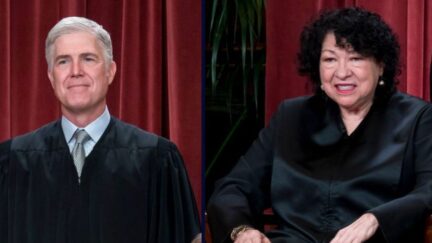
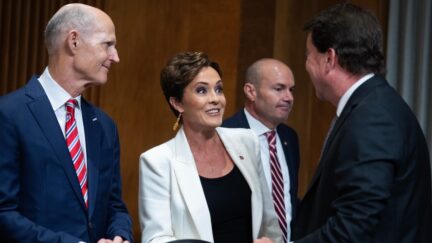
Main: Kaley Chiles, a Christian talk therapist in Colorado, appears in a video about her case (Alliance Defending Freedom/YouTube). Left inset: Supreme Court Justice Ketanji Brown Jackson, the first Black woman on the nation's highest court, speaks at the 60th Commemoration of the 16th Street Baptist Church bombing Friday, Sept. 15, 2023, in Birmingham, Ala. (AP Photo/Butch Dill). Right inset: Neil Gorsuch talks with other attendees before the start of presentation of the Presidential Medal of Freedom in the East Room of the White House, in Washington, Friday, Nov. 16, 2018. (AP Photo/Manuel Balce Ceneta).
Justice Ketanji Brown Jackson stood alone in dissent and proclaimed the rest of the Supreme Court's decision to side Tuesday with a Christian talk therapist who challenged Colorado's conversion therapy ban as applied to her was as "baffling" as it was "dangerous."
The majority, led by Neil Gorsuch and joined by everyone other than Jackson, including Justices Sonia Sotomayor and Elena Kagan, concluded that the state's Minor Conversion Therapy Law (MCTL) violated the First Amendment by purporting to tell Kaley Chiles what she could say to clients under the age of 18 experiencing "unwanted" same-sex attraction or gender dysphoria.
"[T]he State's premise is simply mistaken. In many applications, the State's law banning 'conversion therapy' may address conduct—such as aversive physical interventions. But here, Ms. Chiles seeks to engage only in speech, and as applied to her the law regulates what she may say. Her speech does not become conduct just because the State may call it that," Gorsuch wrote, at once taking Colorado and Jackson's dissent to task. "Nor does her speech become conduct just because it can also be described as a 'treatment,' a 'therapeutic modality,' or anything else. The First Amendment is no word game."
Gorsuch then described it as fortunate that the world the First Amendment "envisions" is different from the one Jackson "embraces" — where the "currently prevailing" consensus reigns supreme.
"Today, tomorrow, and forever, too, any professional speech that deviates from 'current beliefs about the safety and efficacy of various medical treatments' could be silenced with relative ease. It is a consequence Colorado freely acknowledges. And one the dissent embraces. So what if that kind of reflexive deference to currently prevailing professional views may not always end well?" the justice remarked. "Fortunately, that is not the world the First Amendment envisions for us."
As Law&Crime recounted during oral arguments in October, Chiles' attorneys with the Alliance Defending Freedom made the case that Colorado's law unconstitutionally censored and "silenced" Chiles by "ban[ning] voluntary conversation" between a licensed professional and a client under the threat of disciplinary action like "fines, probation, and loss of license."
Telling the justices that Chiles' work is solely speech, ADF emphasized it was her right to engage in "discussion" according to the client's and their parents' wishes about realigning identity with biological sex or reducing unwanted same-sex attraction and behavior.
At the time, Sotomayor and Jackson referred to studies that show conversion therapy is harmful and significantly ups the risk of suicide attempts. Jackson, in particular, found it a "little puzzling" that Chiles claimed to be subject to regulation by the state through licensure but exempt from following a science-based conversion therapy ban. In retrospect, the line of questioning was a sign of things to come.
In her lengthy dissent, Jackson said the "scientific literature confirms what anecdotal experiences suggest: Conversion therapy has harmed patients, particularly minors." As a result, the justice concluded the state of Colorado was well within its right to "prevent its licensed talk therapists from using speech to harm the minors in their care."
That every other justice has said otherwise raises a question about the "quality" of health care in America moving forward, Jackson continued.
"We are on a slippery slope now: For the first time, the Supreme Court has interpreted the First Amendment to bless a risk of therapeutic harm to children by limiting the State's ability to regulate medical providers who treat patients with speech. What's next? In the worst-case scenario, our medical system unravels as various licensed healthcare professionals—talk therapists, psychiatrists, and presumably anyone else who claims to utilize speech when administering treatments to patients—start broadly wielding their new-found constitutional right to provide substandard medical care."
"It is baffling that we could now be standing on the edge of a precipitous drop in the quality of healthcare services in America. But the Court sees fit to bring us one step closer to that fate today," she added.
It wasn't baffling to Kagan and Sotomayor, however, who agreed that Colorado's law "conflicts with core First Amendment principles because it regulates speech based on viewpoint." The two said that if the state had "enacted a content-based but viewpoint-neutral law, it would raise a different and more difficult question."
ADF lead attorney Jim Campbell said in a statement that the Supreme Court delivered a "significant win for free speech, common sense, and families desperate to help their children."
In a statement of her own, Chiles hailed the "victory for counselors and, more importantly, kids and families everywhere."
Follow Law&Crime:




Comments