
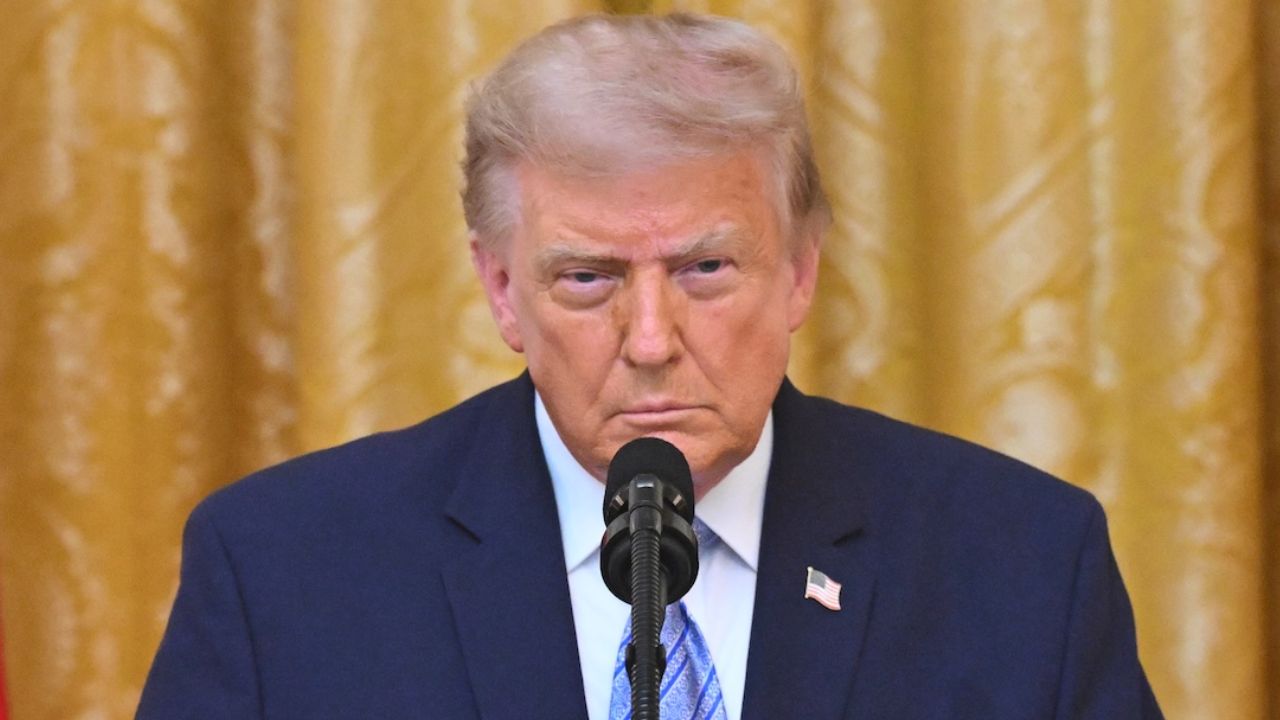
President Donald Trump speaks in the East Room of the White House, July 16, 2026, in Washington (Saul Loeb/Pool via AP, File).
A high-ranking DOJ lawyer urged a federal appeals court on Wednesday to halt a judge's sanctions order in President Donald Trump's lawsuit against the IRS.
Acting Deputy Attorney General R. Trent McCotter submitted a brief notice to the 11th U.S. Circuit Court of Appeals, ripping U.S. District Judge Kathleen Williams for refusing to halt the monetary and nonmonetary "consequences" she doled out to the president and his private lawyers in July.
At that time and ever since, the Barack Obama-appointed jurist has been clear that it was "risible to suggest that there was ever adverseness between" Trump the individual and his administration's IRS in the "collusive" case.
Williams pointed out that the DOJ sat "silent" on the sidelines, with no attorney formally entering an appearance in the case. Instead, "friends of the court," or amici curiae — including 35 former federal judges and ex-IRS and Treasury officials — cried foul, as the president moved to voluntarily dismiss his case and announced a $1.776 billion "anti-weaponization" fund for his supporters and a "settlement" that also immunized his family and himself from backward-looking tax probes.
Most recently, Williams declined to stay her order, defending each of the three sanctions she issued.
As part of her ruling, the judge ordered "nonmonetary" sanctions against Trump's attorneys, Alejandro Brito and Daniel Epstein, for their roles in the case.
For Brito, it meant a referral to the Florida Bar; for Epstein, a former White House lawyer, it meant he would not be granted pro hac vice permission to appear in the Southern District of Florida for "one year or until further order of this Court."
As to money sanctions, the judge said the amici curiae had a right to request reimbursement from Trump for their attorneys' efforts. The amici did so, the former judges seeking $4,610.83 and ex-IRS officials asking for $39,000 in attorneys fees, but the judge has yet to rule on the requests.
Nor did Williams buy the argument that her order barring the parties from "referring to the purported 'settlement agreement'" that she said "had no viable basis in law or fact" was an "unconstitutional, and unlawful gag order."
That history explains why McCotter went to the 11th Circuit on Wednesday to again seek a stay, claiming the judge inappropriately acted on her own and levied "criticism of the Department's litigation strategy" that was "wrong on the facts […] illogical, and […] also contrary to precedent[.]"
"The district court's First Amendment analysis violates decades of precedent," McCotter also argued. "It would allow district judges who lack jurisdiction to sua sponte issue orders muzzling parties' speech and actions in other litigation—and then vaguely gesture towards judicial integrity as the supposed compelling justification," the notice said, alleging a violation of U.S. v. Nixon. "Judicial integrity is best served by complying with the First Amendment, not by purporting to gag parties from acknowledging even historical facts."
McCotter added that if the 11th Circuit doesn't immediately stay Williams' sanctions order, then chaos will surely follow.
"If the order below is left unstayed, this Court and every district court in this Circuit should prepare for an onslaught of sanctions motions and orders against every claim, lawyer, party, or settlement that any interloper or district judge personally dislikes—precedent, logic, jurisdiction, the Constitution, and the facts all be damned," he asserted.
When declining to issue a stay, the judge reasoned that such an action would "undermine[] the legal effect of a court order and diminish[] the public's confidence in the judiciary's ability to impose binding legal consequences."
Follow Law&Crime:

Comments