
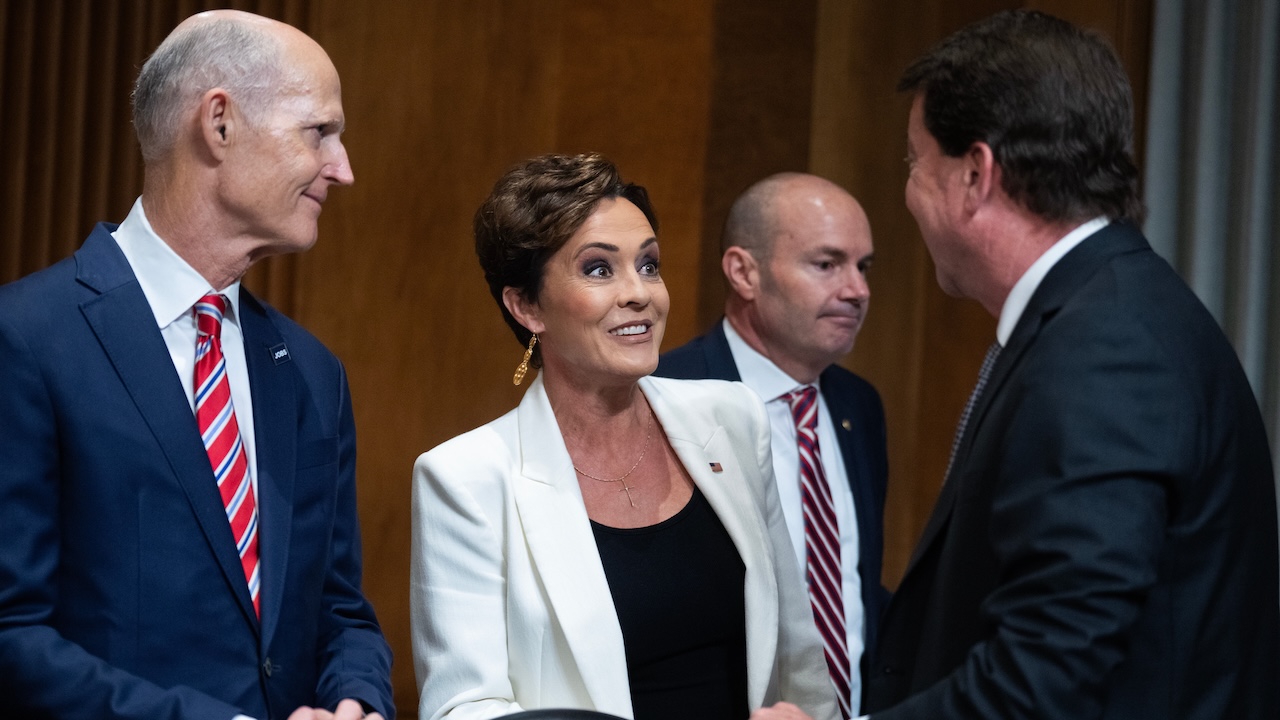
From left, Sen. Rick Scott, R-Fla., Kari Lake, nominee to be U.S. ambassador to Jamaica, Mike Lee, R-Utah, and Bill Hagerty, R-Tenn., arrive for a Senate Foreign Relations Committee hearing on pending nominations in Dirksen building on Thursday, June 18, 2026 (Tom Williams/CQ Roll Call via AP Images).
While court watchers were chronicling the road ahead at the U.S. Supreme Court on Tuesday morning, the justices left Kari Lake's attorneys behind, declining to spare them from sanctions for their 2022 election lawyering.
Without comment or explanation, the justices refused to grant a writ of certiorari in the case of Andrew D. Parker v. Bill Gates, a case against members of the Maricopa County Board of Supervisors in Arizona.
Lake's petition named Gates and other members of the board in a long-shot bid to "summarily" vacate sanctions against lawyers who insisted "injected" ballots cost the Republican candidate the 2022 gubernatorial contest.
Andrew Parker and the firm Parker Daniels Kibort, LLC, argued in vain that a district judge and eventually the full — en banc — 9th U.S. Circuit Court of Appeals wrongly decided to "send a message" about their lawyering for Lake and former candidate Mark Finchem.
"Six circuit judges dissented from denial of Petitioners' petition for rehearing en banc, warning of 'the district court's weaponization of sanctions to chill politically disfavored litigation' that presented 'danger to the rule of law,'" the petition said.
The sanctions order initially applied to Alan Dershowitz as well, but the 9th Circuit dismissed those sanctions, concluding he wasn't "personally liable" for attorneys fees due to his limited participation in the case as "of counsel."
The justices' decision not to disturb the sanctions for "false factual statements" against attorneys for Lake and Finchem comes less than a week after President Donald Trump's attorneys filed a petition for a writ of certiorari to revive his unsuccessful civil RICO case against Hillary Clinton. That brief argued that district judges are wrongly using "judicial disagreement" as "license to punish" lawyers and "chill an attorney's enthusiasm or creativity in pursuing factual or legal theories."
The rejected Lake petition likewise warned that the sanctions in this case "have grave implications for our justice system and will deter attorneys from bringing creative, aggressive, or novel claims of the sort that are often necessary to shape and reshape our legal landscape."
The Maricopa County respondents, on the other hand, said that Lake's lawyers brought this upon themselves when they "doubled down on the false statements made" in an amended complaint "rather than correcting those statements" in their "patently frivolous lawsuit."
"Rule 11 serves an important purpose in American jurisprudence," an opposition brief said. "It is not broken, and it does not need to be modified. Respondents urge this Court to decline Petitioners' invitation to lower the ethical standards that prevent attorneys from misleading federal courts."
On Tuesday, the justices formally jettisoned that "invitation."
Trump nominated Lake to serve as U.S. ambassador to Jamaica following the former news anchor's well-publicized efforts — deemed "unlawful" by a judge — to dismantle the Voice of America.
Follow Law&Crime:



Comments