
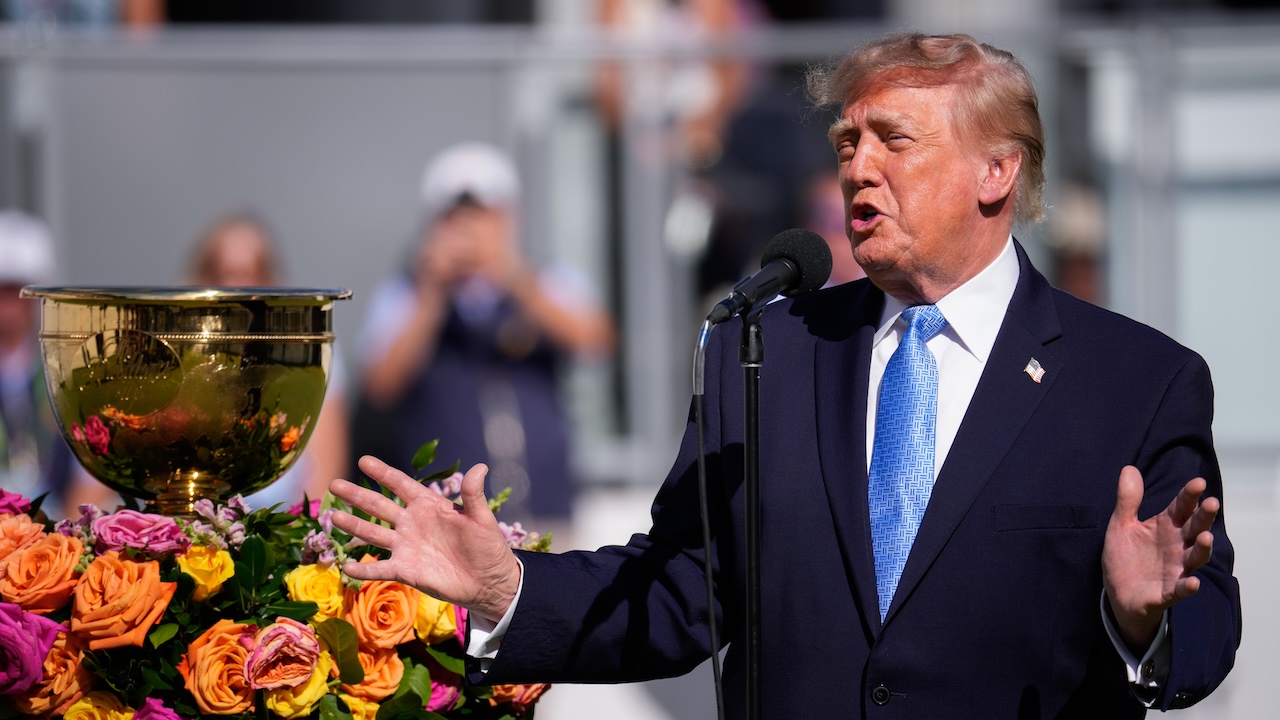
President Donald Trump speaks from the first tee box prior to the Presidents Cup golf tournament final round singles matches between the USA and International teams at Medinah Country Club, Sunday, Sept. 27, 2026, in Medinah, Ill. (AP Photo/Matt Slocum).
A federal appellate panel grilled the DOJ on President Donald Trump's yearslong deployment of the National Guard in Washington, D.C., repeatedly searching for a "limiting principle."
In August 2025, Washington, D.C., Attorney General Brian Schwalb, a Democrat, filed a lawsuit in response to the president's declaration that the National Guard would be deployed to stop "violent gangs and bloodthirsty criminals, roving mobs of wild youth, drugged-out maniacs and homeless people" and protect FBI and ICE agents in efforts to enforce the law.
Trump declared that "special conditions of an emergency nature exist[ed]" that justified the "use" of the Metropolitan Police Department for "federal purposes" of "maintaining law and order," protecting federal buildings and property, and "ensuring conditions necessary for the orderly functioning of the Federal Government."
A year later, thousands of National Guard members are still reportedly patrolling the streets at an estimated cost of $3 million per day.
As groups are separately suing to expose the Trump administration's "unprecedented" plans to deploy "1,000 election monitors" at the polls, the Council of D.C. on Friday posted an image of National Guard soldiers standing in front of an official ballot drop box, calling that action "clearly not acceptable."
This is clearly not acceptable https://t.co/rrlQWhtgkD
— Council of DC (@councilofdc) October 9, 2026
Following the outcry, the Joint Task Force released a statement saying its "service members are directed not to monitor or secure polling locations."
Mitchell P. Reich, the attorney who argued the case for Washington, D.C., on Wednesday, mentioned the incident toward the end of oral arguments, while attempting to demonstrate "harm" in the form of "dramatically alter[ed] life in the district" for the public and police alike.
"The National Guard was staging troops near a public school. There were extensive complaints by residents concerned about going about their daily lives, concerned about fear to their children from the National Guard, the mayor's office put out a statement objecting to the appointment. That's one of many such examples. Issues where the National Guard is posting troops near ballot drop boxes," he said.
But U.S. Circuit Judges Cornelia "Nina" Pillard and Bradley Garcia, and Senior U.S. District Judge Judith Rogers — appointees of Presidents Barack Obama, Joe Biden and Bill Clinton — were mainly concerned with the question of "who is in charge" of Washington, D.C. — Congress or the president.
In the dispute over executive order 14333, the DOJ took the position that Trump was well within his "broad authority" to respond to a "crime emergency" in the way that he did and that D.C.'s view is "untenably cramped," considering that it is not a state and does not have a governor.
"The district hasn't established any irreparable harm from these deployments, and the public interest strongly favors allowing them to continue," DOJ attorney Eric McArthur argued at the start.
D.C. Code § 49–103, dealing with the "suppression of riots," says that "it shall be lawful for the Mayor of the District of Columbia, or for the United States Marshal for the District of Columbia, or for the National Capital Service Director, to call on the Commander-in-Chief to aid them in suppressing such violence and enforcing the laws" in the event of "a tumult, riot, mob."
"[T]he Commander-in-Chief shall thereupon order out so much and such portion of the militia as he may deem necessary to suppress the same, and no member thereof who shall be thus ordered out by proper authority for any such duty shall be liable to civil or criminal prosecution for any act done in the discharge of his military duty," the code says.
While Rogers said a "court may decide" the DOJ is "correct," she was "trying to understand" Congress' intent about the "certain purposes" the D.C. National Guard would be used for, "not just anything [the president] decides he wants to do with the Guard."
Rogers asked McArthur to identify the "limiting principle" in the case.
"I think the limiting principle in our position is the president has to be calling out the guard in aid of the civil authorities," McArthur answered, arguing that Trump is "like" D.C.'s "state governor."
"It's not sort of, well, the president says crime is out of control, so he can just call out the Guard and do whatever he wants," Rogers responded, while also probing why tens of millions of dollars in congressionally appropriated grants for more security in the District of Columbia were cut.
"You acknowledge that under Article One, Congress is in charge basically of the District of Columbia, and as part of the president's budget, he includes requests by the city for law enforcement, and Congress may appropriate money in accord with that, and then at least historically here we have the situation where the mayor is asking that appropriated funds be released to the city for law enforcement purposes, and they're not," the judge said.
"So what I'm trying to understand is, in the state system, if the state legislature had authorized funding for additional hiring, additional police officers, or because the city had identified a need, does that take priority over any assignment for the National Guard?" she asked.
Pillard likewise worried that the DOJ was describing a "federalization" and was "therefore running up against" the Posse Comitatus Act, which bars the use of the military to execute the laws "except in cases and under circumstances expressly authorized by the Constitution or Act of Congress[.]"
The DOJ lawyer said he didn't think Trump's authority in a district — which "is not a sovereign" but is "a federal enclave" — can be "limited by appropriations."
"If he sees that there's a crime epidemic that's impeding the functions of the federal government, certainly that's one tool he has to go to Congress and ask for additional funds to support expanded law enforcement," McArthur stated, suggesting that if it were true that § 49–103 decides this case, then the National Guard couldn't be a presence at "inaugurations, demonstrations, drug interdiction, natural disasters, pandemics" or respond to invasions, like the "War of 1812 situation."
"[T]he D.C. National Guard could never do any of those things, including things that Mayor Bowser herself has previously requested that the DC National Guard do," he added.
Reich, the attorney, countered that the DOJ can't be right about this particular deployment.
"The government has just identified no provision in the D.C. code that would confer the unusual and extraordinary power to deploy the National Guard in any circumstance the president wishes, or to perform any civilian function he wishes," Reich continued, stating that there is no "mob, riot, tumult or similar disturbance" currently unfolding.
Follow Law&Crime:




Comments