
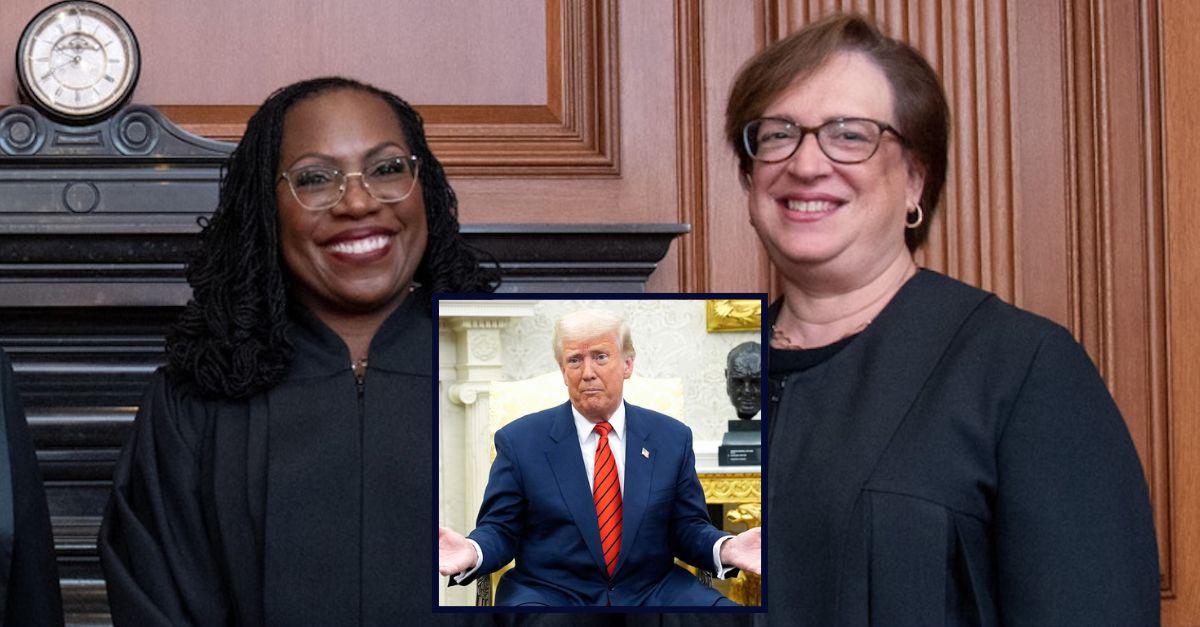
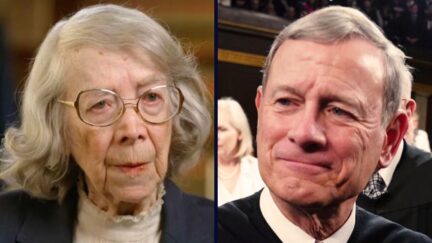
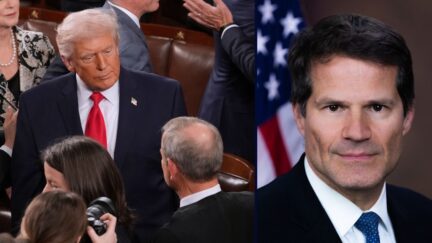
Inset: US President Donald Trump sits during his meeting with NATO Secretary General Mark Rutte in the Oval Office of the White House in Washington on March 13, 2025. Photo by Yuri Gripas/Abaca/Sipa USA (Sipa via AP Images). Background, left to right: Ketanji Brown Jackson and Elena Kagan pose at a courtesy visit in the Justices Conference Room on September 30, 2022 in Washington, D.C. (Collection of the Supreme Court of the United States via Getty Images).
When Justice Ketanji Brown Jackson accused the U.S. Supreme Court of ignoring its own rules to help Louisiana Republicans' election prospects, three conservative justices co-signed a sharp retort blasting her lack of "restraint." Meanwhile, Jackson's fellow travelers on the court did not come to her aid.
SCOTUS' conservative majority made major waves last week by striking down Louisiana's map as an unconstitutional racial gerrymander, leading some prominent legal commentators to declare the Voting Rights Act dead or at death's door upon the gutting of its Section 2. That day, Kagan penned the dissent and was joined by Sotomayor and Jackson in saying that the majority had essentially given Republican-controlled state legislatures the ability to "systematically dilute minority citizens' voting power" and "without legal consequence" ahead of the midterm elections.
In Louisiana v. Callais, the trio went to bat for the invalidated version of Louisiana's electoral map that had added a majority-Black district as an answer to racial vote dilution claims. The map would have included two majority-Black districts out of six, in a state where the Black population is roughly 33%, but Alito's 6-3 majority called that the "very race-based discrimination that the Constitution forbids."
Kagan's dissent responded to that conclusion in strong terms and dinged Alito for claiming "license" to rewrite a statute enacted by Congress to "prohibit electoral schemes based on their vote-diluting effects, regardless whether a State could offer up some race-neutral explanation." The justice also offered a grim assessment that the majority completed its slow-moving "demolition" of the VRA.
"[Congress] understood, just as the Court had, that even race-neutral actions could perpetuate purposeful racial discrimination. And it realized, again in the same vein as the Court, that race-neutral explanations could conceal race-based intent. Today's majority makes plain its disdain for those views."
What Kagan did not do was accuse the majority of doing all of this to help Republicans grab power, but that was the approach Jackson took on Monday, noting that Louisiana's Republican Gov. Jeff Landry, a noted ally of President Donald Trump, wasted no time suspending primary elections in the aftermath of Callais.
Yesterday, Alito issued a follow-up order granting an application to "issue the judgment forthwith" and send the case down to a three-judge district court — not waiting the typical 32 days to do so.
"To permit the losing party time to file a petition for rehearing, the Clerk of Court ordinarily waits 32 days after the entry of the Court's judgment to send the opinion and a certified copy of the judgment to the clerk of the lower court. Sup. Ct. Rule 45.3. This period is subject to adjustment; the default applies 'unless the Court or a Justice shortens or extends the time.' The Callais appellees have asked for the Clerk to issue the judgment forthwith so that 'in the event of a judicial remedy,' the District Court may 'oversee an orderly process,'" Alito wrote. "Appellant Louisiana does not oppose this application. And while the Robinson appellants oppose it, they have not expressed any intent to ask this Court to reconsider its judgment."
After granting the application, Alito turned to Jackson's dissent and said she "level[ed] charges" about the majority's motivations "that cannot go unanswered."
With the backing of Justices Clarence Thomas and Neil Gorsuch, Alito's concurrence blasted Jackson's "insistence on unthinking compliance" with a court rule and called her proposals — which were joined by no one — "trivial at best" and "baseless and insulting."
According to Jackson, the court conveniently ignored Rule 45.3 as Landry "hurried" to suspend "ongoing primary elections for seats in the U.S. House of Representatives" and as the Louisiana legislature is expected to imminently start drawing a "constitutionally compliant map" that just happens to mean Republicans can claim another seat in the House.
"Louisiana's hurried response to the Callais decision unfolds in the midst of an ongoing statewide election, against the backdrop of a pitched redistricting battle among state governments that appear to be acting as proxies for their favored political parties. And as always, the Court has a choice," Jackson said.
"To avoid the appearance of partiality here, we could, as per usual, opt to stay on the sidelines and take no position by applying our default procedures," she added, before surmising that the court departed from the its own norms to politically favor Republicans: "The Court's decision to buck our usual practice under Rule 45.3 and issue the judgment forthwith is tantamount to an approval of Louisiana's rush to pause the ongoing election in order to pass a new map."
Jackson further said the court confirmed that the Purcell principle — judicial caution against making substantial changes to rules too close to an election — is no principle at all.
"And just like that, those principles give way to power. Because this abandon is unwarranted and unwise, respectfully, I dissent," Jackson concluded.
Unfortunately for the justice, even her usual allies in Sotomayor and Kagan opted to stay on the sidelines, leaving her to face Alito's wrath alone.
To turn the tables, Alito cast Jackson as upset that a map Democrats would prefer is no longer a reality.
"[T]he dissent does not explain why its insistence on unthinking compliance with Rule 45.3's default rule does not create the appearance of partiality (by running out the clock) on behalf of those who may find it politically advantageous to have the election occur under the unconstitutional map," he wrote.
From there, the justice ripped Jackson for saying the conservative majority engaged in an "unprincipled use of power."
"That is a groundless and utterly irresponsible charge. What principle has the Court violated? The principle that Rule 45.3's 32-day default period should never be shortened even when there is good reason to do so? The principle that we should never take any action that might unjustifiably be criticized as partisan?" Alito asked, before stating it is Jackson's "rhetoric that lacks restraint," not the majority's decision-making.
Follow Law&Crime:


Comments