
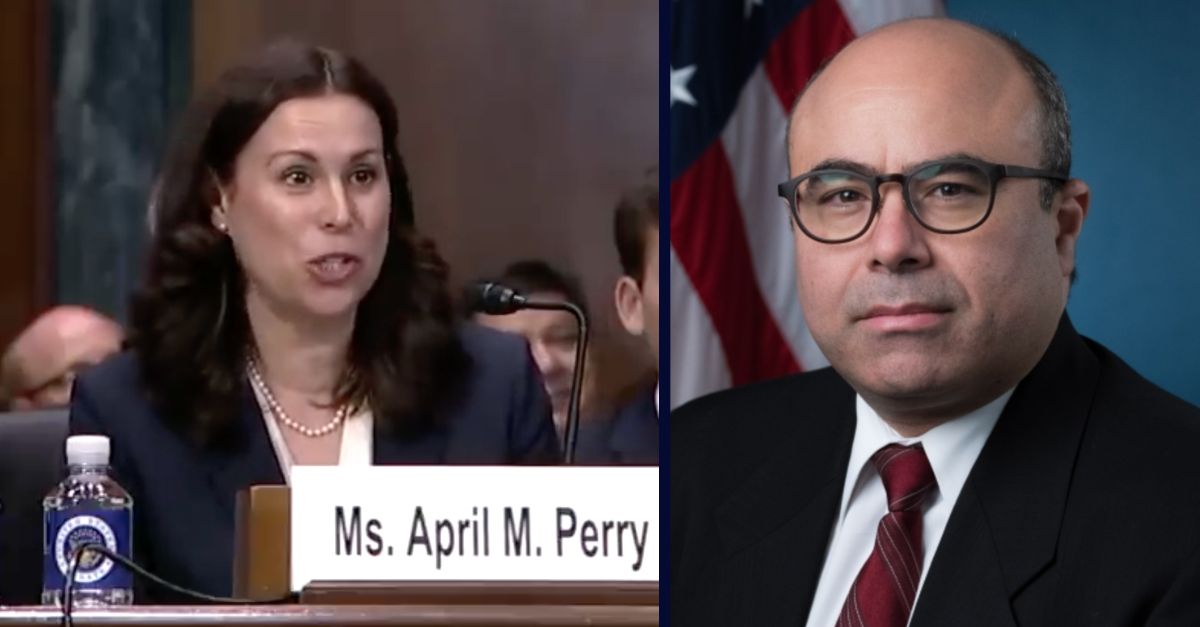
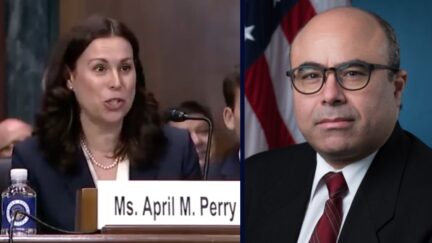
Then-judicial nominee April Perry answers the Senate's questions in July 2024 (Sen. John Kennedy/YouTube). Right: U.S. Attorney for the Northern District of Illinois Andrew Boutros (DOJ).
A roller-coaster transcript of a court hearing in Chicago began with an "incredibly shocked" federal judge warning DOJ attorneys of possible consequences for "prosecutorial misconduct and for potential ethical violations" and ended with the U.S. attorney dismissing "with prejudice" what was left of cases against anti-ICE protesters dubbed the "Broadview Six."
The 60-page document, shared in full by Jon Seidel of the Chicago Sun-Times, is an unsealed account of U.S. District Judge April Perry's grilling on Thursday of DOJ lawyers about why and how "prosecutorial behavior" before the grand jury — the likes of which she's "never seen" before — was redacted in transcripts.
DOJ attorneys William Hogan and Matthew Skiba appeared in court on behalf of the U.S. Attorney's Office for the Northern District of Illinois to answer the judge's questions about their roles in the redaction process and at the grand jury proceeding, respectively. Perry, a Joe Biden appointee who last year blocked President Donald Trump's deployment of the National Guard, noted that attorneys for Kat Abughazaleh, Andre Martin, Brian Shaw, and Michael Rabbitt had raised "concern" of possible misconduct, an increasingly common reason DOJ indictments are being tossed out these days.
The judge noted that the DOJ, rather than handing over the transcripts, in late April dismissed the felony conspiracy charge, seemingly to avoid disclosure in a misdemeanor case. And once she reviewed the transcripts "in full and unredacted form," she found "significantly bigger problems than misinstructions to the grand jurors."
Perry went so far as to say she had "never seen" anything like it.
"Although I am not going to prejudge the issue without a hearing, I will say that I was incredibly shocked by the redactions that were made. I have read hundreds, if not thousands, of grand jury transcripts involving prosecutors who are the most junior of prosecutors to several U.S. Attorneys who appeared before the grand jury. I have never seen the types of prosecutorial behavior before a grand jury that I saw in those transcript," the judge said. Perry raised concerns about "improper prosecutorial vouching to the grand jurors," "improper prosecutorial communications of a substantive nature with the grand jurors outside of the grand jury room," and a "prosecutor excusing grand jurors who disagreed with the government's case from the deliberations process" — on top of all of these details being hidden.
"And frankly, it is that that I find the most problematic," Perry said of the redactions, making clear that she thinks she was lied to. "I think there is also a potential here, separate and apart from the merits of this case and how this case ends up proceeding, on sanctions for prosecutorial misconduct and for potential ethical violations, including lack of candor to the Court."
When it was the government's turn to speak, Hogan took responsibility for the redactions and Skiba spoke on the record about the "vouching incident."
"I remember what you referred to as the vouching incident. I remember thinking at the time that I would never make that statement as a matter of personal style. What I did not know then, and what only became apparent as we were discussing dismissing these charges, is that's beyond personal style, and that is, at a minimum, arguably misconduct," Skiba said, explaining that as of that July 2025 he was still two months into the job and relying on the "20-years-plus senior veteran" experience of Sheri Mecklenburg.
"I am not trying to deflect blame," he said.
Sen. Dick Durbin's office says AUSA Sheri Mecklenburg has been terminated from her position with the Senate Judiciary Committee after revelations in the "Broadview Six" case.
We reported exclusively in February that she'd joined Durbin's staff: https://t.co/zUYLraAMJn pic.twitter.com/VrgWxQRDQy— Jason Meisner (@jmetr22b) May 22, 2026
After the court returned from a break, U.S. Attorney Andrew Boutros walked in and called it "ironic" that he "was actually in the chief judge's courtroom swearing in [six] new AUSAs" at the same time Perry was taking his office to the woodshed, just days before the case was scheduled to go to trial.
Boutros started carefully, but ended in a way that had the judge telling him he was "significantly undercutting" his own "mea culpa."
"I came down from that to learn that Your Honor was understandably quite upset. And I understood that Your Honor was quite likely upset when I saw the minute order that was issued, I believe, yesterday seeking today's hearing," he said, expressing his sincere belief that there was "no deliberate misconduct on the part of the prosecutors" and claiming unawareness of the "vouching" behavior.
The top prosecutor said he "too had not seen conduct like that, and it upset me, which is why we did dismiss that indictment and proceeded with an information."
The attempted cleanup bottomed out at the end, however, when Boutros apparently mischaracterized the judge's prior words.
"And, Your Honor, there was something that you said that really caught my attention and it made the press. Mr. Parente and the defense had asked to take the jurors to go see the Broadview facility and the government didn't object. And Your Honor said that you were not going to allow for that to happen because you didn't want to potentially subject the jurors to a mob scene and to the chaos that ensued," he said. "And that's what this case is about."
Not so fast, said Perry.
"My turn. To be clear, I did not refuse to take the jurors on a field trip to Broadview because I didn't want them to be exposed to the mob like these defendants. That is not at all what I said. If you interpreted it that way, that is apparently on me for not being clear. What I said was, Broadview is a public place that has people from all walks of life. It is an uncontrolled setting where I could not prevent the public from taking photos or recording our jurors, as I can in this building; nor could I prevent messages from being sent to the jurors about people's views of this particular case, as I can in that jury."
"So that's first. Secondly, you are significantly undercutting your mea culpa here by standing behind the charges and continuing to vilify these particular defendants," the judge noted, suggesting she can take up the issue of sanctions later. "[W]hat matters right now is not the defense attorneys or Mr. Boutros or the prosecutors. It is these four defendants whose cases just got dismissed, who no longer have to go to trial on Tuesday. So I suggest we all take a break."
Follow Law&Crime:

Comments