
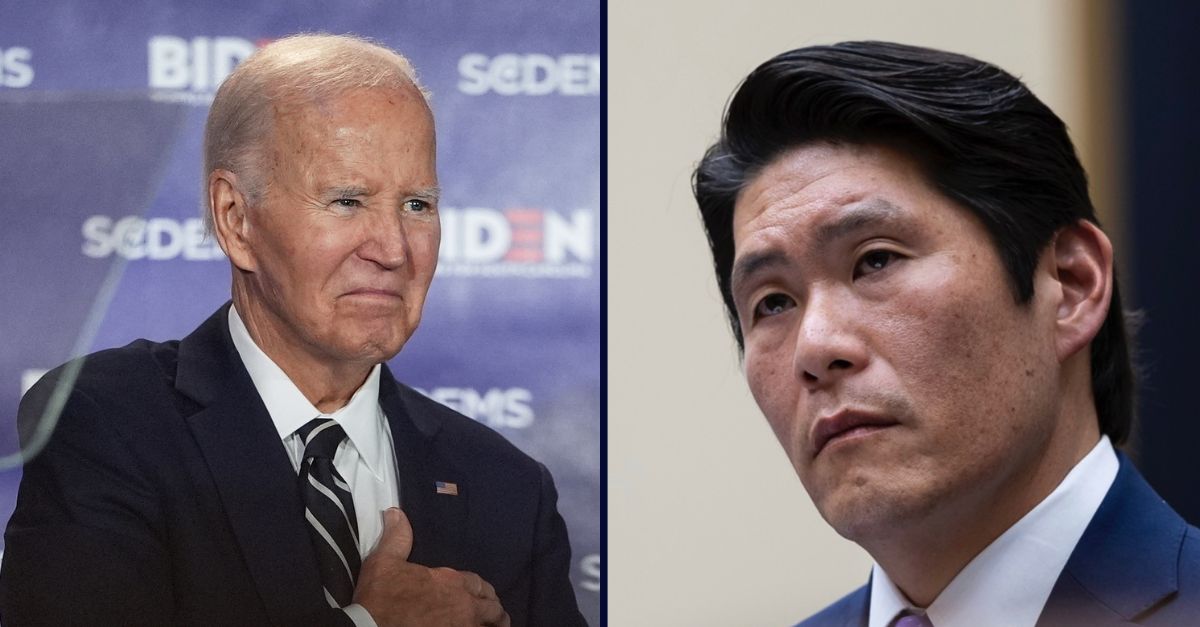
Left: Former President Joe Biden speaks to the South Carolina Democratic Party, Feb. 27, 2026, in Columbia, S.C. (AP Photo/Matt Kelley, File). Right: Former special counsel Robert Hur testifies before the House Judiciary Committee on March 12, 2024 (Francis Chung/POLITICO via AP Images).
Lawyers for the House Judiciary Committee told a federal judge that former President Joe Biden is a "third-party actor" powerless to stop the Trump administration at the "eleventh hour" from handing over evidence from a classified documents investigation that ended with no charges.
The committee, chaired by Rep. Jim Jordan, R-Ohio, filed as expected and on time in U.S. District Judge Tanya Chutkan's court in Washington, D.C., on Monday. The week prior, the Barack Obama-appointed judge who presided over Trump's Jan. 6 criminal case found that the committee had standing to intervene in Biden's lawsuit against the DOJ.
At issue are recordings and transcripts of conversations then-former vice president Biden had with his "writing partner" or ghostwriter Mark Zwonitzer in 2016 and 2017, in the course of creating "Promise Me, Dad," a memoir about his son Beau Biden's 2015 death from brain cancer.
The audiotapes were part of former special counsel Robert Hur's classified documents investigation, which concluded there was evidence Biden "willfully retained and disclosed classified materials" after his vice presidency. But a combination of factors, including the "elderly" Biden's "poor memory," meant there would be no recommendation of criminal charges.
In the present day, the committee's stated interest in subpoenaing the Zwonitzer materials is the possibility of legislative reforms surrounding DOJ appointments of special counsels.
"The Committee seeks to obtain these recordings as part of its broader investigation of the Department of Justice's use of special counsels during the Biden Administration, whether those special counsel investigations delivered impartial justice, and if not, whether legislative reforms to the Department of Justice and its use of special counsels are necessary," the filing said. "Notwithstanding Plaintiff's puzzling and repeated references to the Committee making a 'purported request' for these recordings, the Committee's interest in these materials is real and longstanding."
When Hur released his report in 2024, he doubted a jury would convict a "sympathetic, well-meaning, elderly man with a poor memory." Additionally, DOJ policy ruled out charging a sitting president and the alleged facts were not as serious as those Trump faced in his dismissed Mar-a-Lago classified documents prosecution, Hur said.
For that reason, Biden has argued the subpoenas are "pretextual" and untethered to any "legitimate legislative purpose," only existing as a way for the Trump DOJ to "circumvent its statutory obligations and its own policy and practice" that counsel against disclosure. In his support, Biden cited Trump v. Mazars USA, the 2020 Supreme Court case on congressional subpoenas for Trump's tax returns during his first term as president.
"The Department's exclusive reliance on an invalid 'request' lacks a reasoned basis, and the Department's decision therefore further violates the [Administrative Procedure Act] APA," the former president asserted, slamming the lack of a "legitimate legislative purpose."
On Monday, both the committee and the DOJ said Biden had no business citing Mazars in his favor, considering he is not the current president and the legislative and executive branches are aligned.
"At bottom, if this Court were to adopt Plaintiff's interpretation of Mazars, it would greatly extend its reach and bestow heightened protection from Congressional requests (and subpoenas) for the entirety of any President's life (not just Plaintiff), regardless if the records sought relate to the President's pre-Presidential or post-Presidential life. Nothing in Mazars suggests that was the Supreme Court's intent, and this Court's adoption of such a view would have ramifications for all future Congresses," the committee warned.
Likewise, the DOJ called Biden's motion an "extraordinary" bid to convince a judge to block "appropriately redacted information that both political branches agreed would aid Congress in carrying out its constitutional functions consistent with the interests of the Executive Branch" from being disclosed.
"No such law exists for good reason, as there is no legal basis for private parties to challenge inter-branch information sharing," the DOJ told Chutkan.
Also on Monday, U.S. District Judge Dabney Friedrich ordered the DOJ to provide by midday Tuesday "a copy of the Zwonitzer materials—as the defendant intends to release them to the plaintiffs" so she can inspect the documents in her chambers.
Friedrich, a Trump appointee, is handling the Heritage Foundation's distinct but related Freedom of Information Act lawsuit, in which Biden is an intervenor seeking an injunction against the Trump administration before a June 15 disclosure deadline. Although Biden's special counsel interview was eventually released in May 2025, the Heritage Foundation is still trying to obtain the Zwonitzer materials in audio and transcript form.
Conservative groups' lawsuits to obtain audiotapes from the special counsel investigation began in the latter days of Biden's presidency. Former U.S. Attorney General Merrick Garland's DOJ repeatedly opposed disclosure, arguing that bad actors might create "deepfakes" of the president as he was running for reelection. The arguments were made even after Biden's debate debacle but before he officially announced he would not run.
One day after Biden dropped out, the DOJ said it "learned" of "verbatim" transcripts of the Zwonitzer recordings.
Biden has claimed that the DOJ's redactions of "sensitive, personal information" about him and his family "are wholly inadequate to protect the privacy interests of President Biden and of third parties." The DOJ, on the other hand, represented that "information concerning President Biden's family" health issues "has been fully redacted" and "[i]nformation concerning individuals who are not public figures has been redacted."
Chapter 17 of Hur's report specifically addressed the fact that the Zwonitzer tapes were once "deleted" but recovered due to the ghostwriter's candor. Once recovered, the special counsel said, the materials provided "significant evidentiary value" in the probe of documents on U.S. "military and foreign policy in Afghanistan." Hur's report further characterized the ghostwriter sessions as "often painfully slow," with the then-former vice president "struggling to remember events" and "straining at times to read and relay his own notebook entries" several years before he was elected president.
Follow Law&Crime:


Comments