
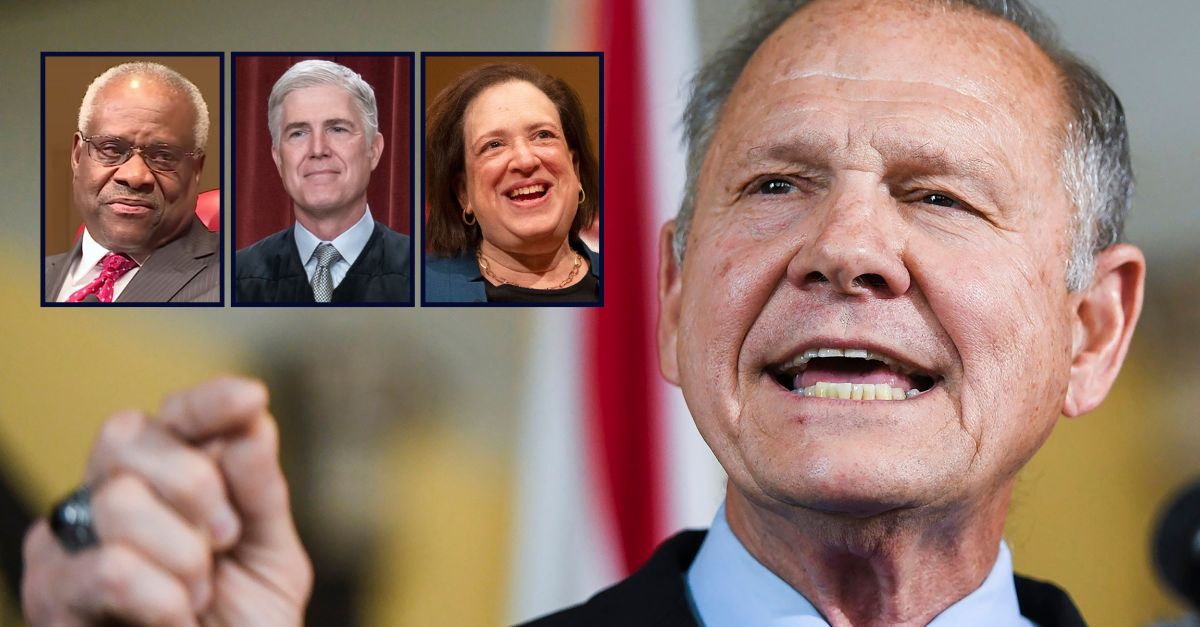
Inset left: Justice Clarence Thomas (YouTube/Library of Congress). Inset center: Justice Neil Gorsuch (Erin Schaff-Pool/Getty Images). Inset right: Justice Elena Kagan (AP Photo/Jess Rapfogel). Background: FILE – Former Alabama Chief Justice Roy Moore announces, in Montgomery, Ala., his run for the Republican nomination for U.S. Senate, June 20, 2019 (AP Photo/Julie Bennett, File).
Roy Moore, a former justice on the Alabama Supreme Court and a failed U.S. Senate candidate who lost a close race in 2017 amid misconduct allegations, is asking the U.S. Supreme Court to stay a recent appeals court ruling that left him without a windfall he had previously won.
After losing that aforementioned election to one-term senator Doug Jones, the onetime GOP hopeful filed several defamation lawsuits, and one of those lawsuits paid off big — at least for a few years.
In August 2022, Moore prevailed against the Senate Majority PAC in the high-profile case. After years of legal wrangling, jurors sided with the plaintiff over how a political attack ad juxtaposed two separate reports from two different publications about two separate allegations leveled against Moore during the 2017 special election.
"Moore was actually banned from the Gadsden Mall," the New American Journal reported on Nov. 12, 2017, "for soliciting sex from young girls."
"One he approached 'was 14 and working as Santa's helper,'" AL.com reported the next day.
The advertisement by the Democratic Party-affiliated PAC combined those two pieces of reporting together. The district court allowed the jury to consider whether the combination claim — that Moore was banned from the mall for soliciting sex from the 14-year-old Santa's helper — was defamatory. The jury found that it was. But the concomitant $8.2 million verdict was not long for this earth.
In April, a three-judge panel on the U.S. Court of Appeals for the 11th Circuit reversed the lower court ruling and the award.
In a 45-page opinion not atypical for defamation cases involving politicians turned plaintiffs, the appellate court ruled that Moore "failed to present clear and convincing evidence" the PAC acted with "actual malice" when it ran those campaign ads against him.
Actual malice is the most exacting standard to prove in defamation law. The standard typically becomes operative when the person claiming to be defamed is a public figure.
In order to satisfy the actual malice standard, a plaintiff needs to first convince a judge — and then later try to convince a jury — that the defendant had actually expressed some doubt about the truth of the disputed statements. Alternatively, a plaintiff can plead facts showing a defendant acted with reckless disregard for such veracity.
In overturning the verdict, the 11th Circuit found the anti-Moore PAC simply "made a poor choice of words in" one of the frames of the attack ad — calling it a "negligent error at best."
Moore, for his part, insists the trial court record is replete with evidence of actual malice. He traces the appellate court's alleged misstep to viewing the words on paper instead of via video.
From the application for a stay:
Because the defamatory meaning arises from the ad's cinematic assembly, this case cannot be fairly understood from a transcript alone. The publication here is the video itself. The falsehood is in what the viewer sees and hears together. A transcript strips away the timing, the transition, the emphasis, and the cumulative effect that made the accusation so powerful and so poisonous…The video itself is the defamatory publication, and, when considered with the jury's findings and the trial record, supplies powerful evidence of actual malice.
The stay request does not mince words — and says the appeals court clearly got things wrong when looking at the text alone.
"In substance, the court of appeals treated the ad too much like text and too little like the audiovisual attack piece the jury actually evaluated," the filing goes on. "It discounted the central theory on which the case was tried: not that [the PAC] repeated an existing accusation word for word, but that [the PAC] created a new, false accusation by splicing together separate reports to convey a defamatory meaning that was both unmistakable and untrue."
To make his case, Moore harkens to the evergreen discomfort with the "actual malice" standard expressed by Justice Clarence Thomas.
For years, Thomas has written solo concurrences and dissents that have called for his colleagues to overturn the landmark ruling in New York Times v. Sullivan — the First Amendment case that set the "actual malice" standard for plaintiffs who are public figures.
And, over the past few years, Thomas has been joined — at least to some degree, in calls to reconsider the precedent — by Justice Neil Gorsuch.
Moore cites and invokes Thomas' name a total of nine times in his stay application; Moore mentions Gorsuch four times.
A representative section of the application reads, in relevant part:
This Court's interest in the actual-malice framework confirms that review is reasonably probable. The panel itself acknowledged "criticism of the actual malice standard," collecting the opinions in which Members of this Court have urged its reconsideration, including Berisha v. Lawson, 141 S. Ct. 2424, 2425 (2021) (Thomas, J., dissenting from the denial of certiorari) … (Gorsuch, J., dissenting from the denial of certiorari), McKee v. Cosby, 586 U.S. 1172 (2019) (Thomas, J., concurring in the denial of certiorari), Counterman v. Colorado, 600 U.S. 66, 105–06 (2023) (Thomas, J., dissenting), before concluding, "unless and until the Supreme Court decides to revisit the actual malice standard, it must continue to apply it." Moore v. Cecil[.]
"Justice Thomas wrote that the actual-malice rule 'bears no relation to the text, history, or structure of the Constitution,' that '[t]he lack of historical support for this Court's actual-malice requirement is reason enough to take a second look at the Court's doctrine,' and that 'reconsideration is all the more needed because of the doctrine's real-world effects,' for '[p]ublic figure or private, lies impose real harm,'" the filing goes on. "Justice Gorsuch explained that what 'started in 1964 with a decision to tolerate the occasional falsehood to ensure robust reporting by a comparative handful of print and broadcast outlets has evolved into an ironclad subsidy for the publication of falsehoods by means and on a scale previously unimaginable.'"
The stay application also quotes Justice Elena Kagan in service of some opposition to the actual malice standard — albeit nestled within a citation within a quote by Gorsuch.
"Drawing on the scholarship of then-Professor Elena Kagan, [Gorsuch] observed that 'it's hard not to ask whether [the standard] now even cut[s] against the very values underlying the decision,'" Moore's attorney Jeffrey S. Wittenbrink writes in the motion.
The application may find sympathetic ears — Thomas is the member of the nation's high court in charge of appeals from 11th Circuit orders.
Comments