
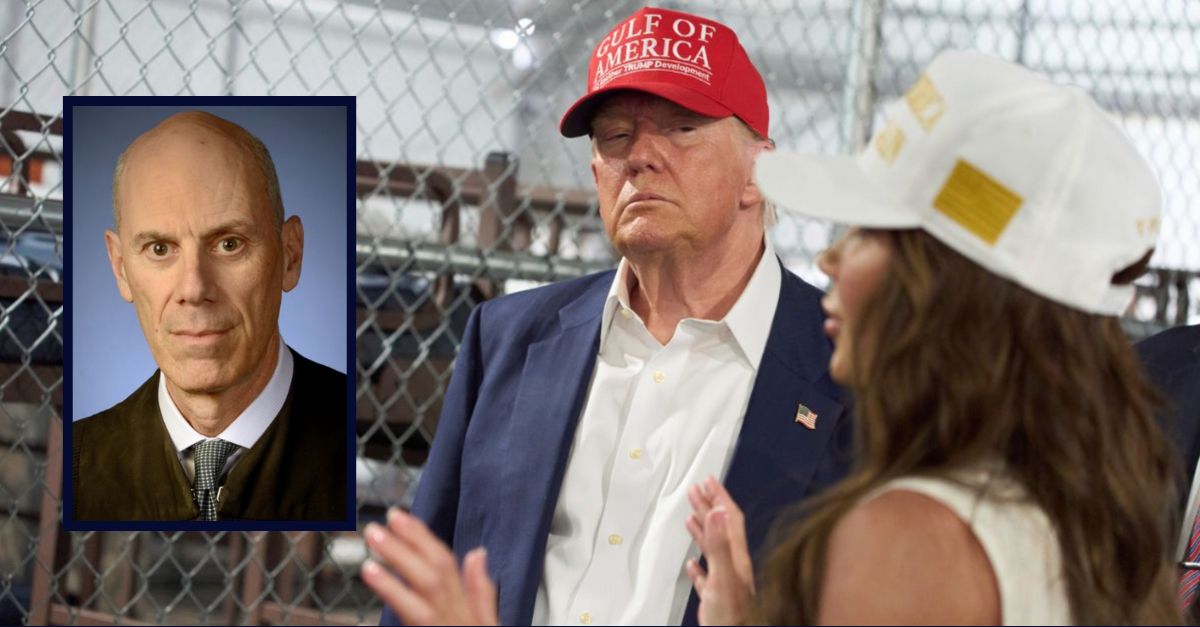
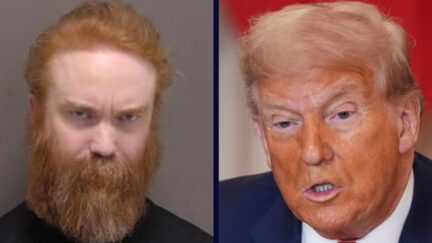
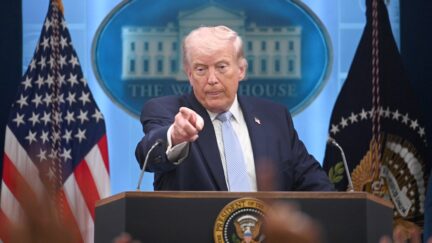
Left inset: Left: Chief U.S. District Judge James Boasberg (U.S. District Courts). Main: President Donald Trump listens as Homeland Security Secretary Kristi Noem speaks during a tour of "Alligator Alcatraz," a new migrant detention facility at Dade-Collier Training and Transition facility, Tuesday, July 1, 2025, in Ochopee, Fla. (AP Photo/Evan Vucci).
A fired DOJ whistleblower and a government attorney who claimed not to be aware of the Trump administration's plans to carry out Alien Enemies Act (AEA) deportations in March have been ordered to testify in court as a federal judge in Washington, D.C., facing impeachment calls from congressional Republicans and President Donald Trump ramps up a criminal contempt inquiry after months of delay.
Chief U.S. District Judge James Boasberg on Monday set testimony for Monday and Tuesday of next week to help him decide whether a criminal contempt prosecution referral is warranted against DHS Secretary Kristi Noem for willfully flouting a court order.
The controversy dates back to March 15, when Boasberg, a Barack Obama appointee also once appointed by George W. Bush to the D.C. Superior Court, held a hearing on a Saturday.
During the proceeding, Boasberg orally issued a temporary restraining order, blocking the government from carrying out sweeping AEA deportations of Venezuelan nationals to a notorious Salvadoran prison — individuals whom the government alleged were affiliated with the Tren de Aragua gang — and ordering the Trump administration to turn around any planes that were in the air.
The planes did not turn around. Ever since, Boasberg has been trying to get to the bottom of who told whom what, when, and why — that is, the legal basis for apparent non-compliance.
According to Boasberg's latest order, Noem and DOJ higher-ups have only "submitted cursory declarations" providing an explanation under penalty of perjury, necessitating the testimony of fired DOJ attorney Erez Reuveni and Deputy Assistant Attorney General Drew Ensign. The latter claimed at the March 15 hearing that he did "not have additional details [he] can provide at this time" about whether deportation flights were afoot.
Noem specifically declared she decided to move the deportations forward before Boasberg issued his order.
"In response to the Court's Order of November 28, 2025, the Government has submitted cursory declarations from Secretary Kristi Noem and attorneys then at the Department of Justice who advised her. Noem avers that she made 'the decision to continue the transfer of custody of the Alien Enemies Act detainees who had been removed from the United States before this Court issued its temporary restraining order in the evening of March 15, 2025,'" the judge wrote. "As this declaration does not provide enough information for the Court to determine whether her decision was a willful violation of the Court's Order, the Court cannot at this juncture find probable cause that her actions constituted criminal contempt."
"A referral for prosecution, consequently, would be premature," and thus Reuveni and Ensign must testify to fill in some blanks, he added.
Reuveni was placed on leave and then fired in April after he said he "refused directions from his superiors to file a brief misrepresenting" facts about Kilmar Abrego Garcia, a Salvadoran who to this day maintains the DOJ is vindictively prosecuting him. It was Reuveni who said in court that Abrego Garcia "should not have been removed," leading to the DOJ veteran's swift ouster.
Reuveni was fired after nearly 15 years at the DOJ for "failure to follow a directive from your superiors; failure to zealously advocate on behalf of the United States; and engaging in conduct prejudicial to your client," according to Deputy Attorney General Todd Blanche. In his previous role as Trump's criminal defense lawyer, Blanche worked with then-principal associate Emil Bove on the Mar-a-Lago and hush-money cases against Trump, helping the president to avoid convictions in one case but not the other.
In the aftermath of his firing, Reuveni turned whistleblower and claimed, the day before Boasberg's March decision, that Bove had suggested giving the courts an "f— you" if the government was blocked from carrying out mass deportations pursuant to AEA, an 18th-century wartime law that has only been invoked three times in American history.
Blanche branded Reuveni as a "disgruntled former employee" who was using Bove's then-pending nomination for a judgeship at the 3rd U.S. Circuit Court of Appeals to lash out with "false" claims. Bove has since been confirmed and now actively sits at the 3rd Circuit.
Love true crime? Sign up for our newsletter, The Law&Crime Docket, to get the latest real-life crime stories delivered right to your inbox
Like Noem and Blanche did last week, Judge Bove submitted a barebones declaration on Monday, saying the DOJ has "not authorized" him to "disclose privileged information[.]" All Bove said was that he was "aware of statements" Boasberg made in court as of the evening of March 15, and that he "contributed to privileged legal advice" given to Noem through Blanche and Acting DHS General Counsel Joseph Mazzara.
Boasberg, however, wants to hear more from Reuveni to decide whether Noem's "decision" to move forward with AEA deportations was a "willful violation of the Court's Order" warranting a referral for prosecution.
"The Court thus believes that it is necessary to hear witness testimony to better understand the bases of the decision to transfer the deportees out of United States custody in the context of the hearing on March 15, 2025," the judge said. "The events surrounding this decision should shed light on this question."
Despite a DOJ argument that the planes were already out of U.S. airspace and the judge lacked jurisdiction, Boasberg in April said there was probable cause to find the Trump administration in criminal contempt for defying his temporary restraining order — one which the U.S. Supreme Court would later vacate.
Months later, in August, two Trump-appointed D.C. Circuit judges took the rare step of granting the "extraordinary" and "drastic" remedy of a writ of mandamus to vacate Boasberg's "contempt-related order."
U.S. Circuit Judge Gregory Katsas said he would "terminate the criminal-contempt proceeding" in its entirety. U.S. Circuit Judge Neomi Rao stopped short of that, writing that "[w]hether to proceed with criminal contempt is a choice left to the district court." Still, they both vacated Boasberg's contempt finding.
In November, after a petition was filed with the D.C. Circuit seeking the full court's review, the court declined to grant the petition but made clear that Boasberg could continue his contempt inquiry.
"To dispel any doubt, we observe that no member of this court has taken the position that the panel's disposition stands in the way of the district court proceeding just as it intended to do in April, only without the voluntary contempt-avoidance option that has now been overtaken by events," the court said, noting Boasberg was not prevented from his "contempt authority" and that he "remains free to require the government to identify the decision makers who directed the potentially contemptuous actions and to carefully consider next steps."
The D.C. Circuit further noted that the Trump administration is not free to ignore court orders it deems illegal, as that is not "how our system of justice is designed to work."
"[R]espect for judicial orders, and courts' independence, are essential to the rule of law. The district court has every ability to set a new deadline for production of the information it sought regarding the probable contempt it identified or to proceed otherwise within his sound discretion," the appellate court concluded. "For its part, the government will have the full opportunity at the appropriate time to raise any defenses it may have. If it is dissatisfied with any appealable order the district court may enter, it will have the opportunity to seek review through the ordinary process."
And Boasberg has, in fact, continued his inquiry.
With the government refusing to provide in-court declarations of the "privileged" substance underlying its legal advice on the record, Boasberg has scheduled testimony for next week.
"Plaintiffs shall attempt to secure the presence of Erez Reuveni for testimony on December 15, 2025, at 9:30 a.m.," the Monday order said. "The Government shall produce Drew Ensign for testimony on December 16, 2025, at 2 p.m.; and Both sides shall appear in person at such hearings and will have the opportunity to question witnesses."
Follow Law&Crime:


Comments