
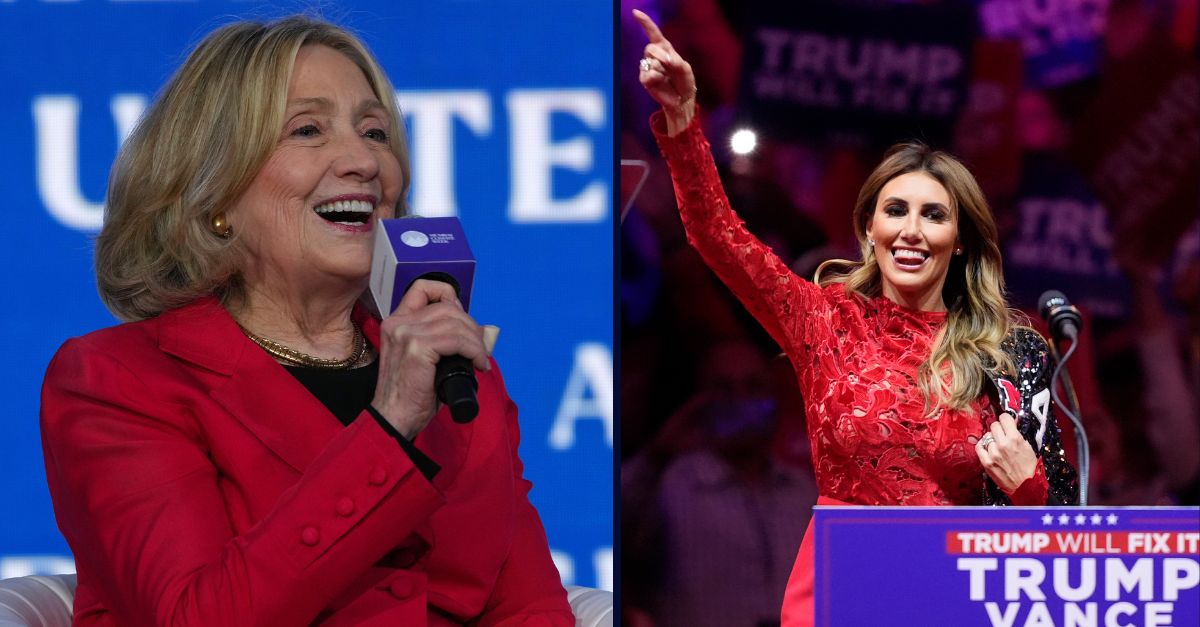
Left: Former US Secretary of State Hillary Clinton speaks at the Mumbai Climate Week in Mumbai, Wednesday, Feb. 18, 2026 (AP Photo/Rafiq Maqbool). Right: Alina Habba speaks before Republican presidential nominee former President Donald Trump speaks at a campaign rally at Madison Square Garden, Sunday, Oct. 27, 2024, in New York (AP Photo/Evan Vucci).
Attorneys for Hillary Clinton, John Podesta, the DNC, and others asked a federal appellate court to make clear that President Donald Trump and his lawyers will be on the hook for more than three years of interest on top of the roughly $1 million in sanctions owed for a "frivolous" RICO lawsuit over the origins of the "Russian collusion" narrative.
The sanctions U.S. District Judge Donald Middlebrooks handed down and the costs he awarded the defendants in November 2022 and January 2023 were $66,274.73 and $937,989.39, respectively.
The greater liability landed with Alina Habba, the firm Habba Madaio & Associates, and Trump himself for bringing a "lawsuit that should never have been filed, which was completely frivolous, both factually and legally, and which was brought in bad faith for an improper purpose."
The lesser punishment likewise went against Habba and her firm, but also against attorneys Michael T. Madaio, Peter Ticktin, Jamie Alan Sasson, and the Ticktin Law Group for errors and falsehoods in claims against Charles Dolan.
"When suing someone it helps to know where they live," Middlebrooks noted at the time — a reference to the fact that Trump's lawyers didn't manage to identify the correct state of residence for the person they were suing.
When paying or being paid sanctions, it also helps to know how much is or will be owed, and that is what Clinton and the rest of the RICO suit parties are asking the 11th U.S. Circuit Court of Appeals to clarify when it issues its formal order for the court below.
From Trump and his attorneys' standpoint, the sanctions enforcement was stayed pending appeal after bonds were posted, so they don't want to also have to pay post-judgment interest — what they termed an "inequitable windfall" — that has amassed since Middlebrooks issued his orders.
"In light of these stays, there is no basis for this Court to include in its mandate an instruction to the district court to impose post-judgment interest as of the original date of the sanctions orders," a recent filing said.
To the extent this is an issue at all, the filing added, Clinton and the other defendants waived it because they haven't brought it up until now.
"Appellees never sought post-judgment interest in the district court. They did not brief the issue on appeal. They did not raise it at oral argument. They consented to stays of both sanctions orders without reserving any claim to interest and without requesting any interest reservation as a condition of that consent. Only after the Court issued its opinion did Appellees raise the issue for the first time, by motion," argued attorneys Jesse Binnall, Jared Roberts, Richard Klugh, and Alejandro Brito. "This course of conduct constitutes a waiver."
Clinton attorneys David Kendall, David Oscar Markus, and Katherine Turner have now countered that the 11th Circuit should state that "post-judgment interest runs from the dates of the underlying sanctions orders" — issued more than three years ago — and accrues until payment, not impacted by the posting of bonds or the issuances of stays from having to immediately pay.
"Sanctions Appellees are 'entitled' to post-judgment interest for the entire period from the date of the district court judgment through the date of payment—they are not asking for anything other than what they get under the law," Clinton's team said. "That Appellants have posted a bond on deposit with the court does nothing to change the fact that Sanctions Appellees do not have the money in hand, and continue to suffer the loss of use of the funds."
"The posting of the supersedeas bond does not constitute payment and therefore has no impact whatsoever on the calculation of post-judgment interest, which by statute continues to run," the filing added.
All of this argumentation comes not long after Trump's lawyers asked the 11th Circuit to rehear the case en banc.
In November, a three-judge panel savaged the case for shortcomings exposed long ago.
Chief U.S. Circuit Judge William Pryor poked holes in Trump's bid to revive a lawsuit that accused Democrats and entities of conspiring to bankroll "an unthinkable plot" to tar the 2016 Trump campaign, cloud his first term through "a sinister link" to Russia, and harm his business interests.
"This is a classic shotgun pleading," Pryor remarked, only scratching the surface of what Middlebrooks said about the lawsuit.
On that score, Middlebrooks summarized that "[t]hirty-one individuals and organizations were summoned to court, forced to hire lawyers to defend against frivolous claims" and the "only common thread against them was Mr. Trump's animus."
"Mr. Trump is a prolific and sophisticated litigant who is repeatedly using the courts to seek revenge on political adversaries," Middlebrooks went on. "He is the mastermind of strategic abuse of the judicial process, and he cannot be seen as a litigant blindly following the advice of a lawyer. He knew full well the impact of his actions."
Calling the complaint a "shotgun pleading," Middlebrooks said that Trump and his legal team deployed "abusive litigation tactics" that were "drafted to advance a political narrative[,] not to address legal harm caused by any Defendant."
Ultimately, the 11th Circuit did nothing of note to disturb Middlebrooks' dismissal and sanctions orders, agreeing the lawsuit was a mess and the sanctions warranted.
"Because Trump's remaining claims are untimely and otherwise meritless, we affirm the dismissal of the amended complaint with prejudice for the other defendants. And because Trump and his attorneys committed sanctionable conduct and forfeited their procedural objections, we affirm both sanctions orders," the court said.
Follow Law&Crime:


Comments