

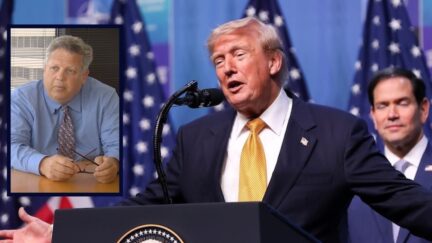
Inset: President Donald Trump walks from Marine One after arriving on the South Lawn of the White House, Tuesday, July 15, 2025, in Washington (AP Photo/Alex Brandon, File). Background: Demonstrators gather in south Minneapolis, Minnesota, on January 24, 2026, after a man is shot and killed by U.S. Immigration and Customs Enforcement agents earlier that morning, according to officials. (Christian Zander/NurPhoto via AP).
The Trump administration suffered a setback in its efforts to enforce a controversial immigration policy that would create a mass detention regime by ending bond eligibility for certain immigrants under the purview of Immigration and Customs Enforcement (ICE).
On July 8, 2025, ICE issued the new policy, instructing agents to deny bond for anyone who entered the country without "inspection," in a memo that has since opened the floodgates of litigation as dozens of detained individuals have filed petitions for a writ of habeas corpus.
Under the terms of the policy, such immigrants are to be detained "for the duration of their removal proceedings" unless granted parole – a rarer form of release. In real terms, however, the Trump administration had made clear such detentions are intended to be indefinite.
On Tuesday, a unanimous panel on the U.S. Court of Appeals for the 2nd Circuit rejected the government's novel interpretation of the Immigration and Nationality Act (INA), producing a circuit split and likely path toward resolution before the U.S. Supreme Court.
The disputed policy is sourced from a long-standing section of the INA that says certain immigrants "shall be detained for a proceeding." Historically, this statute has only applied to immigrants stopped at the border. Now, however, the Trump administration says immigrants detained in the country "may not be released from ICE custody."
Over the intervening months, in hundreds of disputes before district courts, judges have considered the interplay between — and applicability of — two distinct statutes outlining the government's detention authority, using language sourced from a 2018 U.S. Supreme Court ruling.
The government claims ICE has the authority to subject immigrants to mandatory detention under 8 U.S.C. §1225(b), which applies to "aliens seeking entry into the United States."
Advocates for immigrants — as well as most judges who have ruled on the matter — have instead turned to 8 U.S.C. §1226(a), which applies to "aliens already present in the United States."
Notably, upward of 360 district court judges, including many of those appointed by President Donald Trump himself, have rejected the position put forward by ICE about its detention authority, according to a rolling analysis of court rulings by Politico's Kyle Cheney.
Now, settling the dispute at the 2nd Circuit, at least, an appeals court has, for the first time, ruled against ICE's position.
The majority opinion frames the issue as being "dictated by the plain text" of the relevant statutes.
The panel says the result is "further confirmed by the statute's context, structure, history, and purpose" and "comports with the Supreme Court's established understanding" of the INA.
"It reflects Executive Branch practice over thirty years and across five Presidential administrations," the 61-page opinion reads. "Moreover, it explains why Congress has never challenged that settled practice despite making numerous amendments to the immigration laws."
The court also offers a public policy argument.
"Finally, even if the government's newfound interpretation of Section 1225(b)(2)(A) were plausible—and it is not—we would nonetheless reject it based on our obligation to construe these statutes in a manner that would avoid the serious constitutional questions attendant to what would be the broadest mass-detention-without-bond mandate in our Nation's history for millions of noncitizens," the filing reads.
The New York-based panel characterized the government's arguments as "flawed" and "unpersuasive" — and explicitly rejected pro-detention analyses issued by the 5th Circuit and the 8th Circuit.
To hear the Trump administration tell it, Section 1226(a) is a limited-use statute that only applies to immigrants "who were admitted to the country but later become deportable and are subject to removal proceedings."
The court says the government's position "is untenable based on the plain text of the statute" because the law "obviously does not limit its application to that narrower category of noncitizens."
"If Congress had wanted to limit Section 1226(a)…only to those noncitizens charged with deportability as opposed to inadmissibility, it would have said so, as it did repeatedly in other parts of [federal law]," the opinion goes on. "In sum, Section 1226(a) plainly applies to noncitizens…who are present in the United States, but charged as inadmissible for entering the country without inspection and admission."
The panel then takes issue with how the government defines Section 1225(b).
The U.S. Department of Justice, for its part, says nearly any immigrant in the country who "is not clearly and beyond a doubt entitled to be admitted" is rendered an "applicant for admission" and therefore subject to mandatory and indefinite detention under Section 1225(b).
The court wholeheartedly rejects a series of definitions and analogies offered by the government and the other reviewing appeals courts.
The 2nd Circuit then provides a homegrown analogy, at length:
It is precisely because Congress employed a statutory term of art for "applicant for admission" but not for "seeking admission" that the analogy to an applicant for college, relied upon heavily by the government and our two sister circuits, is inapposite…Using the ordinary meaning of "seeking admission," no one would consider an individual who never applied to also be "seeking admission" to the college. Here is a better analogy. If someone sneaks into Yankee Stadium at the start of the game with no ticket for admission (and no intention of ever paying) and he is later found by security in a seat in the seventh inning, no one would consider that fan to be "seeking admission" to the game.
Such a drastic reinterpretation of law, the majority cautions, cannot be achieved by the executive branch acting alone.
"The government's interpretation of Section 1225(b)…would send a seismic shock through our immigration detention system and society, straining our already overcrowded detention infrastructure, incarcerating millions, separating families, and disrupting communities," the opinion goes on. "If Congress meant to achieve such a radical break from the past, it would not have done so in such an indirect and ambiguous way."




Comments