
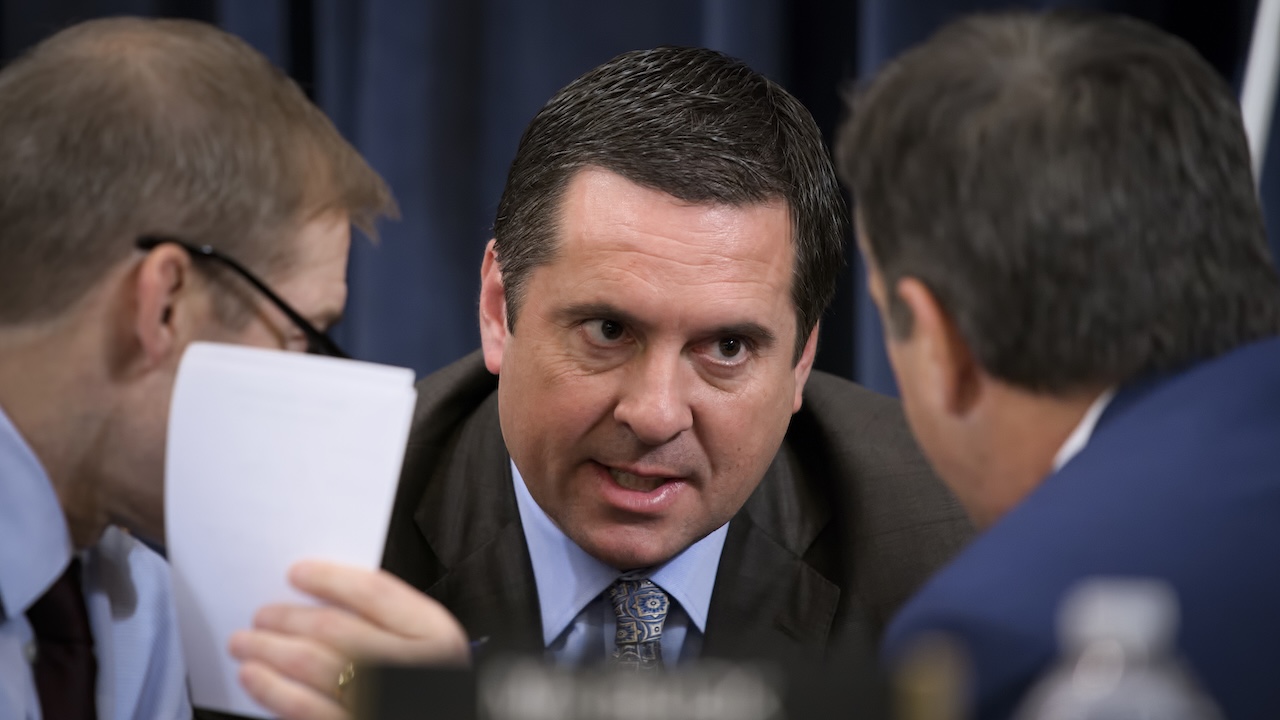
FILE – Rep. Devin Nunes, R-Calif., then the ranking member of the House Intelligence Committee, center, talks with Rep. Jim Jordan, R-Ohio, left, and Rep. John Ratcliffe, R-Texas, during a break in the House Judiciary Committee hearing considering the investigative findings in the impeachment inquiry against President Donald Trump, on Capitol Hill in Washington, Dec. 9, 2019. (AP Photo/J. Scott Applewhite, File).
A federal appellate panel had no interest in disregarding what it deemed "binding" U.S. Supreme Court precedent, leading to another loss for former House Intelligence Committee Chairman Devin Nunes in his defamation lawsuit against NBCUniversal and Rachel Maddow.
The 2nd U.S. Circuit Court of Appeals' summary order reveals that the onetime Trump Media & Technology Group CEO and Republican lawmaker failed to show the lower court erred in granting NBCUniversal summary judgment.
"As a preliminary matter, this Court has no authority to disregard the Supreme Court's binding interpretation of the First Amendment," the order said. "And the Supreme Court has squarely held that the actual malice standard governs in this scenario."
During oral arguments, U.S. Circuit Judge William J. Nardini and Senior U.S. Circuit Judge Guido Calabresi both repeatedly pointed out that Nunes could not win because New York state had codified the "actual malice" standard for public figures established in the landmark Supreme Court case New York Times v. Sullivan.
"The Supreme Court could completely reinterpret the First Amendment right now, but New York has adopted that test, the actual malice test, by statute, right?" Nardini asked. "Why are we even talking about this?"
As attorney Jason Greaves began to answer, 93-year-old Senior U.S. Circuit Judge Guido Calabresi — appointed by Bill Clinton in 1994 — chimed in via Zoom, telling the lawyer that [t]he most you are doing is trying to get us to say that we don't like Times, and you know I'm not in the business of saying I don't like what the Supreme Court did, although I often don't, and even if I don't in this case, it doesn't matter[.]"
"You would agree, even if the Supreme Court overturned New York Times v. Sullivan, it could not have an impact on the outcome of this case, correct? Because of New York statutory law adopting the actual malice standard, correct?" Nardini later followed up.
The court made that same point when affirming Nunes' loss.
"Nunes asks us to disregard New York Times to 'allow the states to fashion their own libel laws,'" the order said. "But even if New York Times did not govern, the actual malice standard is required by New York statute. Nunes concedes that this Court has subject matter jurisdiction over his case because of the diversity of citizenship of the parties. That means that his defamation claim arises under state law."
Ultimately, the panel saw "no error in the district court's conclusion" that Maddow and her executive producer Cory Gnazzo's reliance on a Politico article as a source for their broadcast "cannot support a finding of actual malice."
During a March 18, 2021, broadcast of "The Rachel Maddow Show" on the cable news network formerly known as MSNBC, the host raised questions about a package Nunes had allegedly received from suspected Russian operative Andriy Derkach, claiming Nunes "refused to show the contents of the package to other members of the intelligence community" and "refused to hand it over to the FBI[.]"
Derkach was described as a suspected "Russian agent" involved in an attempt to discredit former special counsel Robert Mueller, and Nunes was still serving as a prominent lawmaker when he sued.
By August 2025, the district judge found in a summary judgment order that Nunes was "unable to show, through clear and convincing evidence, that defendant either had actual knowledge of the falsity of the statement or recklessly disregarded the truth of the statement" that he "refused" to hand over the package to authorities.
"[N]o reasonable fact finder could find by clear and convincing evidence that Maddow and Gnazzo made the statement with a 'high degree of awareness of … probable falsity,'" the judge said.
The 2nd Circuit agreed that Nunes "provided no evidence at the summary judgment stage that provided any basis for a reasonable inference that Maddow or Gnazzo should have regarded the Politico article as unreliable."
Follow Law&Crime:



Comments