
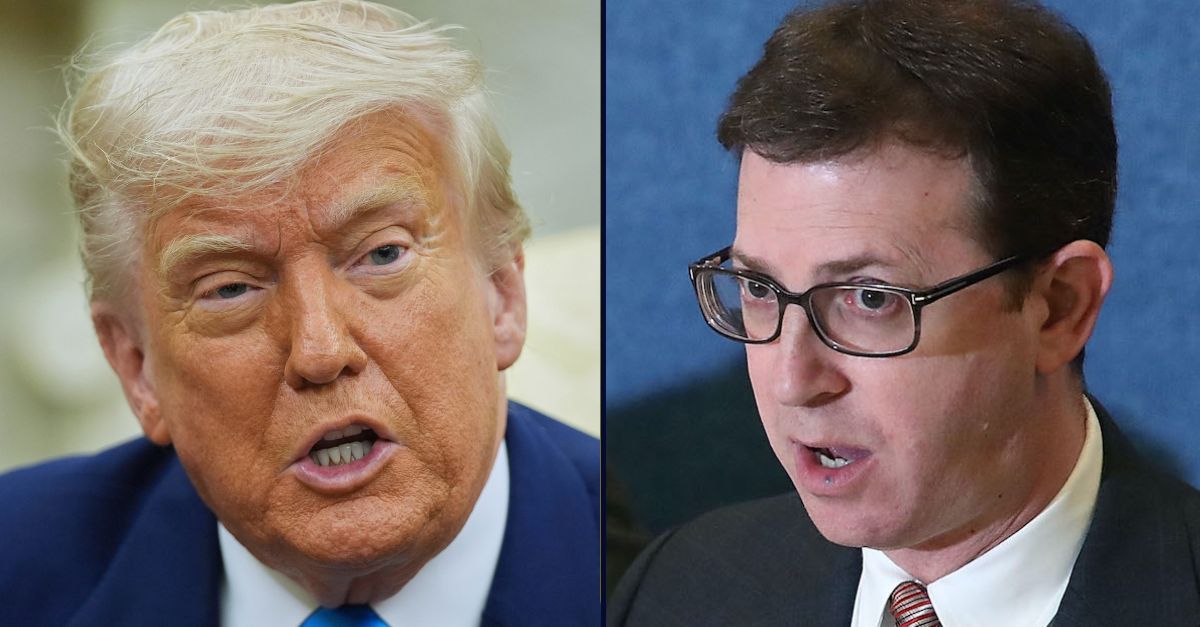
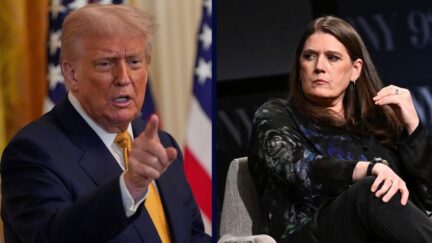
Left: President Donald Trump speaks as he meets with South African President Cyril Ramaphosa in the Oval Office of the White House, Wednesday, May 21, 2025, in Washington. (AP Photo/Evan Vucci). Right: Attorney Mark Zaid speaks about an unfair competition lawsuit against President Donald Trump, on March 9, 2017, in Washington, D.C. (Photo by Mark Wilson/Getty Images).
A federal court of appeals took up the issue of national security lawyer Mark Zaid and his once and future security clearance on Thursday.
Setting off the dispute, President Donald Trump issued an executive order in March 2025 stripping Zaid and several other high-profile individuals of their security clearances.
In May 2025, Zaid sued, assailing the executive order as "improper political retribution" and "dangerous, unconstitutional retaliation."
In December 2025, U.S. District Judge Amir Ali, a Joe Biden appointee, sided with the plaintiff in a strongly worded 39-page memorandum opinion and order, and the revoked clearance was restored.
On appeal before the U.S. Court of Appeals for the District of Columbia Circuit, the president scored a panel consisting of Chief U.S. Circuit Judge Sri Srinivasan and U.S. Circuit Judge Cornelia Pillard, both appointees of Barack Obama, as well as U.S. Circuit Judge Neomi Rao, who was appointed by the 45th and 47th president during his first term.
Appearing for Zaid, attorney Abbe Lowell assailed the agencies that effectuated Trump's targeting of his client as "ignoring not just the policies and procedures to which they were bound…but also the protections in three parts of the Bill of Rights."
To hear the targeted attorney tell it, there are several constitutional avenues of redress through which he should be able to keep his clearance.
"Facing the strength and the basically uncontested factual record supporting Zaid's First Amendment, due process and right-to-counsel arguments, the appellants 'blur a proper reading' that would turn the clearance process into a blank check for forbidden government retaliation," Lowell said.
But a major issue facing the appellate court — and one that took up a great deal of Thursday's oral arguments — is whether or not the court system should have any say over the matter whatsoever.
The basic issue of justiciability was front and center as Lowell fielded a series of questions from Rao, a known conservative jurist who is often mentioned as a potential U.S. Supreme Court nominee.
Lowell said the justiciability question before the judges was essentially determined by a quartet of earlier cases that, in a continuum-like fashion, came to stand for the idea that a president's action with regard to a security clearance decision "would and could be judicially reviewable" under certain distinguishing circumstances.
Srinivasan then asked a question as to what it would take to actually distinguish Zaid's case into the realm of judicial review.
"There is a fundamental departure from policy," Lowell said, before juxtaposing his client's facts with the earlier cases and stressing that there never has been a merits decision about Zaid's clearance.
The lawyer argued that Zaid received "no notice…no investigation, no polygraph, no interview, no record, no process, no possibility of appeal" and added that there was no individualized review.
Srinivasan then clarified to ask if this line of thought goes to the First Amendment or procedural due process claim.
Lowell said it was more basic than that.
The lawyer said the first question is "what gets Mr. Zaid into the front door of the courthouse" and argued three things bear on the question for purposes of making the justiciability distinction.
First, Lowell said there is a memo in which Trump said, "I've already made the decision." Second, he noted the revocation of earlier executive orders. Third, he said, "in terms of a departure" the other cases are about "when the agency starts the process of determining whether or not" certain factors apply and then raise the matter to the point of asking the president about revocation "if necessary."
"Here was the reverse," Lowell said. "None of those cases…have a case in where the president says, 'I am starting this process and the agencies have to carry it out the way I did.' That's what gets us justiciability. Once we're in the court to have justiciability, then I think the court has to look at all three [constitutional claims]."
Rao then interjected to ask Zaid's attorney: "What if the president were to enact an executive order that said…'I revoke the other executive orders and their processes' and then he made an individualized revocation decision?"
Lowell replied that this hypothetical suggests there is no executive order on point. The lawyer went on to say under such circumstances, the president would be making an individualized determination — but then he dismissed the relevance of that particular fact pattern.
"It still doesn't stop us from getting into the court because, again, it's the president doing it whether he invokes the executive order or not," Lowell said.
Rao then interjected to ask whether Lowell thinks this means the issue is now more justiciable or equally justiciable.
Lowell attempted to clarify.
"If a president does this in a non-individualized process, I can come into court and say there's something going on here that the court has the ability to review," Zaid's attorney said.
But Rao was not having it.
The Trump-appointed judge — who replaced Brett Kavanaugh on the D.C. Circuit court — said one of the four cases cited by Lowell "says over and over again that the revocation decision itself is not something that courts can assess" and is "sort of off-limits."
"If the lawsuit is going to the substance of a revocation decision, it's just not for the Article III courts because it's been committed to the executive branch," Rao said, summing up her understanding.
Lowell pushed back, saying he did not read the case that way.
"Of course not every case touching national security lies beyond judicial cognizance," Lowell said, quoting precedent. Then he added his upshot of that line: "It doesn't depend that the president did it himself, it's still going to be, 'How did he do it himself.'"
Zaid's attorney then conceded the president does have a "textually committed power" and noted there are many cases on the topic.
"But not to the exclusion of all constitutional boundaries," he said.
Comments