
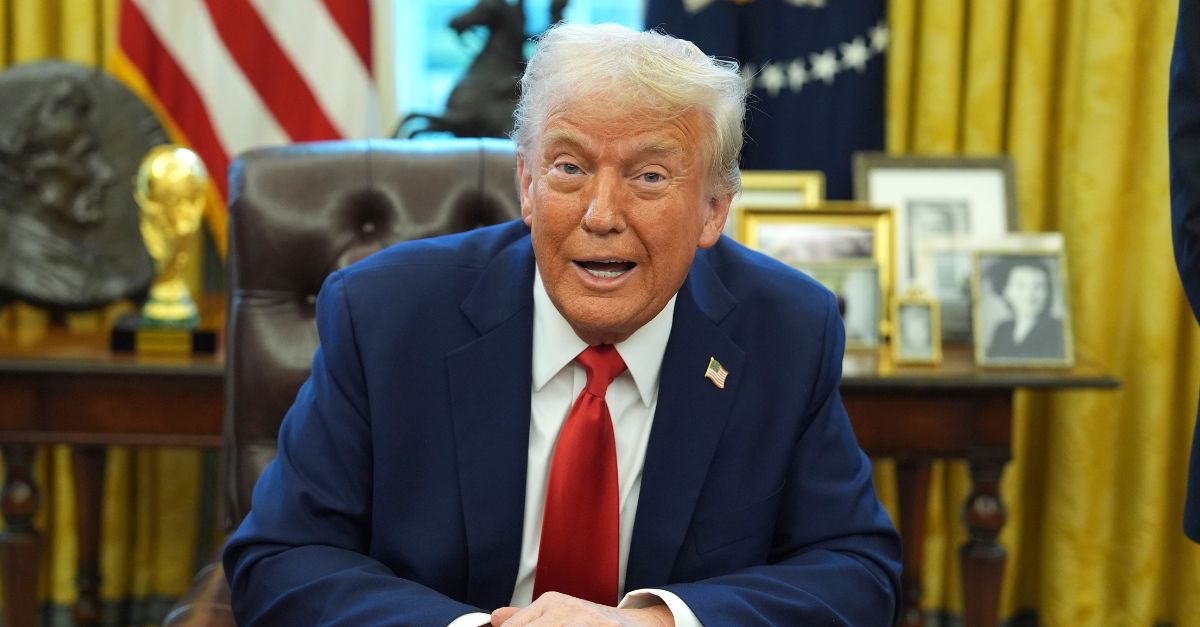
President Donald Trump speaks after signing an executive order in the Oval Office of the White House, Monday, Feb. 3, 2025, in Washington. (AP Photo/Evan Vucci)
A Maine man who was accused of spewing death threats at President Donald Trump has been allowed to walk free after the Department of Justice asked to have his case thrown out. The dismissal comes after the man referred to himself as a "loose cannon" and allegedly admitted he "wanted to shoot" George W. Bush, as well.
U.S. District Judge John Woodcock, a Bush appointee, agreed to dismiss Kevin Bell's indictment last Tuesday after Trump's DOJ put in an oral request asking him to do so, according to court records. A jury trial had been scheduled to begin that same day.
"I wanted to shoot Bush but didn't, but now Trump is in and I don't care for him," Bell allegedly told a law enforcement officer in April. "I'll just shoot him," he said, according to a criminal complaint.
Another alleged statement included Bell calling for others to kill Trump, saying, "I hope POTUS visits Iraq and gets assassinated," per the complaint.
Woodcock dismissed the Bell case last week in an oral order, without a written explanation.
In September, Woodcock had denied a motion to dismiss from Bell's public defender, which argued that his indictment was "defective" because it "fails to sufficiently articulate the charge he must defend." Bell also claimed that "even if the indictment did sufficiently allege a charge, his speech is protected by the First Amendment of the United States Constitution."
Federal prosecutors filed a response in opposition to Bell's motion to dismiss in early August, saying his claims were "without merit" and that his alleged threats were made "knowingly and willfully" by him. They noted how Bell, who is a pilot, spoke about hijacking commercial aircraft and stated that he "is able to take over a plane and crash it, hurting a lot more people." He also allegedly claimed he could "do anything he wants" with an aircraft, "like fly to D.C.," according to court documents.
"True threats fall outside the protection of the First Amendment," the DOJ said in opposition.
"Bell claims he lacked a subjective awareness of the nature of his threat because he was not aware others may regard the statement as threatening, is autistic and has trouble responding to social cues, was dissatisfied with the government, was making off-color attempts at humor or engaging in political hyperbole, and because there 'was never any real possibility of violence; because he was far from both Washington, D.C. and President Trump and knew no one in, and had not made arrangements to visit, Washington, D.C.," prosecutors explained. "While many of those claims are simply irrelevant to the existence of a 'true threat' or Bell's subjective awareness, Bell must raise them — if at all — through the admission of evidence at trial."
In his September order dismissing that motion, Woodcock stated, "The court concludes that the indictment is legally sufficient and that it is unable to address the defendant's remaining issues because to do so would require it to go outside the allegations of the indictment and make factual findings appropriate only for a jury."
It's unclear what changed between August and December, only that Trump's DOJ chose to request a dismissal on Dec. 16, according to court records.
In their motion to dismiss from earlier this year, Bell's defender claimed he is an "autistic person" who has trouble understanding and responding to social cues.
"He allegedly expressed his initial support for and then, his disappointment in President Trump," the motion said. "He made these alleged statements while dissatisfied with the government and the state of the world. Any statement he allegedly made during the conversation was nothing more than an off-color attempt at humor — political hyperbole — and not a serious expression of any intent to commit unlawful violence."
The Justice Department did not respond to Law&Crime's requests for comment on Tuesday, nor did Bell's federal defender. The Portland Press Herald was able to reach a federal prosecutor last week who said he couldn't discuss the case. Bell's lawyer did not respond to the Herald's requests for comment, either.

Comments