
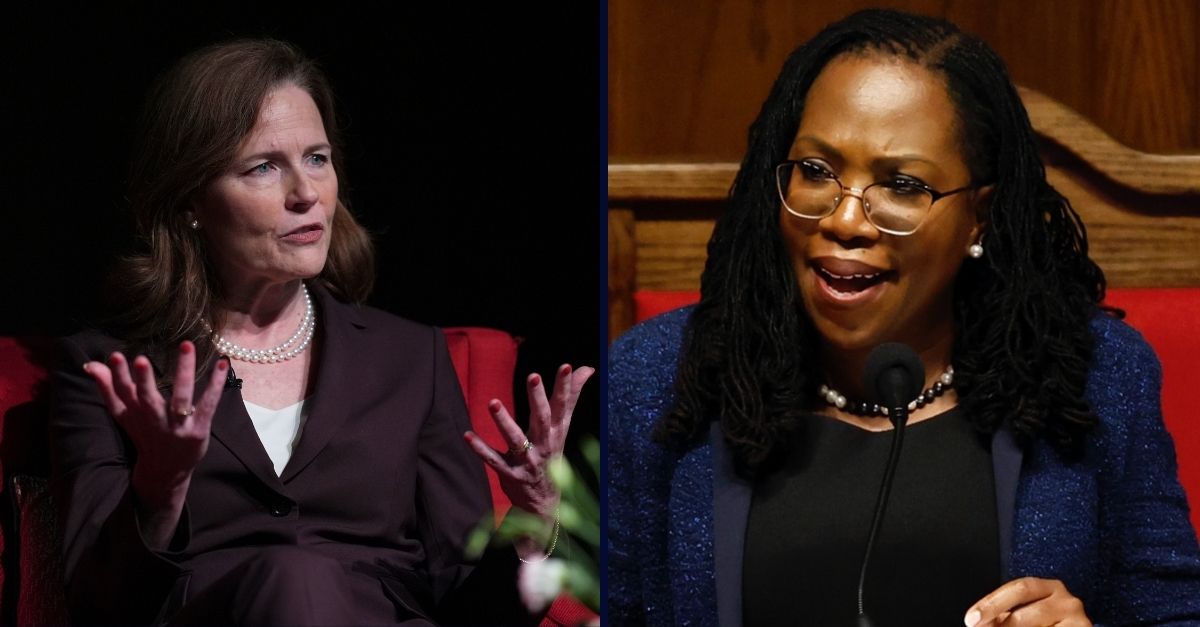
Left: Supreme Court Associate Justice Amy Coney Barrett speaks during an event at the LBJ Library in Austin, Texas, Thursday, Sept. 18, 2025 (AP Photo/Eric Gay). Right: Supreme Court Justice Ketanji Brown Jackson, the first Black woman on the nation's highest court, speaks at the 60th Commemoration of the 16th Street Baptist Church bombing Friday, Sept. 15, 2023, in Birmingham, Ala. (AP Photo/Butch Dill).
Justice Ketanji Brown Jackson slammed the Supreme Court for making it easier for political candidates to establish standing to challenge the lawfulness of state vote-counting rules in advance, noting that even as Justice Amy Coney Barrett agreed with the result, she disagreed with the majority's "reasoning" as "unmoored from precedent."
In a Wednesday decision led by Chief Justice John Roberts and joined in full by each of the conservative justices except for one, the high court sided with Rep. Mike Bost, R-Ill., and ruled that Bost, "[a]s a candidate for office […] has standing to challenge the rules that govern the counting of votes in his election."
Those rules under Illinois law meant election officials must "count mail-in ballots postmarked or certified no later than election day and received within two weeks of election day." Bost, who won reelection in 2024, argued those rules ran afoul of federal law.
For Roberts' majority — referring to three-part Article III standing test which applies to all plaintiffs — Bost and other candidates have "a concrete and particularized interest in the rules that govern the counting of votes in their elections, regardless whether those rules harm their electoral prospects or increase the cost of their campaigns."
Barrett, joined by Justice Elena Kagan, concurred in the judgment that Bost has standing but expressed disagreement about how the majority arrived at its conclusions, instead stating that Bost's lawsuit could survive not because he's a candidate, but because he "suffered a traditional pocketbook injury," crediting the argument that counting mail-in ballots after election day ratchets up a candidate's campaign costs for two more weeks to "mitigate or avoid" a "'substantial risk' of a harm caused by a statute," for instance bearing costs for extended poll-watching and monitoring.
The majority made short work of Barrett's pumping of the brakes, however, by following her preferred path to its logical endpoint.
Practically speaking, forcing candidates to "show a substantial risk that a rule will cause them to lose the election or prevent them from achieving a legally significant vote threshold in order to have standing," could "channel many election disputes to shortly before election day—or worse, after," the majority said.
Beyond that, said the majority, Barrett's approach could have created an absurdity of its own.
"Apparently, a candidate who pays poll watchers a penny would have standing, while one who relies on volunteers would not," the opinion said.
But Barrett and Kagan were concerned that majority had created "special standing rules for particular litigants," specifically candidates for public office.
"I cannot join the Court's creation of a bespoke standing rule for candidates," Barrett wrote. "Elections are important, but so are many things in life. We have always held candidates to the same standards as any other litigant."
For Barrett, Bost's "expenditures" to "mitigate a substantial risk of harm" were enough, at least at the motion to dismiss stage, to demonstrate standing on "traditional pocketbook injury" grounds, so there was no need to invent a "broader rule" that is "unmoored from precedent."
"So in addition to being unmoored from precedent, the Court's broader rule is unnecessary on Congressman Bost's own telling," Barrett wrote, concurring "only" in the judgment. "We need not deviate from established standing principles to resolve this case in Congressman Bost's favor."
Jackson's dissent, joined by Justice Sonia Sotomayor, repeatedly cited Barrett's concurrence to make the case that even she recognized the majority greenlit a "dubious departure from settled law" to grant political candidates standing leeway ordinary litigants cannot enjoy.
"As Justice Barrett explains, this harm-free Article III standing rule finds no support in our precedents," the dissent said.
Jackson went so far as to say the majority disregarded "judicial restraint" — "complicat[ing] and destabiliz[ing] both our standing law and America's electoral processes" — by "carving out a bespoke rule for candidate-plaintiffs" where they need not show "any real and immediate harm[.]"
"I am all for simplifying our standing law. But I am against doing so selectively; either Article III standing requires an actual or imminent injury in fact that is particularized to the plaintiff, or it does not," Jackson concluded. "Bost has plainly failed to allege facts that support an inference of standing under our established precedents."
Follow Law&Crime:

Comments