
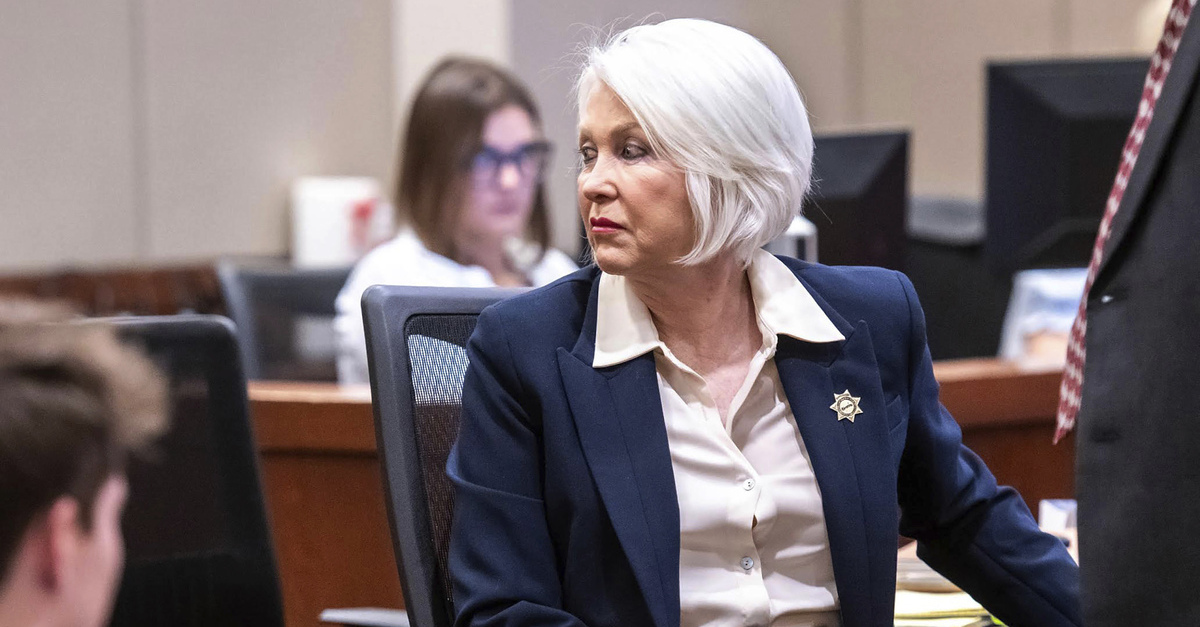
Former Mesa County Clerk and Recorder Tina Peters looks on during sentencing for her election interference case at the Mesa County District Court Thursday, Oct. 3, 2024, in Grand Junction, Colo. (Larry Robinson/The Grand Junction Daily Sentinel via AP).
A Colorado appeals panel has tossed out a nine-year prison term for Tina Peters, the first election official found guilty of a felony in connection with 2020 election conspiracy theories, and ordered that she be re-sentenced — declaring that the lower court violated her First Amendment right to free speech and "went beyond relevant considerations for her sentencing."
In a 78-page opinion released Thursday, Colorado Court of Appeals judges Craig R. Welling, Ted C. Tow III, and Lino Lipinsky agreed that "the trial court's comments about Peters's belief in the existence of 2020 election fraud went beyond relevant considerations for her sentencing" and she was punished too harshly, per the ruling.
"Her offense was not her belief, however misguided the trial court deemed it to be, in the existence of such election fraud; it was her deceitful actions in her attempt to gather evidence of such fraud," the opinion says. "Indeed, under these circumstances, just as her purported beliefs underlying her motive for her actions were not relevant to her defense, the trial court should not have considered those beliefs relevant when imposing sentence."
Responding to the decision in a statement Thursday, Colorado Attorney General Phil Weiser said Peters "will always be a convicted felon who violated her duty as Mesa County clerk, put other lives at risk, and threatened our democracy" regardless of "whatever happens" with her sentence.
"Nothing will remove that stain," Weiser blasted.
Peters was convicted in August of seven counts of engaging in a security breach related to unauthorized access to voting machines while she worked as a county clerk in Mesa County, Colorado. In October — after a marathon hearing in which Peters repeatedly expressed defiance and brought up conspiracy theories — the 70-year-old was sentenced to nine years in state prison for her felony offenses.
According to the appellate judges, it is "apparent that the court imposed the lengthy sentence it did because Peters continued to espouse the views that led her to commit these crimes." They say in their opinion that the "tenor of the court's comments makes clear that it felt the sentence length was necessary, at least in part, to prevent her from continuing to espouse views the court deemed 'damaging.'"
While Peters did not testify at trial, the panel points out that she chose to make statements at her sentencing hearing that the lower court claimed were evidence of a "lack of remorse." Her comments included spending "a great deal of time" talking about the alleged 2020 election fraud that she believes went down, according to Senior Assistant Attorney General Lisa Michaels.
"She used [the hearing] as a platform to make all these allegations, so of course it was relevant to what the court was doing at the sentencing hearing," Michaels asserted during a January appellate hearing. "The court was entitled to consider what she said," Michaels added.
The appeals panel ruled that it was "not inappropriate for the court to consider at sentencing whether Peters's statements evidenced a lack of remorse," per the Thursday opinion.
"The court failed to acknowledge that Peters is no longer the Mesa County Clerk and Recorder," the opinion says. "She is no longer in a position to engage in the conduct that led to her conviction. So it cannot be said that the lengthy prison sentence was for specific deterrence. To the contrary, the sentence punished Peters for her persistence in espousing her beliefs regarding the integrity of the 2020 election."
The appeals court ordered 21st Judicial District Judge Matthew Branch to resentence Peters. "The division reverses her sentence because it was based in part on improper consideration of her exercise of her right to free speech," the opinion says. "The division remands the case to the trial court for resentencing."
While the judges tossed out Peters' prison term, the panel did affirm her convictions after Peters filed a motion "to determine whether this court has jurisdiction to adjudicate" her appeal following claims by President Donald Trump that he was going to be pardoning Peters.
"While this appeal was pending, President Donald J. Trump purported to pardon Peters for 'those offenses she has or may have committed or taken part in related to election integrity and security," the opinion recounts. "Thereafter, Peters filed a motion … asserting two arguments — a claim that the President's pardon abrogates her state law offenses and a reiteration of her Supremacy Clause immunity argument."
The court of appeals dismissed both arguments, with the judges shooting down a claim from Peters' lawyers that the president had the authority to grant "pardons for offenses against the United States" in any state in the union.
"We join what appears to us to be every other appellate court that has addressed the issue and reject such an expansive reading of the phrase," the opinion reads, noting how Peters contends "without citation to any legal or historical authority" that the words "United States" refer to individual sovereign states.
"Specifically, Peters points to the use of plural pronouns to refer to the United States in the Constitution to contend that the term must be referring to the states, not the federal government, which would take a singular pronoun," the opinion explains. "We disagree."
The judges believe that despite the arguments made by Peters' lawyers, the words "several States," "each State," "that State," and "any State" come up repeatedly in the U.S. Constitution.
"Had the Founders wanted to extend the presidential pardon power to state offenses, they could have used language identical or similar to 'the several States' later in the sentence," their opinion concludes. "But they did not. Instead, they used only 'the United States,' which must mean something different than 'the several States.'"
Peters' attorneys have argued and asked for a pardon to be handed down by Trump throughout the appeals process. They sent a letter to Trump last year urging him to consider a workaround for pardoning Peters on her state charges. The Trump administration has said multiple times that it has been probing ways to get involved.
"The president's pardon of Tina Peters is meaningless and won't free her from prison," said AG Weiser in his statement Thursday. "Presidential pardons do not extend to state crimes, and the president cannot wipe away Ms. Peters' conviction with a stroke of a pen."
Colorado Secretary of State Jena Griswold issued a statement Thursday saying, "The Appeals Court affirmed Peters' conviction, and I am appreciative of their rejection of Trump's unlawful attempt to pardon her. Peters will continue to face accountability for coordinating a breach of her own election equipment. Her actions have been repeatedly used to spread conspiracy theories, amplify falsehoods, and fuel dangerous election lies. Peters should not receive any special treatment as the District Court considers re-sentencing."
Peters was slated to be eligible for parole in November 2028, according to the Colorado Department of Corrections, but that timeline will now change. A date has not been set yet for her resentencing.


Comments