
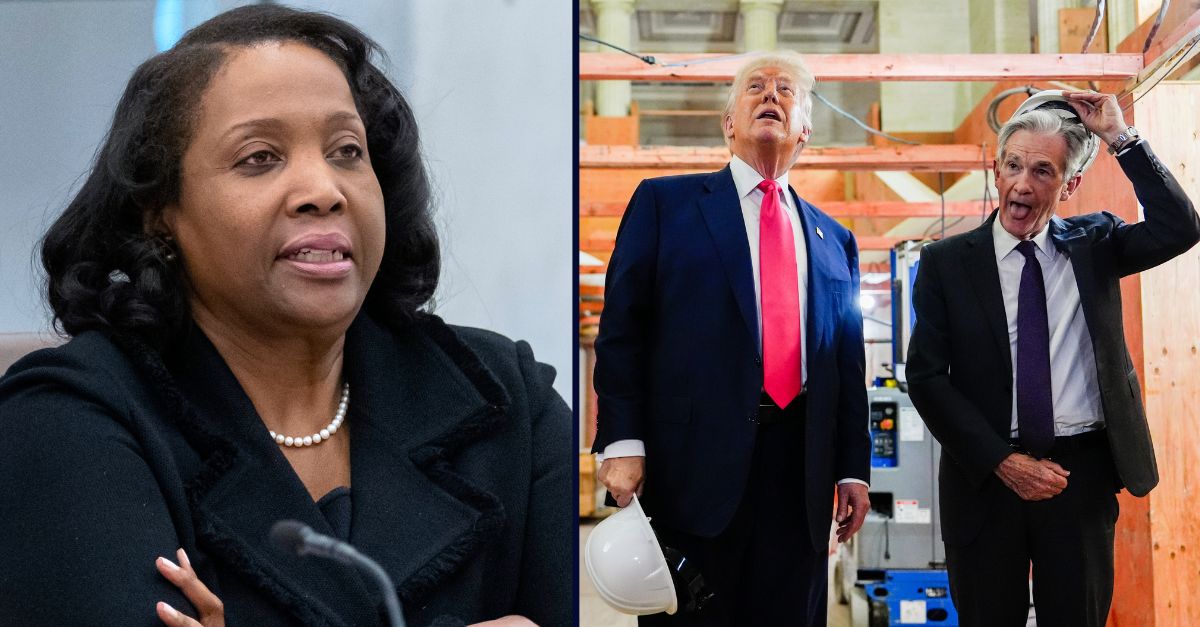
Left: Federal Reserve Board of Governors member Lisa Cook listens during an open meeting of the Board of Governors at the Federal Reserve, June 25, 2025, in Washington (AP Photo/Mark Schiefelbein, File). Right: Federal Reserve Chairman Jerome Powell takes off his hard hat as President Donald Trump looks at ongoing construction at the Federal Reserve, Thursday, July 24, 2025, in Washington (AP Photo/Julia Demaree Nikhinson).
Not even two weeks away from oral arguments at the U.S. Supreme Court over President Donald Trump's attempt to fire Federal Reserve Board governor Lisa Cook, the DOJ has taken aim at the central bank's chairman Jerome Powell, handing the high court a potential case-in-point for preserving the Fed's independence from politically motivated threats.
Trump is on record nicknaming Powell "Too Late" — pillorying him in social media posts and in other remarks for declining to swiftly cut interest rates — and on record threatening to file a lawsuit over Powell's alleged "gross incompetence" in presiding over multibillion dollar renovations of the Fed's buildings.
Even though the Trump-appointed and Joe Biden-reappointed Powell's term as chair is set to expire in May, the Trump administration has launched a criminal probe, according to an extraordinary statement from Powell himself over the weekend, in which he directly linked grand jury subpoenas to his policy differences with the president on interest rates.
Video message from Federal Reserve Chair Jerome H. Powell: https://t.co/5dfrkByGyX pic.twitter.com/O4ecNaYaGH
— Federal Reserve (@federalreserve) January 12, 2026
Powell revealed Sunday that the DOJ served the Fed with grand jury subpoenas two days earlier, "threatening a criminal indictment related to my testimony before the Senate Banking Committee last June."
"That testimony concerned in part a multi-year project to renovate historic Federal Reserve office buildings," Powell said, adding that the "unprecedented action should be seen in the broader context of the administration's threats and ongoing pressure."
"This new threat is not about my testimony last June or about the renovation of the Federal Reserve buildings. It is not about Congress's oversight role; the Fed through testimony and other public disclosures made every effort to keep Congress informed about the renovation project. Those are pretexts," he stated. "The threat of criminal charges is a consequence of the Federal Reserve setting interest rates based on our best assessment of what will serve the public, rather than following the preferences of the President."
Powell said further that the conversation should be about whether Americans will stand for a Fed subservient to the chief executive's whims, whether that president is a Republican or a Democrat.
"This is about whether the Fed will be able to continue to set interest rates based on evidence and economic conditions—or whether instead monetary policy will be directed by political pressure or intimidation," Powell concluded, vowing to "continue to do the job the Senate confirmed me to do, with integrity and a commitment to serving the American people."
The statement sparked rapid reaction on Capitol Hill, with increasingly vocal Sen. Thom Tillis, a North Carolina Republican not seeking reelection, questioning the Trump DOJ's "credibility."
"If there were any remaining doubt whether advisers within the Trump Administration are actively pushing to end the independence of the Federal Reserve, there should now be none. It is now the independence and credibility of the Department of Justice that are in question," Tillis said in a post on X. "I will oppose the confirmation of any nominee for the Fed—including the upcoming Fed Chair vacancy—until this legal matter is fully resolved."
The grand jury subpoenas do not come in a vacuum. Trump-supported federal prosecutions of New York Attorney General Letitia James and James Comey have so far come and gone the way of the dodo bird. A longtime Trump rival in CIA director John Brennan is under grand jury investigation. Former national security adviser John Bolton faces criminal charges the likes of which Trump escaped.
Most pertinently for the topic at hand, Trump-appointed Federal Housing Finance Agency Director Bill Pulte hit Sen. Adam Schiff, D-Calif., and Rep. Eric Swalwell, D-Calif., with mortgage fraud criminal referrals. Pulte is the same official who filed a mortgage fraud referral against Lisa Cook, a move that Trump cited in Supreme Court briefs as legally sufficient and unreviewable "appearance" of fraud cause to fire her from the Fed's board. And Pulte reportedly has a role, too, in the Powell subpoenas.
On Jan. 21, the Supreme Court will hear from Cook's legal team that "untested" mortgage fraud allegations were cooked up by the Trump administration in an attack on the Fed's "historic independence and statutory for-cause protection[.]"
In a supplemental filing from November, Cook's lawyers said the executive branch accepts that the Fed is not like the cornucopia of independent agencies it has sought to put squarely under the control of the president.
To that end, during oral arguments in December over Trump's disputed firing of FTC Commissioner Rebecca Kelly Slaughter, Justice Brett Kavanaugh brought up the Federal Reserve and said he "shared" concerns about its "independence." U.S. Solicitor General D. John Sauer responded by accepting that the U.S. central bank is "unique and distinct" in the "historical tradition."
The timing of the subpoenas raises questions about what Kavanaugh, if he was concerned then, will think now, nine days from the Cook oral argument.
Cook has argued that the president's stated "cause" for her firing was "conveniently timed" and based on "flimsy, unproven allegations of pre-office wrongdoing." To allow Cook's firing on that basis would be to "eviscerate the independence of the Federal Reserve Board" from presidential meddling and fly in the face of the Supreme Court's "history and tradition" rulings of recent years, her lawyers have said.
"Granting that relief would dramatically alter the status quo, ignore centuries of history, and transform the Federal Reserve into a body subservient to the President's will," Cook asserted, before the Supreme Court put the firing on ice at the start of October.
Follow Law&Crime:



Comments