
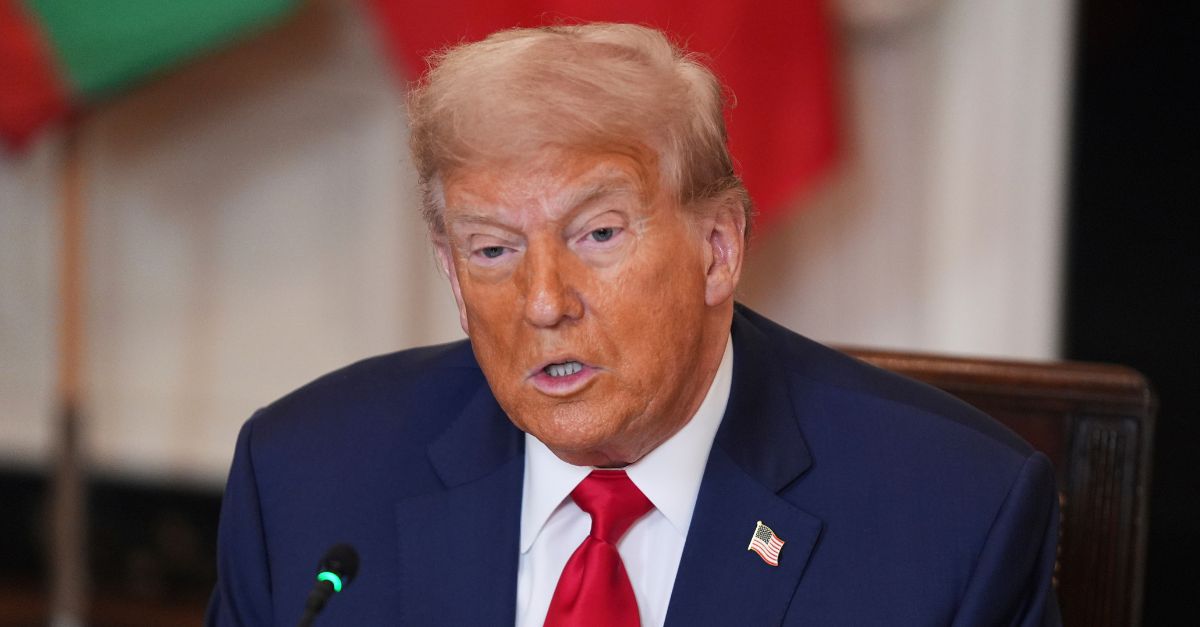
President Donald Trump speaks during a lunch with African leaders in the State Dining Room of the White House, Wednesday, July 9, 2025, in Washington (AP Photo/Evan Vucci).
The Trump administration's controversial policy of deporting immigrants to countries they are not from without due process must stop, a federal judge in Massachusetts ruled on Wednesday.
In the underlying case, several detained men challenged the Department of Homeland Security (DHS) deportation directive. The case then snowballed and generated headlines when DHS attempted to deport eight men to South Sudan — men who are not Sudanese nationals. After a series of court orders, those men were detained on a U.S. military base in the East African country of Djibouti.
Now, in an 81-page memorandum and order, U.S. District Judge Brian E. Murphy, a Joe Biden appointee, has determined the so-called "third-country" policy violates the "bedrock principle" of due process.
"This case is about whether the Government may, without notice, deport a person to the wrong country, or a country where he is likely to be persecuted, or tortured, thereby depriving that person of the opportunity to seek protections to which he would be undisputedly entitled," the ruling begins.
The judge then cites, at length, the Trump administration's own defense of the policy in its own words. During a hearing held in late March 2025, a Department of Justice attorney testified such deportations are "fine" so long as the government "doesn't already know that there's someone standing there waiting to shoot."
Murphy then rubbishes that excuse, at length:
It is not fine, nor is it legal. Congress made it "the policy of the United States not to expel, extradite, or otherwise effect the involuntary return of any person to a country" where that "person would be in danger of being subjected to torture." Congress decided that the Government "may not remove" someone to a country where her "life or freedom would be threatened" on account of her "race, religion, nationality, membership in a particular social group, or political opinion." These are our laws.
Murphy has long been highly critical of the Trump administration's policy while disdaining any efforts at formal workarounds.
Over several months last year, the judge issued a series of opinions which culminated in a national injunction barring the policy.
The stream of court orders in the case was steady — six from the district court; two from a court of appeals — and responsive to the Trump administration's continued efforts to conduct such deportations. Murphy repeatedly rebuked the government — reiterating and clarifying orders; certifying the class to broaden the scope of relief — after immigrants were sent to El Salvador on two separate occasions in violation of another judge's orders.
The district judge even jousted a bit with the U.S. Supreme Court. The government moved for a stay with the nation's high court in May 2025. A majority granted the stay in June 2025. Undeterred, Murphy said the stay had no effect on a remedial order the district court issued after finding the government had repeatedly violated multiple court orders. In July 2025, however, the high court's majority struck down the remedial order over a dissent by Justice Sonia Sotomayor.
But all of those prior disputes were unfolding on preliminary matters — and did not concern the actual merits of the case.
Now, finally, ruling on cross-motions for summary judgment filed by the plaintiffs, and to dismiss, filed by the defendants, the court has ruled in the plaintiffs' favor by finding the policy "unlawful" under the Immigration and Nationality Act (INA) and the due process clause.
In the ruling, the judge offers a basic legal lesson about the applicability of constitutional protections by citing the Supreme Court:
At the outset, it is worth noting what Defendants' argument does not, and cannot, suggest: that the Due Process Clause simply does not apply to individuals present without admission in the United States. Rather, the Supreme Court has repeatedly held that "the Due Process Clause applies to all 'persons' within the United States, including aliens, whether their presence here is lawful, unlawful, temporary, or permanent."
Murphy then describes how the Trump administration's case largely rested on an exception to the due process rule by invoking the "entry-fiction" doctrine. This legal notion suggests certain immigrants are treated as if they never actually set foot on U.S. soil.
The court rejects application of the doctrine by explaining how "more than a century of Supreme Court case law" shows it is only ever used in cases focused on an immigrant's admissibility into the country. Here, the issue is about something else entirely, Murphy notes: U.S. obligations under the Convention Against Torture (CAT).
"Because Plaintiffs challenge neither their orders of removal nor any of the processes that produced those orders, their claims do not implicate, nor even 'relate to,' the issue of their admissibility," the opinion goes on. "Withholding of removal and CAT relief cannot issue until after the order of removal has been entered and thus after any question of admissibility has been resolved."
The judge further chastises this off-base argument in a footnote: "Because Plaintiffs' claims are not within the substantive scope of the entry-fiction doctrine, it is somewhat of a distraction to argue about whether any class members might be (or might have been) impacted by it in other contexts. Nevertheless, the Court would be remiss not to point out that Defendants' misstatement of the law is striking."
Murphy goes on to criticize the government's "incendiary gloss" for focusing on class members whose home countries do not want them to return. The court says this focus ignores people who were "previously granted protection from being sent back to their home countries" because they face persecution there.
In fact, the court says, protected individuals appear to have been "targeted" by DHS — again in violation of the law and the Constitution.
"This new policy — which purports to stand in for the protections Congress has mandated — fails to satisfy due process for a raft of reasons, not least of which is that nobody really knows anything about these purported 'assurances,'" Murphy continues. "Whom do they cover? What do they cover? Why has the Government deemed them credible? How can anyone even know for certain that they exist? These are basic questions that the Constitution permits a person to ask before the Government takes away their last and only lifeline."
The court issued a 15-day stay of the judgment to allow the government to request a stay from the U.S. Court of Appeals for the 1st Circuit.


Comments