
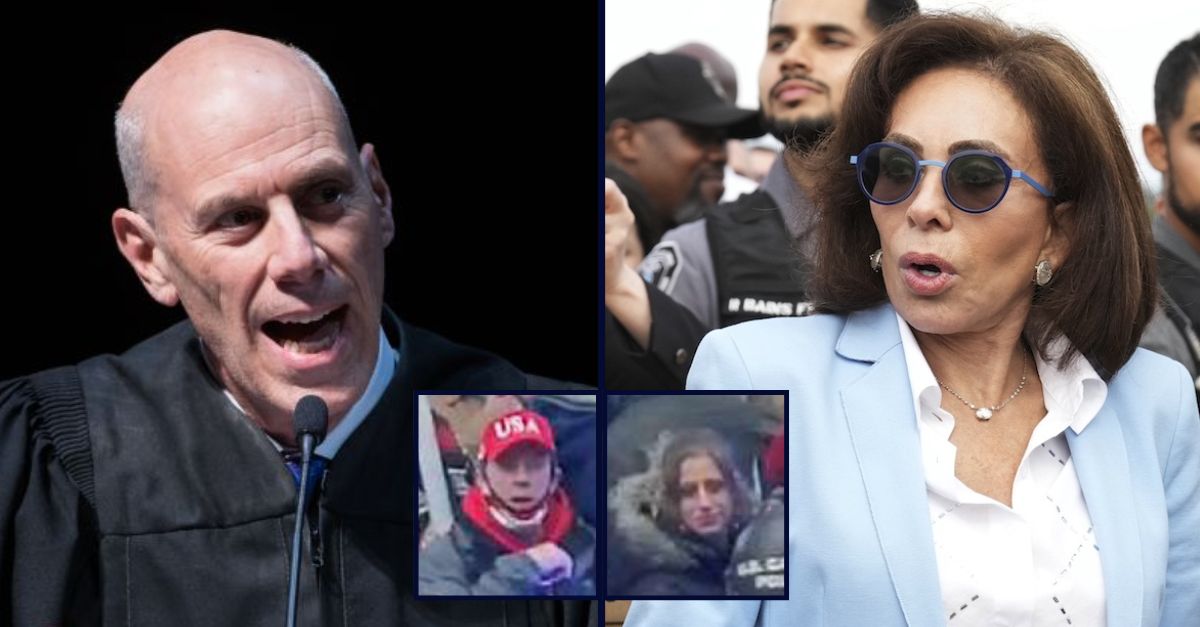
Inset left to right: Christopher Price and Cynthia Ballenger (U.S. Department of Justice). Background left: U.S. District Court for the District of Columbia Chief Judge James "Jeb" Boasberg takes part in a mock trial at Harman Hall in Washington, D.C., Feb. 17, 2026. (Francis Chung/POLITICO via AP Images). Background right: U.S. Attorney for the District of Columbia Jeanine Pirro waits for President Donald Trump to arrive to speak with members of law enforcement and National Guard soldiers, Thursday, Aug. 21, 2025, in Washington (AP Photo/Jacquelyn Martin).
One judicial turnabout deserves another in Washington, D.C., where refunds for pardoned Jan. 6 defendants are currently in vogue.
On Friday, U.S. Attorney Jeanine Pirro filed a motion in one such case – asking the D.C. District Court to sign off on an order that would effectively claw back funds paid to two separate agencies within the legislative branch and executive branch, respectively.
In the underlying case, Cynthia Ballenger and her husband, Christopher Price, were convicted in a bench trial before U.S. District Judge James Boasberg. In March 2023, the court found the couple guilty on all four counts against them over their actions during the pro-Donald Trump riot at the national seat of legislative government.
In April 2023, the couple moved for a new trial. The U.S. Department of Justice, at the time, filed a 16-page motion in opposition detailing the defendants' behavior at the nation's capital.
"[T]he Defendants were not alone on January 6," prosecutors wrote. "Rather, they were part of a riot consisting of thousands of people."
In late January 2025, the couple received their own share of a blanket pardon issued by the 45th and 47th president to Jan. 6 defendants – while their cases were still on appeal.
In March 2025, Ballenger and Price filed a motion seeking reimbursement for the $570 each paid as part of their sentence. In April 2025, the newly constituted DOJ filed a motion in support.
"As part of its sentence, the Court ordered each Defendant to pay a $70 special assessment and $500 in restitution to the Clerk of the Court for disbursement to the Architect of the Capitol," prosecutors appointed by Trump wrote. "Here, the Defendants' convictions were 'invalidated' when the D.C. Circuit vacated them, and thus 'there is no longer any basis justifying the government's retaining funds exacted only as a result of that conviction.' The government thus agrees that, so long as the Clerk of Court confirms that the Defendants in fact paid the special assessment and restitution they seek to have returned, the Defendants are entitled to reimbursement of those payments."
Judge Boasberg saw things a bit differently.
In June 2025, he rebuffed the reimbursement request by likening the effort to a similar request denied in the federal district.
"Although the government agrees that return is appropriate, the court does not and will deny the Motion," Boasberg said.
Two weeks later, the defendants filed a relatively lengthy 29-page motion to reconsider the denial, replete with numerous citations to precedent supporting reimbursement under such circumstances. This time, Boasberg was convinced.
In December 2025, the court granted the motion and said the "United States shall refund Defendants Ballenger and Price $570 each."
However, the judge's volte-face did not result in a spendthrift attitude at the D.C. District Court.
In Friday's motion, Pirro explained that there has been something of an argument as to where the money should come from.
"In the months that followed, both defense counsel and attorneys for the government have contacted the District Court Clerk's office to refund the $570 each defendant paid to that office," the motion reads. "The Clerk's office has declined to do so, stating that the Court's order requires '[t]he United States'—which it apparently reads as 'the Executive Branch'—to refund the defendant's money."
But, Pirro claims, her research – comprising of extensive consultations "with other attorneys within the Department of Justice" – has turned up something of a payment-source dead-end.
"[T]here is no mechanism through which the Executive Branch can directly refund money it received via the District Court Clerk," the motion goes on. "Rather, to facilitate the refund to the defendants, the District Court clerk must 'pull back' money that it previously paid."
To get the requested funds, the court must convince the Architect of the Capitol – an agency under the legislative branch – to return the $500 in restitution each defendant paid, and convince the Crime Victim's Fund – a program administered by a subagency within the DOJ – to refund the $70 assessment each defendant paid, according to the motion.
"Once the Clerk's office initiates that process, the money owed to the defendants will then pass back into the Clerk's custody, and the Clerk can then refund the money to the defendants," Pirro goes on. "It is the undersigned's understanding that the Executive Branch has no other mechanism by which to effectuate the refund required by the Court's order."
To that end, the DOJ is now asking Boasberg to enter an order requiring "the District Court Clerk's office to refund $570 to each defendant" under the terms outlined by Pirro.
Chris Perez contributed to this report.

Comments