
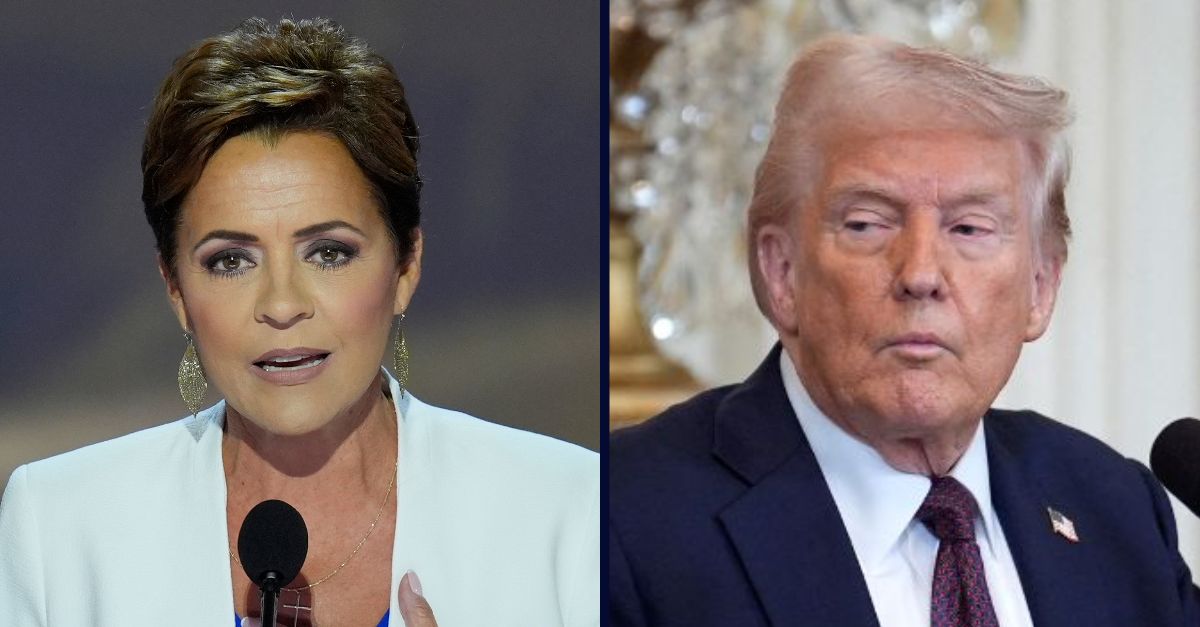
Left: Kari Lake speaking during the second day of the Republican National Convention, Tuesday, July 16, 2024, in Milwaukee (AP Photo/J. Scott Applewhite). Right: President Donald Trump at a press conference at the White House in Washington on February 27, 2025 (Yuri Gripas/Abaca/Sipa USA; via AP Images).
While setting aside the Trump administration's teardown of the U.S. Agency for Global Media (USAGM) and the Voice of America (VOA) as unlawful, a federal judge used Kari Lake's deposition against her and criticized the Arizona governor who never was for having "no opinion" on a "basic question" she needs to know under the law.
Senior U.S. District Judge Royce Lamberth, a conservative judge appointed by President Ronald Reagan in the 1980s, made a point early on in his opinion to pen a lengthy footnote explaining why he ignored the government's objections and made the depositions of Kari Lake, senior adviser Frank Wuco, and VOA director of Persian broadcasts Leili Soltani part of the record.
"The objection lacks merit," Lamberth said, because the defendants "have long withheld the administrative record in this case despite an obligation to produce it contemporaneously with the filing of their motion to dismiss" and depositions were needed "precisely because" of that "ongoing refusal to produce basic information about USAGM and VOA's operations and future plans."
Lamberth noted that it wasn't until he threatened to hold Lake in contempt that the agency defendants revealed the so-called "Statutory Minimum Memorandum," an "agency action implementing" President Donald Trump's March 2025 executive order to "continue the reduction" of the "federal bureaucracy."
"The defendants' persistent omission and withholding of key information in this case has been a Hallmark production in bad faith and is more than sufficient to justify consideration of the depositions," Lamberth said.
Lake's evasive answers about whether the VOA was functioning at the legal and statutory bare minimum mandated by Congress sparked the judge's ire in August, leading him to order her deposition.
Just over a week ago, Lamberth additionally ruled the Trump administration unlawfully delegated Lake "nearly all" the authority of the USAGM's CEO, an issue known by those closely following the DOJ's losses in court over interim or acting U.S. attorney appointments.
Lake began at USAGM as a senior adviser but got an upgraded title of deputy CEO and eventually started holding herself out for months as acting CEO.
As a result, the judge found actions Lake took from July to November 2025 while wielding that authority were "void," including firings.
Lamberth's latest opinion recounted that Lake one year ago responded to Trump's executive order by promptly putting more than 1,000 employees on administrative leave and ripping up hundreds of contracts.
The results of Lake's deposition about her actions evidently didn't impress the judge, a boost for the plaintiffs who insisted all along that ideologues were trampling on the "statutory mandate that VOA continuously broadcast to the world[.]"
If Lake, a former news anchor, can't or won't form an opinion on "significant" places for the U.S. to broadcast as required by law, and with an understanding of "censorship or repression" unique to regions around the world, that's a problem, Lamberth suggested.
"Defendant Lake has repeatedly thumbed her nose at these statutory requirements, testifying that she has no opinion about which countries censor and repress their people — or even the basic question of which regions of the world qualify as significant, as would be required just to feign compliance with 22 U.S.C. § 6202(b)(6) and (7)," Lamberth said. "These refusals constitute a 'transparent violation[] of a clear duty to act.'"
The statute the judge referred to says U.S. "international broadcasting shall include information about developments in each significant region of the world" and "a variety of opinions and voices from within particular nations and regions prevented by censorship or repression from speaking to their fellow countrymen[.]"
Lamberth said the plaintiffs came up with "undisputed evidence" that the VOA is "unable to operate its Iran service at current staffing levels, despite a statutory mandate to do so," as a war unfolds.
"Apart from boilerplate responses, the defendants rebut none of these facts," he added, ordering employees back to work and ensuring the VOA is functioning as mandated by Congress.
Follow Law&Crime:




Comments