

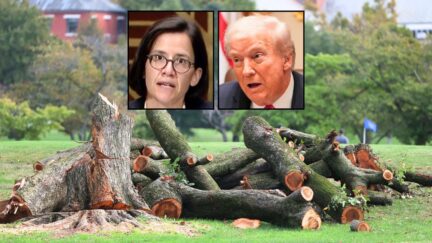
Main: A portion of border wall is under construction in the Big Bend region, Wednesday, Sept. 23, 2026, near Sierra Blanca, Texas (AP Photo/John Locher). Right inset: President Donald Trump smiles after speaking at a campaign rally at the Salina Regional Airport, Sunday, Nov. 1, 2026, in Salina, Kan. (AP Photo/Charlie Riedel).
The U.S. Supreme Court in an 8-1 per curiam decision on Monday — over the objection of only Justice Ketanji Brown Jackson — allowed President Donald Trump's administration to continue construction of a border wall in Big Bend National Park.
"The Government is exceedingly likely to prevail on its argument that the District Court lacked jurisdiction to adjudicate respondents' so-called major-questions-doctrine claim," the majority said, staying U.S. District Judge Kathleen Cardone's injunction from early October.
The case centers on Section 102 of the Illegal Immigration Reform and Immigrant Responsibility Act of 1996 (IIRIRA), granting the DHS secretary broad authority to construct border barriers and waive statutory requirements. Crucially, IIRIRA strictly limits district court jurisdiction to claims alleging a "violation of the Constitution of the United States."
The DOJ argued in its stay application that the Friends of the Ruidosa Church plaintiffs made a "major-questions claim" that "borders on frivolous" and which the judge accepted as a "constitutional challenge" to block the government's "expeditious" construction.
The major questions doctrine has served to limit the executive branch from interpreting vague legislative language in a way that would give the president power to effectuate sweeping changes on a national level without the approval of Congress.
But eight justices said on Monday that "[t]here is no such thing as a 'constitutional' major-questions claim." Jackson, who would have denied the stay application, stood alone.
The DOJ had called the injunction a "baseless" block on a "major portion" of the border wall to address an "'area of high illegal entry' requiring additional border barriers[.]"
The Friends of the Ruidosa Church said the stakes were enormous for an "irreplaceable landscape" facing "permanent alteration."
"As the district court recognized, if construction proceeds and Respondents ultimately prevail, this beloved landscape and Respondents' livelihoods, recreation, and enjoyment 'will have been forever altered,'" a response brief warned.
Follow Law&Crime:

Comments