
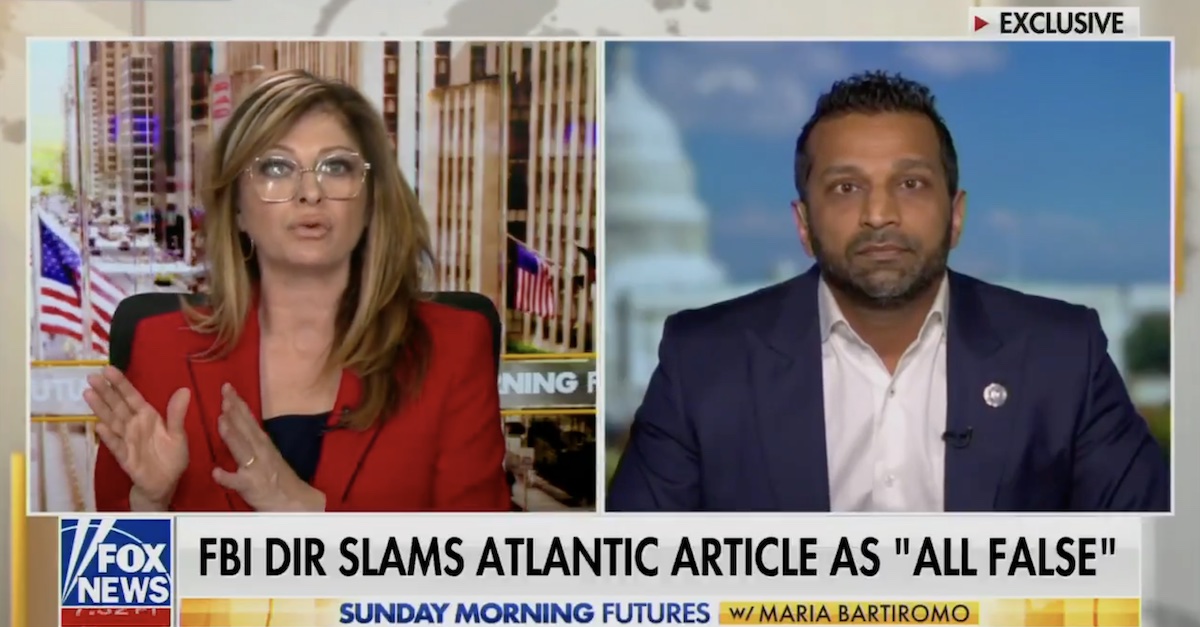
FBI Director Kash Patel appears on Fox News on April 19, 2026, to deny the Atlantic article's claims (Fox News).
Kash Patel filed a $250 million defamation lawsuit on Monday after spending the last couple of days broadly blasting the Atlantic's reporting about him as "all false" and "pure fantasy." But a leading First Amendment expert says the sitting FBI director actually has a "daunting" and "tough" road ahead.
Last Friday, the Atlantic's staff writer Sarah Fitzpatrick published a story claiming Patel has been missing in action at the FBI, alleging "excessive drinking" and instances of being "unreachable behind locked doors." The report described an FBI director in over his head and paranoid that he's going to be fired next, citing nine unnamed "people familiar" reporting that Patel had a wild "freak-out" over a non-issue a week earlier.
Patel allegedly started "frantically calling aides and allies" on April 10 when he was unable to sign in to a computer, erroneously believing that meant the White House had fired him and locked him out. According to the report, the problem was due to a "technical error" rather than a firing.
The Atlantic cast that alleged episode as a case in point for how on edge Patel currently is in the aftermath of Pam Bondi's firing as attorney general and several high-profile failures by the administration to investigate and federally prosecute President Donald Trump's perceived enemies. The article additionally cited witness accounts of Patel's alleged "unexplained absences" and "bouts of excessive drinking."
To support the claim that his "drinking is no secret," the story referenced Patel's public chugging of a beer as he celebrated Team USA's Olympic gold medal in hockey. The Atlantic cited two anonymous "officials" in reporting that Trump called Patel to "convey his unhappiness" about that video. In addition, the report said "FBI officials and others" have questioned whether "alcohol played a role" when the director "shared inaccurate information" after the murder of Charlie Kirk and the shooting at Brown University, to name two.
The article itself included a short response from Patel, making clear that the Atlantic reached out to him ahead of time and included a denial in the piece.
"Print it, all false, I'll see you in court—bring your checkbook," Patel said.
As the Atlantic expresses confidence that its reporter nailed the story down, Patel complains that the FBI was only given a "two-hour window" or 111 minutes to respond to a litany of claims. Worse yet, Patel's lawyers Jesse Binnall, Jason Greaves, and Jared Roberts said the Atlantic went ahead with a publication "replete with false and obviously fabricated allegations" to "drive him from office."
"Defendants are of course free to criticize the leadership of the FBI, but they crossed the legal line," the complaint said, asserting that Fitzpatrick's sources must be lying partisans because they are anonymous.
Notably, Patel currently faces multiple lawsuits from fired FBI agents who have accused him of unconstitutional political revenge firings and "defamatory speech."
Over the weekend, the director appeared on Fox News, vowed arrests relating to the 2020 election, and attributed the Atlantic allegations he denied to his being "over the target."
Much of Patel's complaint slammed the Atlantic for not buying the administration's prepublication claims that the allegations were "'totally false,' 'made up,' and 'made up to the point of satire.'"
The lawsuit claimed that the Atlantic willfully "avoid[ed] receiving information that would refute their narrative" and that of their "sham sources."
According to Patel, the Atlantic didn't include a response from the Office of Public Affairs, which called the claims "one of the most absurd things I've ever read" and "[c]ompletely false at a nearly 100% clip" and left out information about the FBI's successes during his tenure.
"Defendants buried this striking language, never reported it, and chose to publish the claims anyway," the complaint said, calling that proof of actual malice. "They made no effort to reconcile these on-the-record denials—backed by documented, publicly reported law-enforcement successes—with the Article's central thesis that Director Patel is a derelict and erratic leader, who abuses alcohol to the point of being unfit for his duties."
Fitzpatrick, on the other hand, defended her reporting as the result of "alarm coming from within the FBI and within other really serious law enforcement and intelligence agencies that view Patel's conduct not just as problematic or as an embarrassment, but as a national security threat."
"And specifically in light of recent events in Iran, you know, sources felt that this was really important to have known to the public," she explained in an NPR interview.
When Law&Crime asked famed First Amendment lawyer Floyd Abrams for his thoughts on the strength of the lawsuit, he called it "a really tough case for Kash Patel to win" and a "daunting" hill to climb.
"He needs to meet the daunting burden of showing that The Atlantic knew or suspected that what it said about him was false," Abrams, father of Law&Crime founder Dan Abrams, said in an email. "I wouldn't bet on it."
Later on Monday, the case was assigned to Senior U.S. District Judge Emmet Sullivan, perhaps best remembered for not simply letting Michael Flynn's prosecution be dismissed.
Binnall, one of Flynn's lawyers, is now representing Patel.
Read the complaint in full here.
Follow Law&Crime:





Comments