
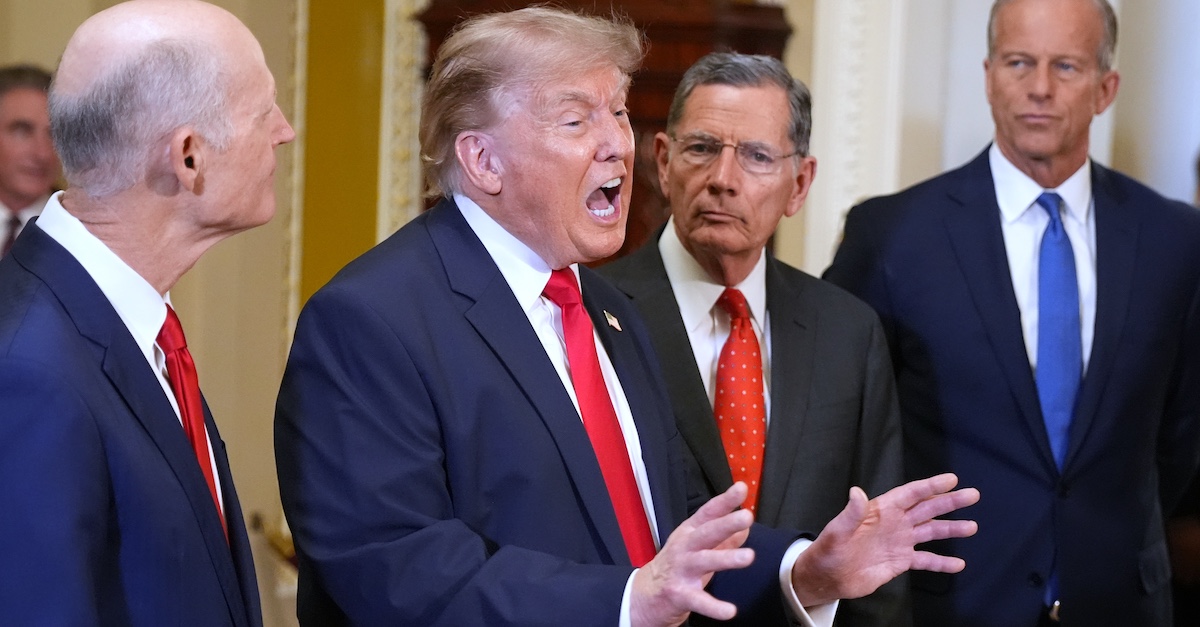
President Donald Trump speaks with reporters as Sen. Rick Scott, R-Fla., from left, Sen. John Barrasso, R-Wyo., and Senate Majority Leader John Thune, R-S.D., listen on Capitol Hill, Wednesday, June 24, 2026, in Washington (AP Photo/Jacquelyn Martin).
In another blow to President Donald Trump's executive order targeting mail-in voting ahead of the midterm elections, a federal appeals court has refused — for now — to let the U.S. Postal Service carry out "unprecedented levels of involvement by federal officials" in nearly two dozen states.
The 1st U.S. Circuit Court of Appeals, in a 2-1 decision over the weekend favoring blue states led by California, left in place a lower court order blocking the implementation of Trump's late-March executive order 14399, "Ensuring Citizenship Verification and Integrity in Federal Elections."
U.S. Circuit Judges Gustavo Gelpí and Julie Rikelman, both appointees of former President Joe Biden, and Joshua Dunlap, a Trump appointee, formed the three-judge panel.
Only Dunlap registered a partial dissent as to Section 2 of the order, finding the 23 plaintiff states and Washington, D.C., "likely lack[ed] standing to challenge certain, though not all, aspects of [the] Executive Order." Dunlap said Section 2(a), for instance, "does not order States, including Plaintiffs, to take any action based on the State Citizenship List," but instead directs DHS to take actions.
The majority, on the other hand, denied the Trump administration the stay of a lower court injunction it sought, while also rejecting 12 red states that attempted an intervention.
"The federal defendants and 12 states that intervened in the case in support of the executive order have now filed separate motions seeking a stay of the district court's injunction pending appeal, arguing only that the Plaintiff States lack standing to bring their claims and that those claims are not ripe. We deny their motions," the panel said, noting that Trump's order "directs unprecedented levels of involvement by federal officials in how states administer elections."
A federal judge in Massachusetts last week declined to dismiss Trump from a lawsuit brought by the League of Women Voters, as Law&Crime reported.
U.S. District Judge Indira Talwani reiterated that Section 3 of the order, which directed USPS to "refuse to transmit mail ballots for certain voters," was "unconstitutional." The judge added that Trump's order "directs the violation of several of obligations imposed on USPS by Congress, including the exhaustive statutory definition of 'nonmailable matter,' which does not include ballot mail from unenrolled individuals, and USPS's obligation not to make 'any undue or unreasonable discrimination among users of the mails.'"
"The right to vote is a fundamental right, which the Constitution guarantees to all citizens," the judge said.
On June 25, Talwani granted summary judgment for the plaintiffs, holding Sections 2 and 3 were "legally void as they are ultra vires and unconstitutionally violate the separation of powers[.]"
The 1st Circuit panel left the order untouched.
"[T]he Government has failed to demonstrate any error in the district court's analysis, especially because, during the district court proceedings, it did not contest that several states had already purchased mail-ballot envelopes and even conceded 'that making design changes to mail-ballot envelopes or adding Intelligent Mail barcodes would add costs to Plaintiff States,'" the panel said. "The Government nevertheless argues in its stay briefing that these anticipated pocketbook injuries cannot support standing because USPS has not yet issued a final rule implementing Section 3 of the EO."
"As the district court determined, the summary judgment record reflects that any change to the kind of envelopes state and local officials must use for voting by mail will necessarily force the Plaintiff States to incur monetary and operational costs," the order added.
On Monday, the DOJ swiftly brought an emergency application to the U.S. Supreme Court, claiming Talwani "issued an extraordinary injunction barring federal agencies from implementing an Executive Order promoting election integrity in the upcoming federal elections in November."
"The injunction is particularly remarkable because the Order merely sets forth general policy guidance, leaving substantial discretion to agencies about how to implement the Order while admonishing them that they may do so only consistent with applicable law. And the injunction is especially indefensible because the agencies are still deliberating over how (if at all) to implement the Order, yet the district court preemptively decided that whatever the agencies may choose to do will necessarily be unlawful," U.S. Solicitor General D. John Sauer argued.
Justice Ketanji Brown Jackson, assigned to handle 1st Circuit emergency applications like these, ordered the states to file their response a week from today.
Follow Law&Crime:

Comments