
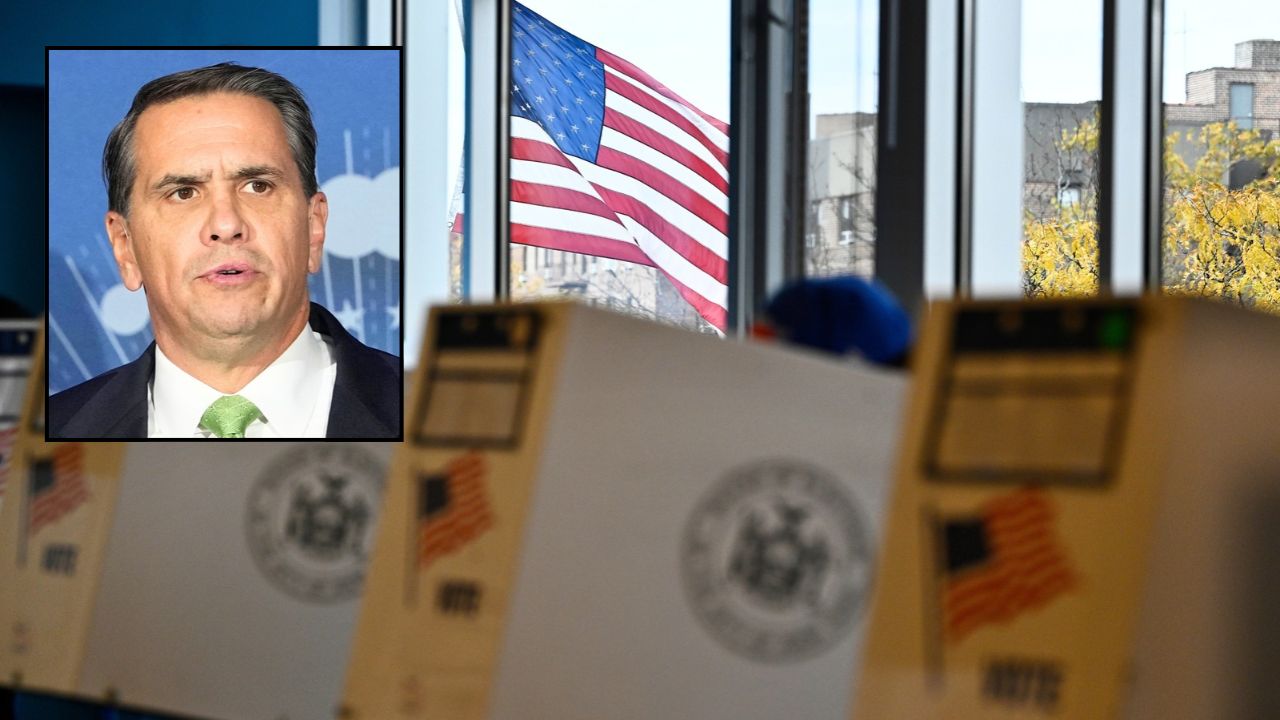
Background: People take part in the midterm elections at a polling site in the Queens borough of New York City, NY, Nov. 3, 2026. (Photo by Anthony Behar/SIPA USA)(SIPA via AP Images). Inset: Attorney General Todd Blanche speaks at the FBI Cincinnati Field Office, Wednesday, Oct. 21, 2026, in Cincinnati. (AP Photo/Jacquelyn Martin, Pool).
A full appellate court has ruled that the U.S. Department of Justice (DOJ) can continue sending directives – including "threats" of prosecution – to election officials in two states.
The U.S. Court of Appeals for the 9th Circuit heard the case en banc – meaning the entire bench of judges – after labor unions and civil rights organizations suing the Trump administration asked it to do so. With only hours left before the end of Election Day, the full appeals court agreed with an earlier three-judge panel in staying the original order from a district judge.
In October, the Trump administration sent letters to election workers in California and Washington state asking that election officials "sequester" the ballots of voters whom federal officials believed to be noncitizens, threatening that failing to do so would be breaking the law and that the election officials could be prosecuted. Labor unions, such as the Service Employees International Union, and civil rights organizations, including the League of United Latin American Citizens, sued, alleging that the DOJ was using tactics of intimidation in violation of the Voting Rights Act.
On Oct. 30, a U.S. district judge granted a temporary restraining order blocking the DOJ and the Department of Homeland Security (DHS) from making additional ballot-sequestration requests and "threats" of prosecution. The Trump administration appealed the ruling, and a three-judge panel on the U.S. Court of Appeals for the 9th Circuit reviewed the case.
Two of the judges found that the district court was "likely wrong" in its determinations, and by a vote of 2-1, they granted the government's request for a stay of the district order.
The DOJ celebrated the decision.
"The TRO issued by a San Francisco judge purporting to restrict DOJ investigations into election officials has been appropriately lifted," said Bill Essayli, First Assistant U.S. Attorney for the Central District of California. "Conducting criminal investigations is a core function of the executive branch, not the judiciary."
The labor unions and civil rights organizations asked the circuit court to rehear the case en banc, and within hours, that request was granted. For a brief moment, the order blocking the "threats" against election workers was back in effect.
That ended when 11 judges on the 9th Circuit came back with a final order – with six judges ruling to reinstate the stay and five dissenting. The majority wrote that the judges found the DOJ's "requests to be core Executive functions that did not actually disturb the states' regulation of their own elections."
As a result, the DOJ may continue its investigative efforts "[p]ending further order of the court."
It remains unclear whether the reinstatement of the stay will have a tangible effect on the DOJ's efforts or the results of Election Day.


Comments