
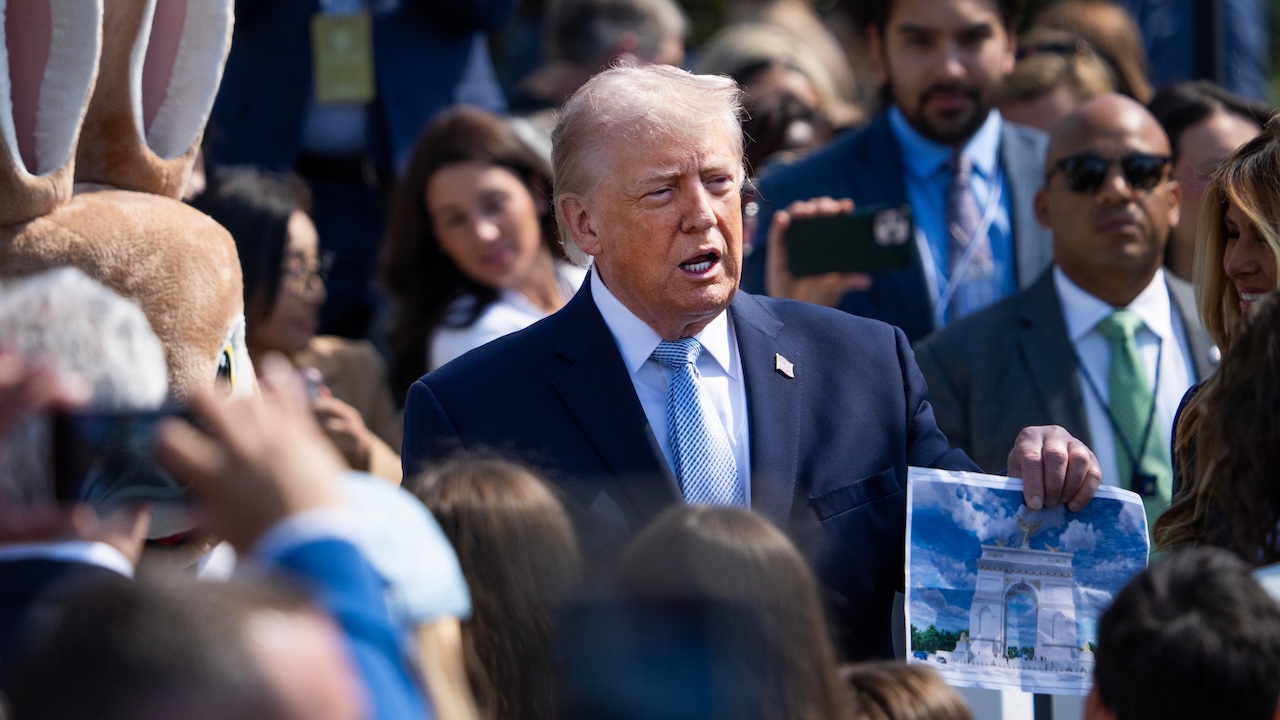
President Donald Trump holds a picture of the proposed Triumphal Arch, on the South Lawn during the White House Easter Egg Roll on Monday, April 6, 2026 (Tom Williams/CQ Roll Call via AP Images).
Military veterans and an architectural historian trying to stop the administration from starting construction on Donald Trump's "Great Triumphal Arch" have no standing to sue, just like the challengers of the president's ballroom, the DOJ said Thursday.
The notice of supplemental authority from the government was filed on the same day that Interior Secretary Doug Burgum openly declared that the administration is "preparing to start, over the next two-week period, the excavation work necessary for the Great Triumphal Arch and Military Observation Deck, at Memorial Circle on Columbia Island between the Lincoln Memorial and Arlington National Cemetery."
We are pleased to announce that after a very long wait (over 125 years!), we are preparing to start, over the next two-week period, the excavation work necessary for the Great Triumphal Arch and Military Observation Deck, at Memorial Circle on Columbia Island between the Lincoln… pic.twitter.com/8aff90jKNd
— Secretary Doug Burgum (@SecretaryBurgum) September 3, 2026
Burgum suggested that the arch is something the grandson of former President Ulysses S. Grant would have wanted — and that Congress intended more than 100 years ago — at a site with only an "informal circle" and not a "central plaza."
Every "major Western capital" has an arch, and so should the nation's capital, the secretary added.
According to a federal lawsuit filed in February by Vietnam War veterans Michael Lemmon, Shaun Byrnes, Jon Gundersen, plus architectural historian Calder Loth, the administration's plan to construct a 250-foot-tall "Triumphal Arch" for the nation's 250th anniversary was always going to "situate the monument on an axis between the Lincoln Memorial and Arlington National Cemetery," at Memorial Circle.
If allowed to go forward, the plaintiffs said, the arch would "obstruct[] a line of sight that was designed to represent the unification of the Nation following the Civil War and that has existed for nearly a century."
To hear the DOJ tell it, the Supreme Court's rejection of an architectural historian's "aesthetic interests" in a suit over Trump's ballroom should be the end of the story.
"The Court granted the government's application to stay an injunction prohibiting construction of the East Wing of the White House, holding that aesthetic interests in viewing the White House likely did not suffice to establish Article III standing," the notice said, seeking the same result in the arch lawsuit and a separate case on the overhaul of the golf course at East Potomac Park.
"Plaintiffs cannot distinguish their injury as being about 'the destruction of a landscape,' as the Trust's member made indistinguishable allegations about 'the permanent visual destruction' of a planned landscape," the filing added. "Nor does Plaintiffs' theory of view 'interference' create injury in fact."
That the plaintiffs are military veterans and an architectural expert changes nothing, the government asserted.
"Plaintiffs' personal and professional experiences cannot transform distaste for the arch and its proposed placement into concrete and particularized injuries required for Article III standing," the filing said.
Public Citizen Litigation Group, in a notice of its own for U.S. District Judge Tanya Chutkan, said the difference between this case and the ballroom case is that construction of the arch "has not yet begun, and it is Plaintiffs who stand at risk of irreparable harm if an injunction does not issue."
"Defendants have introduced no declarations or other evidence that enjoining construction of the arch, unless and until it is authorized by Congress, will cause any cognizable harm to Defendants or to the public interest," the plaintiffs answered.
The group's lead attorney, responding to Burgum's online statements about imminent construction, said in a statement that the administration "has no legal authority to begin work on its monumental arch."
"By law, the administration cannot proceed with this project unless and until Congress authorizes construction. And even the administration appears to recognize that the arch requires authorization from the National Capital Planning Commission, which it has not received," said attorney Nicolas Sansone. "Even under the administration's own view of the law, then, the preparatory work that Secretary Burgum has announced has no legal basis."
On Friday, the plaintiffs moved for a temporary restraining order, to bar the Executive Office of the President and NPS defendants "from initiating construction of an arch on Memorial Circle without congressional authorization[.]"
"[P]reserving Congress's role in authorizing the design and siting of commemorative works and other structures on federal land in our national capital will ensure democratic accountability and a measure of consensus in determining the symbolic configuration of those landmarks and the national narrative that they convey," the filing said.
Later on Friday, Judge Chutkan ordered that the administration "shall provide the court with 48 hours' notice before engaging in any activity on Memorial Circle other than on-site information gathering[.]"
Follow Law&Crime:


Comments