
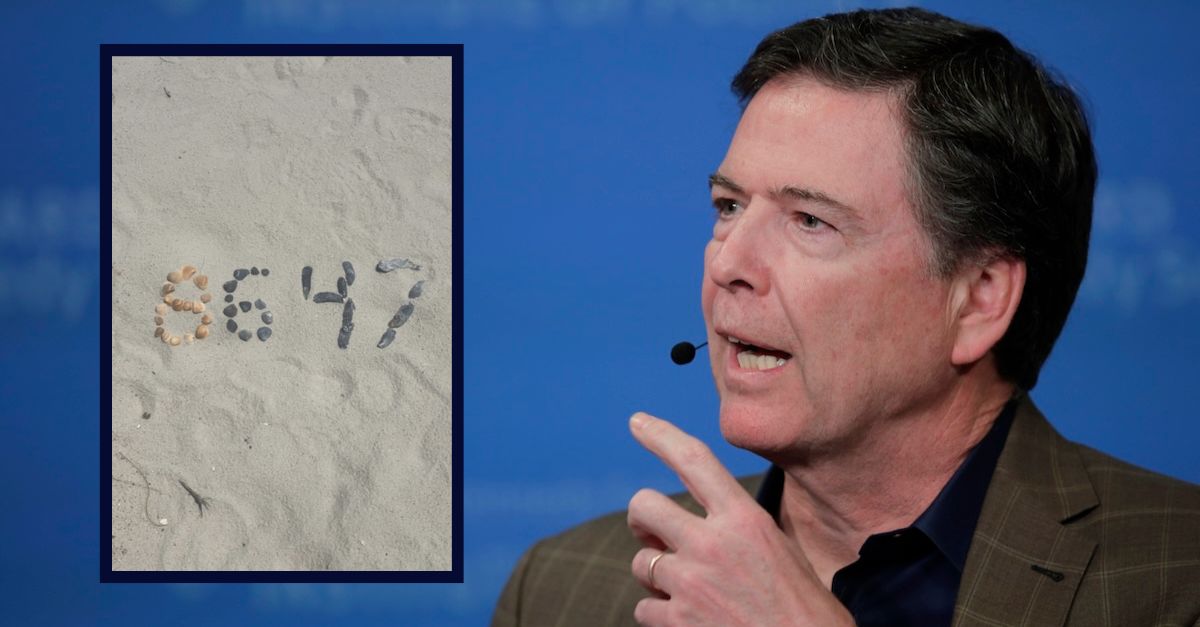
Main: Former Director of the Federal Bureau of Investigation James Comey at Harvard University's Institute of Politics' JFK Jr. Forum in Cambridge, Mass., Monday, Feb. 24, 2020 (AP Photo/Charles Krupa). Left inset: A court exhibit shows the seashell formation on Comey's phone (DOJ).
Former FBI Director James Comey is a "charismatic leader" who knew what he was doing when he posted a picture of seashells on a North Carolina beach in an "8647" formation — just take it from his "eerily on-the-nose novel," according to President Donald Trump's Department of Justice.
The DOJ filed several documents on Tuesday in opposition to Comey's various motions to suppress evidence, uncover grand jury materials, or dismiss the case on vindictive or selective prosecution grounds.
But one document attempted to justify the seashells prosecution on the merits, arguing a jury should decide whether Comey's Instagram post of the "cool shell formation" he saw "on [his] beach walk" with his wife Patrice in May 2025 actually was a "true threat" against a political rival.
To date, the government has not succeeded in convincing courts that posting or displaying "86" necessarily amounts to a true threat, but it maintains the Comey case's context is different.
Comey's legal team has said the administration's interpretation of "86" defies dictionary definitions, "context, precedent, and common sense," even submitting an affidavit from a former mob prosecutor to argue "there is literally no support for the central allegation on which the case rests."
The government has countered by claiming that U.S. District Judge Louise Flanagan can "easily" deny Comey's "attempt to short-circuit these proceedings," because "[w]hether Comey's post constitutes a true threat depends entirely on the sharply disputed factual context."
That's what a jury is for, the DOJ said, claiming that the context must include mention of the defendant's novel "FDR Drive," which "was only five days from public release" when Comey posted the photo.
The DOJ turned to an excerpt from the book in which a character described the concept of "stochastic terrorism" by way of a "charismatic leader [who] jacks people up but, through the wonder of the internet, avoids a direct connection to what comes next."
Comey is just such a leader, the Trump DOJ said.
"On May 15, 2025, a charismatic leader named James Comey, through the wonder of the internet, posted a coded message to his followers meaning 'kill' or 'get rid of' (a euphemism for 'kill') President Trump. Comey has acknowledged taking the picture of the seashells on May 15," the filing said. "To be sure, Comey's account suggests any similarity between his conduct and his novel are coincidental."
But because the "heart of this case is a dispute over what that context means," the DOJ said, "[o]nly a jury can resolve" it.
"Rather than argue the phrase has a single objective meaning, [Comey] acknowledges that '86' has at least 'in more recent times' and 'on isolated occasions' been used to mean 'to kill.' And of course, Comey himself previously admitted that 'some folks associate those numbers with violence' after deleting his post," the opposition filing said, claiming it would be "exceedingly odd" for the judge to toss the case "without the government having ever had the opportunity to present evidence of that context to substantiate its allegation of a true threat."
After he deleted the post, Comey also said in an appearance on the "Late Show with Stephen Colbert" that he and his wife thought "8647" was a "clever political message" protected by the First Amendment.
"You know what I think it is, I think it is a reference to restaurants when you '86' something in a restaurant," Patrice said, according to her husband.
Follow Law&Crime:


Comments