
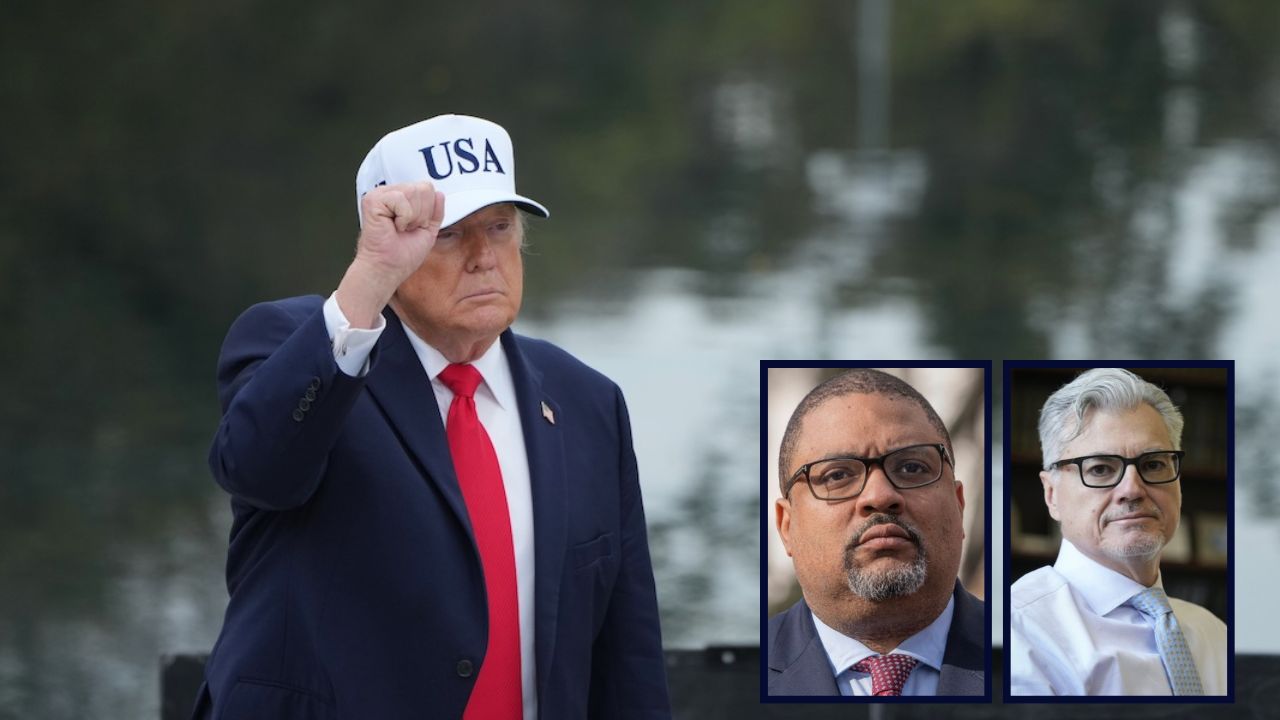
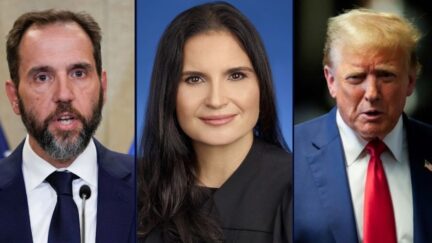
Main: President Donald Trump after speaking in front of the Lincoln Memorial Reflecting Pool, Monday, Nov. 2, 2026, in Washington (AP Photo/Mark Schiefelbein). Left inset: Manhattan DA Alvin Bragg attends as Senator Kirsten Gillibrand released report on illegal guns arrests and seizure on the plaza in front of Police Headquarters on December 4, 2023 in New York. (Photo by Lev Radin/Sipa USA)(Sipa via AP Images). Right inset: Judge Juan Merchan poses for a picture in his chambers in New York, Thursday, March 14, 2024. Merchan is presiding over Donald Trump's hush money case in New York (AP Photo/Seth Wenig).
While President Donald Trump's personal attorney argued Thursday that his falsification of business records convictions and sentence "must" be "reversed" on appeal as a matter of law, the Manhattan DA's office said that even if certain official-acts evidence shouldn't have been used at trial, that was "harmless error."
Presiding Justice Troy Webber led the New York Supreme Court Appellate Division, First Department, panel on Thursday and was joined by Justices Manuel J. Mendez, Martin Shulman, Bahaati Pitt-Burke and Shlomo S. Hagler.
In making the case that Manhattan DA Alvin Bragg, a Democrat, improperly secured 34 convictions against Trump in the case over hush-money payments to Stormy Daniels, attorney Robert Giuffra said the prosecution was "infected by multiple fatal errors under New York and federal law" — whether by violating the U.S. Supreme Court's immunity decision in Trump v. United States or through the use of the Federal Election Campaign Act (FECA) to "bump up" and jumpstart the otherwise dead-in-the-water charges.
The prosecution's use of FECA was so "critical" for the state convictions that Acting New York Supreme Court Justice Juan Merchan went on "for pages about all of the requirements" jurors had to consider, Giuffra said.
"The district attorney relied upon New York Election Law 17-152, which is an obscure provision that's only been used really for ballot fraud or people trying to intimidate people at the polling places," the attorney said. "What makes it a crime is the unlawful means, and at trial, the district attorney argued in summation that the payments to [Daniels and others] were all illegal FECA contributions in the context of the 2016 election."
"The only thing that makes it an agreement, which is what we're talking about here — conspiracy […] is you've got to do it through unlawful means, and the only unlawful means that the other side focused on a trial was FECA," he added.
A wave of amicus curiae briefs in the case supported Trump's appeal in various ways.
In one of those briefs, law professor Seth Barrett Tillman and the Landmark Legal Foundation argued that the trial's jury instructions violated Trump's Sixth Amendment jury-unanimity rights, as established in U.S. Supreme Court jurisprudence.
Because prosecutors relied on an underlying election conspiracy to elevate a misdemeanor to a felony, the brief said, the jury was constitutionally required to unanimously agree on the specific "unlawful means" committed — but they did not. According to the brief, prosecutors put forward three entirely separate and independent means that the jury might have considered.
Law professor Jed Shugerman's brief — which Giuffra referenced multiple times — argued Congress intended FECA to expressly preempt all state-level regulation of federal elections, rendering Manhattan prosecutors' reliance on a state election conspiracy charge fundamentally void.
Trump's legal team focused heavily on the trial court's jury instructions, arguing it was unconstitutional to allow jurors to convict without unanimously agreeing on the specific "unlawful means" underlying the alleged conspiracy.
Worse yet, Merchan "barred" the president's FECA expert from testifying at trial, Giuffra said.
Webber noted that the DA's office argued the hush-money payments facilitated by Michael Cohen and former National Enquirer publisher David Pecker on Trump's behalf were meant to "avoid maybe a certain type of publicity" before the 2016 election but were, at bottom, "fraudulent transfers."
"Your Honor, again, the key requirement is what was the unlawful act that is at the center of this," Giuffra responded, turning later to presidential immunity issues.
Bragg's appellate chief Steven Wu spent the bulk of his time downplaying the role of FECA in securing the convictions.
"FECA's scope is extremely narrow here," Wu said.
Webber asked if the attorney agreed that the misdemeanor charges were bumped up based on FECA.
"That's correct," Wu answered.
"What the state is concerned about is the broader integrity of the electoral process, and that's what the election law focuses on," he added. "The falsifying business records were done with the intent to conceal this underlying conspiracy here, which involved not just the FECA violations."
"Because the state was focused on other harms that are within a core power of regulation, there was no preemption," Wu also said.
When Giuffra stepped back to the podium, he focused on presidential immunity, which the Supreme Court addressed in its landmark ruling in Trump v. United States roughly one month after the hush-money verdict in 2024.
Wrangling continues over the decision's application to the evidence used at trial, such as communications with aide Hope Hicks or a statement Trump made about former Attorney General Jeff Sessions.
"When you when you introduce evidence that's covered by presidential immunity, you can't do that," Giuffra said.
Wu countered that even if that evidence was not allowed, it was "harmless error" — because of the "overwhelming evidence" of Trump's "guilt."
"If we were to accept that this particular statement that involved Jeff Sessions maybe was subject to immunity, would harmless error apply?" Pitt-Burke asked.
"It would. It would absolutely apply here," Wu answered. "It is true that there is a reference to the Attorney General here, but yes, but the purpose of this statement was not to establish the defendant had actually made that statement. It was instead to — and the judge gave the jury a very specific instruction on this conversation — it was instead to evaluate David Pecker's and Michael Cohen's credibility and their reactions, their reactions to the statement at a time when the defendant was pressuring them to stay quiet."
"Immunity simply does not attach to that," he added, and even "assuming there was any error in admitting this evidence [..] any error here would be harmless in light of the overwhelming evidence of the defendant's guilt that they don't challenge at all."
Follow Law&Crime:

Comments