
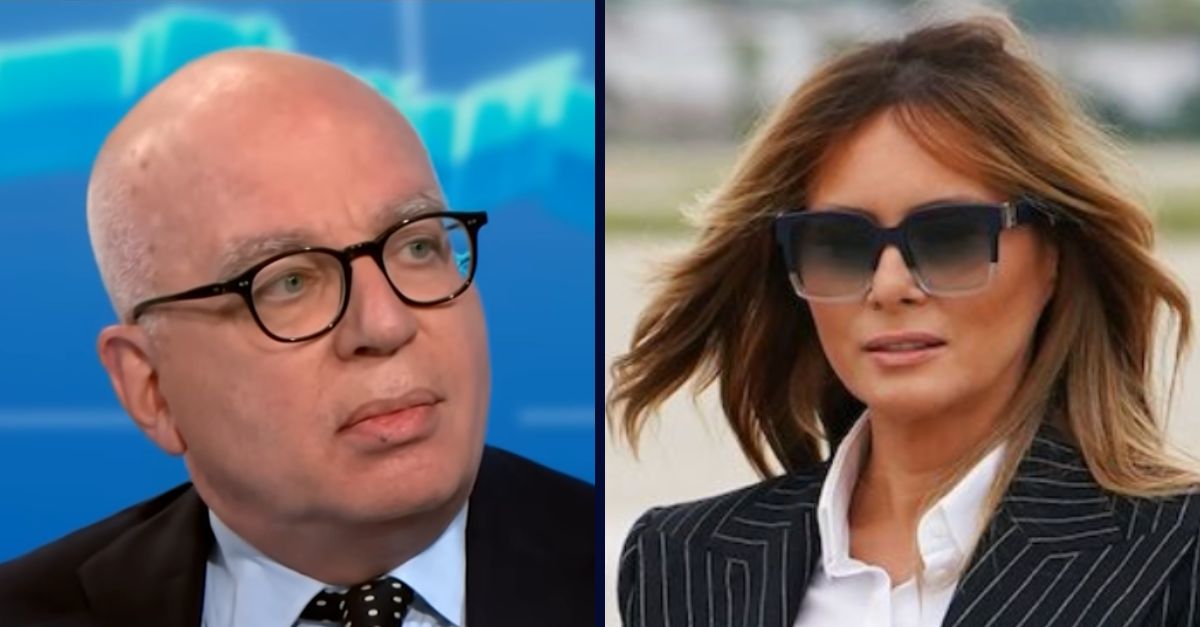
Left: Michael Wolff (CNN/YouTube). Right: First lady Melania Trump (Photo by MANDEL NGAN/AFP via Getty Images).
A federal judge in Manhattan has handed first lady Melania Trump a significant victory in court by dismissing a lawsuit against her filed by political biography writer Michael Wolff.
In a 45-page opinion and order on Friday, U.S. District Judge Mary Kay Vyskocil, who was appointed by President Donald Trump during his first term, put the kibosh on a preemptive lawsuit filed by Wolff.
In October 2025, the author filed an anti-SLAPP lawsuit against Melania Trump – alleging that a "threat letter" he received from her attorneys was "[f]or all intents and purposes" a complaint that outlines a number of would-be defamation claims against him.
Wolff has penned a number of bestselling books about Trump and has been a vocal critic of the president's alleged ties to Jeffrey Epstein, along with Melania Trump's alleged connections to the deceased pedophile financier. In interviews and his own complaint, Wolff has said: "First Lady Melania could be the missing link in President Trump's ties to convicted sex offender Jeffrey Epstein."
In a threat letter, Melania Trump's attorneys said Wolff must "issue an apology for the false, defamatory, disparaging, misleading, and inflammatory statements" about her and "demanded an offer of money to compensate" for the "overwhelming reputational and financial harm" he caused her, according to Wolff's own lawsuit.
That letter further cautioned that if Wolff did "not comply" with those demands by the end of business on Oct. 21, 2025, Melania Trump would initiate legal action to the tune of $1 billion in damages.
But, while Melania Trump's threatened defamation lawsuit has yet to materialize, Wolff himself sued on the basis that her lawyer letter was issued "for the purpose of harassing, intimidating, punishing, or otherwise maliciously inhibiting Mr. Wolff's free exercise of speech."
Wolff's lawsuit was filed under the New York State anti-SLAPP — or strategic lawsuit against public participation — law, which can put a quick end to a defamation lawsuit if a court determines the person complaining of defamation is actually trying to chill free speech.
The judge, however, rubbished Wolff's effort as too much, too soon.
"In this case, a chronicler of the First Family sues the First Lady because she threatened to sue him for defamation," the opinion begins. "While Plaintiff and the First Lady have a real dispute, they must litigate it according to the same procedures as everyone else. Plaintiff asks for a declaration that, if the First Lady sues him, he deserves to win. That is not how the federal courts work."
Wolff also complains about the lawsuit being removed to federal court – which was done on Melania Trump's request – and the judge similarly has no patience for the author's arguments there.
"[W]hile it may have started in state court, this case was properly removed," the opinion goes on. "Plaintiff and the First Lady are citizens of different states, and the lawsuit she threatened seeks a billion dollars in damages."
The judge also takes the opportunity to poke at both sides.
"There are many features of this case that make it complicated: the prominence of the personalities involved, the scandalizing content of the underlying statements, and, frankly, an inappropriate level of tactical gamesmanship," the opinion continues. "But the outcome is simple. The Court will not be conscripted to oversee an abusively presented spat and so declines to reach the merits here."
Part of the simplicity for Vyskocil is the fact that there is no actual defamation lawsuit that has been filed against Wolff.
"On the merits, the basic issue here is whether Plaintiff's public statements about the First Lady were defamatory," the judge observes. "But that question, however much attention it may have received in the media, is not yet before the Court."
The court outlines the disjointed nature of the case, at length:
This case is presented to the Court in a somewhat contorted posture: A would-be defamation defendant sues a would-be defamation plaintiff in New York state court. He seeks a declaration that statements identified in a demand letter threatening litigation under Florida law are not defamatory, and, further, that any such litigation would violate—or, perhaps, has violated already—New York's anti-SLAPP law. Thereafter, the would-be defamation plaintiff removes the action to federal court, and moves to dismiss.
But, Vyskocil says, the "would-be" nature of the claims and allegations involves the future – and that is neither litigable nor proper.
"Plaintiff may or may not have defenses to the First Lady's would-be claim of defamation," the opinion goes on. "Indeed, he may or may not have—or come to have—anti-SLAPP claims of his own. The Court takes no position on these possibilities. The Parties are free to pursue in good faith whatever claims they wish. But it is disingenuous for Plaintiff to assert that he had 'no choice' but to preemptively file this action in New York."
The judge casts Wolff's claims as a "simulated adjudication of a would-be Florida-based defamation suit" in which she would have to "generate" a "needless" decision on the scope of New York law.
"To reach the merits here would be an abuse of the judicial system and a waste of its resources," Vyskocil chides.
For all the rancor, the judge says, the only truly salient and live issue was the matter of removal to federal court.
"The First Lady was entitled to have Plaintiff's action against her heard by a federal court according to federal procedures," the opinion concludes. "That action does concern a live case or controversy, but it is one that should be litigated according to the 'traditional procedures for adjudicating' speech-tort cases between private parties. Accordingly, it should not be litigated here. Because this case presents a real dispute—one between citizens of different states—this Court has subject matter jurisdiction. The Court, however, declines to exercise that jurisdiction. Instead, based on prudential abstention, it dismisses this case to be litigated like any other."
Chris Perez contributed to this report.




Comments