
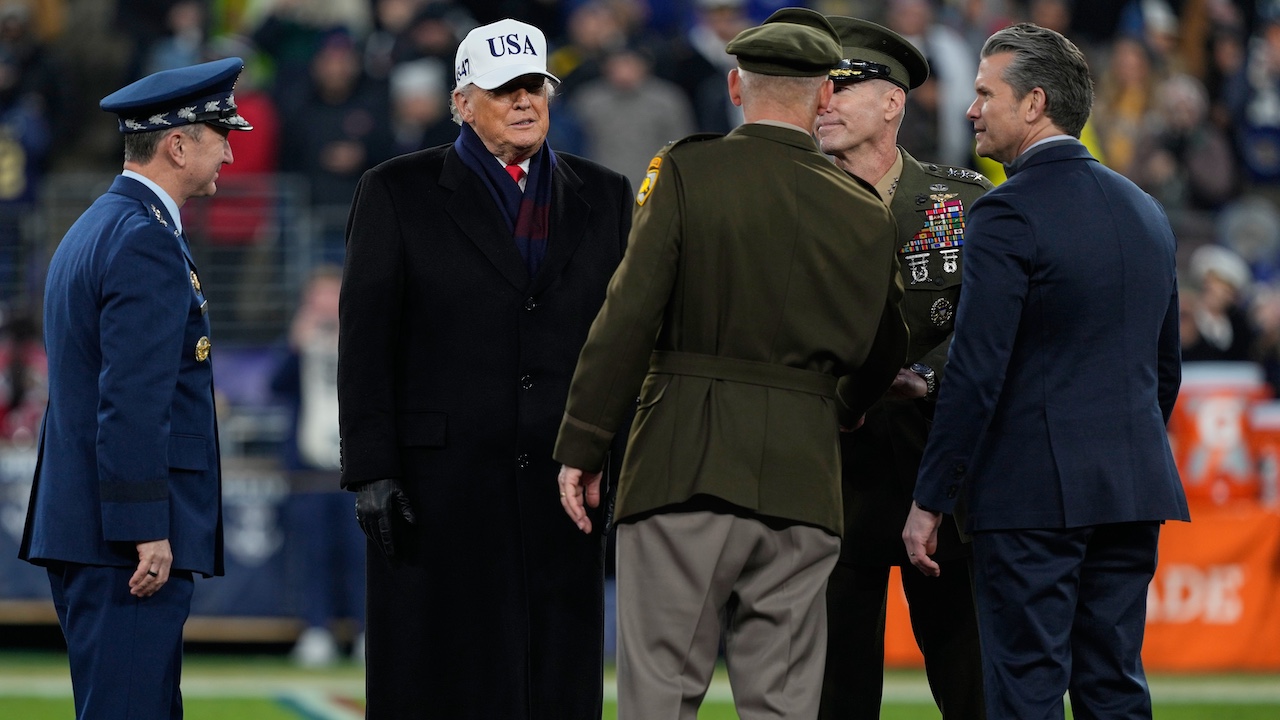
President Donald Trump talks with Chairman of the Joint Chiefs of Staff Gen. Dan Caine, from left, Lt. Gen. Steven Gilland, superintendent of the U.S. Military Academy at West Point, Lt. Gen. Michael Borgschulte, superintendent of the U.S. Naval Academy, and Defense Secretary Pete Hegseth during halftime of the 126th Army-Navy NCAA college football game at M&T Bank Stadium, Saturday, Dec. 13, 2025, in Baltimore (AP Photo/Julia Demaree Nikhinson).
A federal judge in New York handed down a stipulated judgment favoring a civilian law professor whom she earlier found was "likely" to show unconstitutional censorship at West Point, formally resolving a lawsuit against the Trump administration.
When U.S. Military Academy Department of Law and Philosophy Professor Tim Bakken filed his complaint in September 2025 on behalf of himself and the "putative class of all those similarly-situated," he alleged that one of the executive orders President Donald Trump signed near the start of his second term — "Restoring America's Fighting Force" — was the genesis of a "censorship regime."
Bakken observed that executive order 14185, which barred "un-American, divisive, discriminatory, radical, extremist, and irrational theories," like those that say "America's founding documents are racist or sexist," was issued on Jan. 27, 2025, two weeks before the "Dean's Policy and Operating Memorandum No. 03-24 came into effect at West Point."
When Bakken raised concerns at a faculty meeting that the policy was "an unconstitutional restriction on speech," claiming that senior military officers were implementing "radical compliance" with the administration to protect their jobs at the academy, the professor alleged he was "angrily 'admonished that [he] must obey the regulation.'" Bakken was told to sue if he wanted to challenge the so-called "Academic Engagement Policy" and an "informal policy" that instituted a "total ban" on professors sharing opinions dubbed the "Classroom Directive," according to the lawsuit.
By May, the plaintiff persuaded Senior U.S. District Judge Cathy Seibel that it was "plausible" that the "Classroom Directive" and Trump's executive order were linked, noting the Department of Justice (DOJ) left the allegation "unaddressed." She also slammed the directive for treating cadets like "snowflakes who will somehow be harmed by learning about controversial issues or competing viewpoints."
"At worst the Academic Engagement Policy reflects an effort to control the content of USMA professors' speech in a way that censors their academic writing and research where the Government disagrees with its message and seeks to align their scholarship with the preferred views of the current administration," the judge said. "Even considering West Point's unique role compared to other public universities, Plaintiff is still likely to succeed on the merits of his challenge to DPOM 03-24."
On Tuesday, Seibel "converted" her preliminary injunction into a permanent one, now that Bakken and the DOJ have stipulated an end to the district court proceedings.
As part of the stipulation, the government did not admit liability but said it agreed a "final judgment" should be entered for appellate purposes.
That agreement was made "solely to […] facilitate full appellate review of the May 2026 Ruling" at the 2nd U.S. Circuit Court of Appeals, the DOJ said.
At the same time, the judge "ordered, adjudged, and decreed" that the challenged West Point policies "violate[d] the First Amendment and are therefore unconstitutional." Seibel permanently blocked "officers, agents, servants, employees, attorneys, and any other persons who are in active concert or participation with any such person" from "prohibiting or restraining [Bakken] from expressing or offering his opinions, beliefs, or views to his students on the subjects he teaches" and barred enforcement of the dean's policy against civilian faculty members.
"The Clerk of Court is respectfully directed to enter this judgment accordingly and close this case," the judge concluded, giving Bakken an opportunity to seek attorneys' fees and preserving the DOJ's "right" to appeal.
Follow Law&Crime:


Comments