
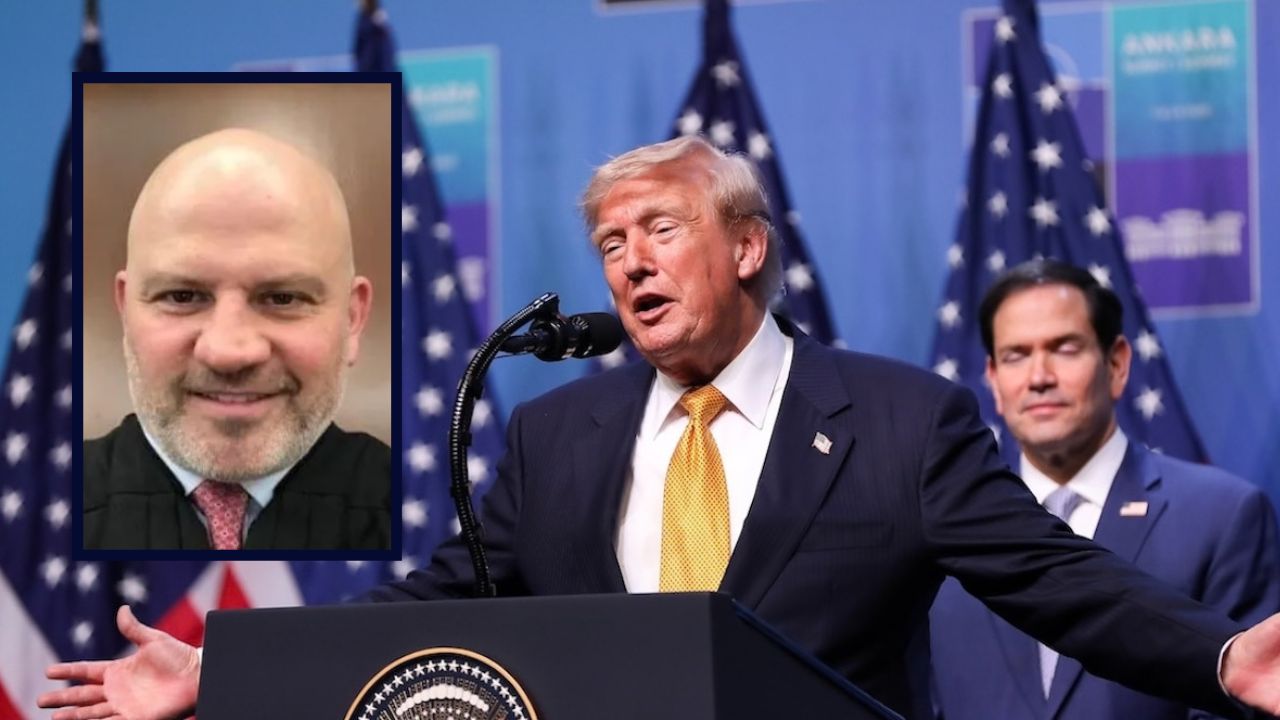
Main: President Donald Trump and Marco Rubio, United States Secretary of State, attend a press conference at the NATO Summit at the Presidential Complex in Ankara, Turkiye, on July 8, 2026 (Photo by Klaudia Radecka/NurPhoto via AP). Left inset: U.S. District Judge Timothy Kelly (Historical Society of the D.C. Circuit).
During a brisk hearing on Wednesday afternoon in Washington, D.C., a prominent First Amendment lawyer for CNN defended the network, MS NOW, and Politico by mocking the DOJ's use of "national security" as if those were "magic words" that meant President Donald Trump must get his way.
U.S. District Judge Timothy Kelly, a Trump appointee whom the president branded as "totally disloyal" on the eve of the hearing, ensured that the proceeding lasted under an hour and took place just two days after the media organizations filed their lawsuit on First Amendment and Fifth Amendment due process grounds.
At the start, Kelly acknowledged that CNN attorney Ted Boutrous appeared before him nearly eight years ago and persuaded him to restore then-CNN correspondent Jim Acosta's press pass.
Kelly commented that "it is fair to say that the processes that the [D.C. Circuit] court laid out in" the Acosta case and in the similar case of Playboy correspondent Brian Karem "wasn't followed here."
Boutrous argued that the latest "no notice, no process, and no warning" White House ban should fail, as the "viewpoint discrimination is probably the clearest case in history."
But he had particular scorn for the "post hoc" national security claims the DOJ raised in a court filing on Tuesday night.
The filing signed by DOJ attorney Michael Velchik stated that "[a]fter all, access to the White House is a privilege—not a right."
The DOJ said D.C. Circuit precedent in Sherrill v. Knight is "wrong and should be overruled," and that Trump has "'compelling interest[s]' in enforcing minimum standards for bona fide journalists and safeguarding national security information."
Boutrous said this was the latest example of the Trump administration using the phrase "national security" to turn the tables in litigation.
Shouting national security, he said, is meant to distract from the "clear" and unconstitutional "retaliation."
"The first mention of national security in this case came from President Trump after we announced Monday morning we were going to be filing this lawsuit, and suddenly I guess the light bulb went off, and they all decided to start talking about national security," Boutrous snapped.
"Here they're just saying national security. They're using national security as this Taoism, these magic words, and whatever happens, it's national security. But that doesn't work," he went on. "There's no specifics. There are no stories identified by the president himself that would justify this. He disclaimed that. So this is just a pretextual, post hoc effort to justify just a blatant violation of due process."
Looking ahead, the attorney said he was "very concerned" — and he repeatedly brought up Trump's attempted sudden firing of Lisa Cook from the Federal Reserve board.
"I'm very concerned that even if the court grants a TRO [temporary restraining order] on due process grounds, the shenanigans will continue. And I think of the Trump versus Cook decision from the Supreme Court about how judges — courts don't have to have naiveté that ordinary citizens wouldn't. We can kind of see where we're headed here," said Boutrous.
For the DOJ, Velchik repeated that "access to the White House is a privilege—not a right," asserting that the president "set out notice of his determination that he personally made" and "identified with particularity a non-exhaustive list of reporting incidents."
"It provided a process for plaintiffs to contest these particular incidents; they have until 5 p.m. Friday," he said.
On rebuttal, Boutrous said that's no process at all, and again referenced Cook v. Trump.
"Now they're saying, 'Well, Friday at 5 p.m. Maybe we'll get a fair shot.' I think we all know. Again, that's Cook versus Trump. None of us are that naive. If they're going to keep playing games or keep moving the ball, that's not due process," he added.
The hearing ended without a ruling, but Kelly said he'd "try to get you an answer as soon as I can."
Follow Law&Crime:

Comments