
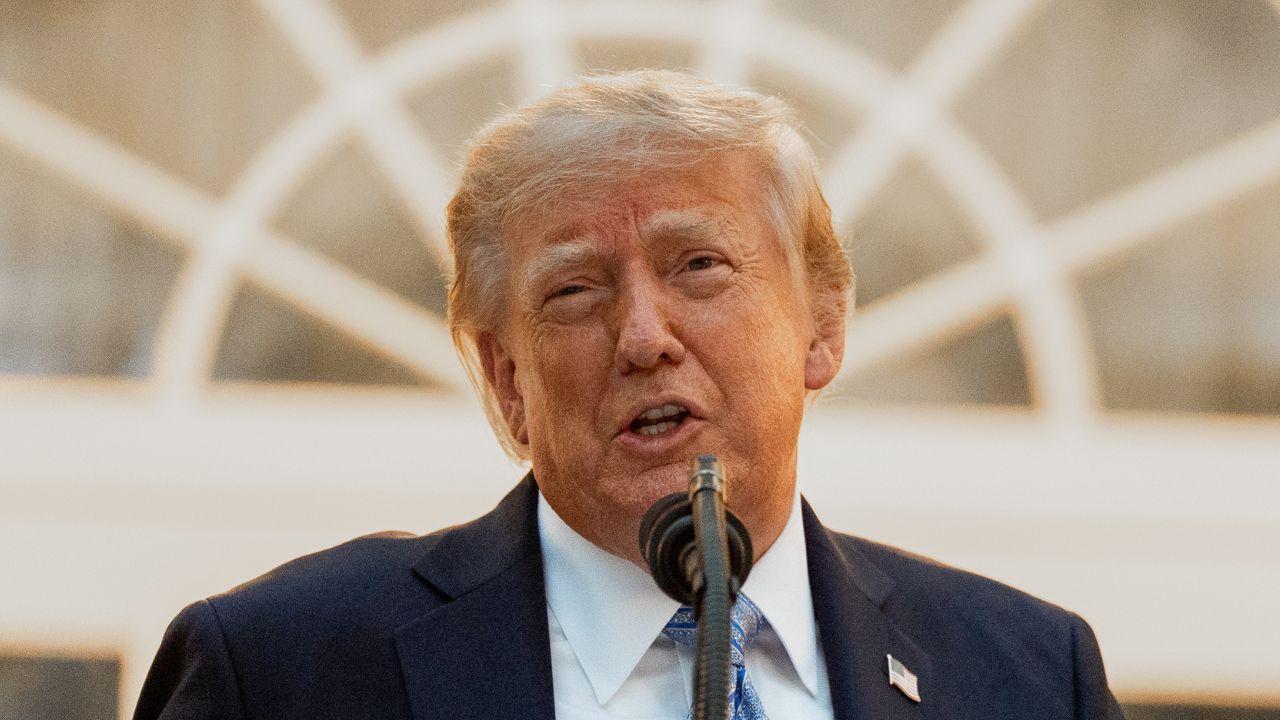
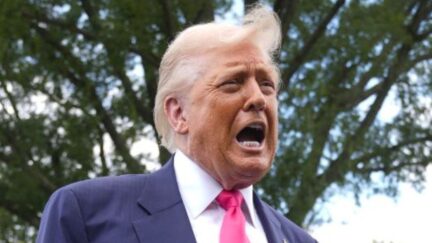
President Donald Trump speaks during a dinner in the Rose Garden of the White House, Thursday, Sept. 17, 2026, in Washington (AP Photo/Alex Brandon).
The Trump administration aims to unwind a nearly 50-year-old First Amendment precedent in its efforts to keep three media companies out of the White House, according to a Tuesday night court filing.
In the case brought by CNN, MS NOW and Politico, the media companies claim Trump's purported ban runs afoul of a line of cases that began in 1977 with the case of Sherrill v. Knight.
In that case, a reporter for The Nation was twice denied a White House press credential. After years of back and forth, the U.S. Court of Appeals for the District of Columbia Circuit set a new precedent by finding that the First Amendment "requires that this access not be denied arbitrarily or for less than compelling reasons."
"No official can deprive Plaintiffs of those interests on a whim — with no notice, no process, and no warning — as the President did here," the media companies argue in their 27-page Monday lawsuit.
Now, the U.S. Department of Justice expressly signaled its intent to have the D.C. Circuit revisit the line of cases that began with Sherrill.
"While Defendants acknowledge the D.C. Circuit's decision in Sherrill, that case was wrongly decided, and Defendants expressly reserve their right to argue so on appeal," the DOJ wrote in their overnight motion. "Access to the White House is a privilege, not a right."
The 19-page motion in opposition to the media companies' request for a temporary restraining order argues that a different "reality" is at play in the modern-day White House than existed in the 1970s.
"[T]here are more journalists who wish to interview the President than he can accommodate," the motion reads, arguing in favor of having the president choose his questioners based on their viewpoint.
The concept relied on by the DOJ is not novel. The motion cites a 2025 decision by the D.C. Circuit in an ongoing case in which The Associated Press is currently barred from the Oval Office, Air Force One, Mar-a-Lago and the Cabinet Room. In a stay of a lower court's order, U.S. Circuit Judge Neomi Rao, who was appointed by Trump, found certain places are not subject to the First Amendment at all — giving the president discretionary power over access to such places.
"The same logic and standard should apply to access to White House grounds more generally," the motion goes on. "Indeed, there are currently a finite number of hard passes, and yet the White House briefing room and West Wing facilities can accommodate only so many reporters."
The government's efforts to keep the media companies out also run into the modern U.S. Supreme Court forum doctrine. The Sherrill decision predated this doctrine, but the D.C. Circuit has, on multiple occasions, likened the older case's description of the White House credentialing system to the modern "nonpublic forum."
The U.S. Supreme Court's public forum doctrine centers on the notion that certain places — either physical or digital — have, by tradition or practice, been used for First Amendment purposes and should remain free of government interference. Under high court jurisprudence, there are four major types of forums: traditional or quintessential, designated, limited and nonpublic.
Under First Amendment jurisprudence, the government has broad authority to regulate speech in a nonpublic forum. Still, such regulations must remain reasonable and viewpoint-neutral.
Now, the DOJ wants to get rid of precedent that subjects the White House to any kind of First Amendment forum analysis whatsoever.
Notably, the government's argument here begins with the unsupported claim that the forum doctrine is actually contained in the Sherrill case — in a one-off citation that does not cite any language.
From the motion:
While the D.C. Circuit has held that some areas of the White House grounds constitute a nonpublic forum, Sherrill v. Knight, 569 F.2d 124 (D.C. Cir. 1977), that decision is wrong and should be overruled.
The heart of the anti-forum analysis dovetails with the broader argument in favor of presidential prerogative viewpoint discrimination.
The motion argues that opening the White House to some reporters should not "transform these spaces into nonpublic forums to which access must be granted on a viewpoint neutral basis," again citing Rao's words in the AP case.
To hear the government tell it, the upshot of that case is that the entirety of the White House should be immune to forum analysis.
"In short, there is no principled way of easily distinguishing between rooms that are a nonpublic forum and those that are no forum at all — particularly where the White House is not obligated to respond to any questions by reporters in the first place," the motion goes on.

Comments