
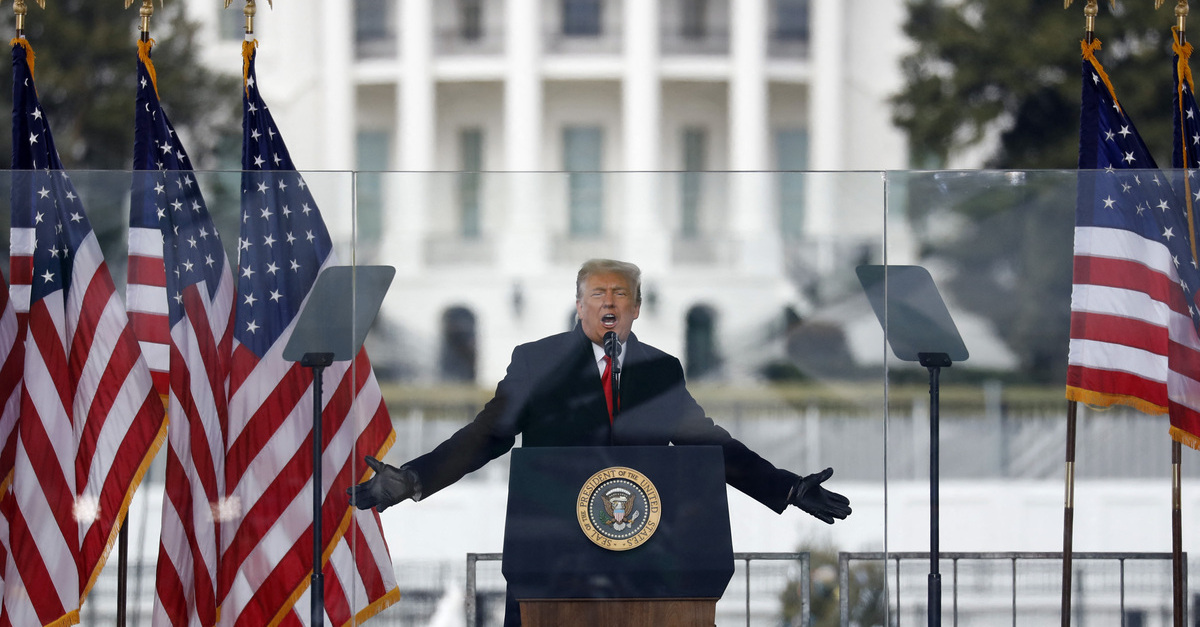
U.S. President Donald Trump speaks to his supporters at Save America Rally on the Ellipse near the White House in Washington on January 6, 2021 Photo by Yuri Gripas/Abaca/Sipa USA(Sipa via AP Images).
The BBC told a federal judge on Monday that Donald Trump cannot be allowed to embark on a fishing expedition before the UK's public service broadcaster tries to dismiss the president's defamation lawsuit over allegedly misleading edits in a Jan. 6 documentary that has nothing to do with Florida.
In a 21-page filing, the BBC insisted that Trump's suit over the Panorama documentary "Trump: A Second Chance" should be thrown out for a basic "threshold" failure: The defendants "did not create" the documentary "in Florida, produce [it] in Florida, or air [it] in Florida," meaning there is no jurisdiction for U.S. District Judge Roy K. Altman, a Trump appointee, to hear the case.
The BBC asked Altman to slam the brakes on "any merits-based" discovery in the case to instead allow limited discovery over jurisdiction to unfold.
In the defendants' view, the Jan. 6 documentary Trump is suing over has nothing to do with Florida, so he shouldn't be allowed to make "objectionable" discovery demands before he can show that he has filed the case in the appropriate place.
"The Complaint suggests that the Plaintiff will seek broad, objectionable discovery on the merits, implicating the BBC's entire scope of coverage of Donald J. Trump over the past decade or more and claiming injury to his entire business and political profiles," the filing said. "Especially given Plaintiff's framing of his claim, Defendants' jurisdictional arguments should be resolved before the parties undertake any merits-related discovery and engage in the likely discovery disputes that will ensue."
Evidently, Trump's legal team "rejected" this order of discovery operations, leading the BBC to move for a stay and to tip its hand as to its self-proclaimed "clearly meritorious" motion to dismiss that would "dispose of the entire case."
"As the Motion to Dismiss will show, exercising personal jurisdiction over Defendants would violate Florida law and constitutional due process protections," the filing previewed.
Citing the Supreme Court's landmark defamation precedent New York Times v. Sullivan, the BBC said Trump, a public figure and official, "fails to plausibly allege" actual malice.
While the president has claimed the documentary was edited to create a "false, defamatory, deceptive, disparaging, inflammatory, and malicious depiction" of his Jan. 6, 2021, speech from the Ellipse — amounting to a "brazen attempt to interfere in and influence" the 2024 election — the BBC counters that Trump can't show "any cognizable injury," even though it offered an apology.
At issue is an edit in the documentary that stitched together different parts of Trump's Jan. 6 speech that, by the BBC's own admission, "unintentionally created the impression that we were showing a single continuous section of the speech, rather than excerpts from different points in the speech, and that this gave the mistaken impression that President Trump had made a direct call for violent action."
Trump's complaint said the documentary "falsely depicted" Trump telling the crowd that would become a mob, "We're going to walk down to the Capitol and I'll be there with you. And we fight. We fight like hell and if you don't fight like hell, you're not going to have a country anymore."
"President Trump never uttered this sequence of words," the complaint said — and the BBC acknowledged.
Follow Law&Crime:


Comments