
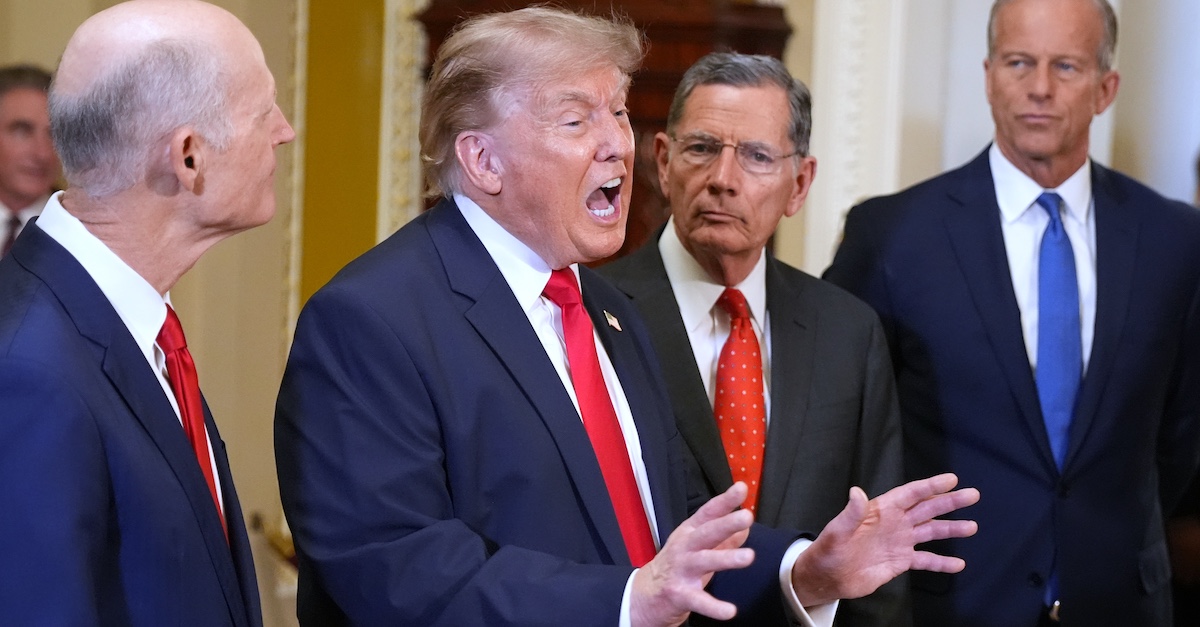
President Donald Trump speaks with reporters as Sen. Rick Scott, R-Fla., from left, Sen. John Barrasso, R-Wyo., and Senate Majority Leader John Thune, R-S.D., listen on Capitol Hill, Wednesday, June 24, 2026, in Washington (AP Photo/Jacquelyn Martin).
A federal judge heard Wednesday afternoon that the Trump administration and the American Bar Association "are at an impasse" on discovery, as the premier lawyers' organization seeks White House communications.
U.S. District Judge Amir Ali, a Joe Biden appointee, presided over a virtual discovery hearing. Before the proceedings began, a court employee read the last four digits of various phone numbers and asked individual callers to confirm their identities.
After lawyers introduced themselves, the judge himself confirmed he had called in, to some amusement. That's where the humor ended.
"It appears we are at an impasse," said ABA attorney Steve Seigel of the law firm Susman Godfrey.
In June 2025, the ABA sued the Executive Office of the President to block President Donald Trump's "unprecedented and uniquely dangerous" orders, a series of executive actions the plaintiff said were plainly meant to "coerce lawyers and law firms to abandon clients, causes, and policy positions the President does not like."
Some of those law firms capitulated despite widespread criticism, but at least four defended their contracts and their security clearances in court, persuading judges — including Ali — to issue injunctions across the board.
In May, the U.S. Court of Appeals for the District of Columbia Circuit heard oral arguments from the DOJ and attorneys for Jenner & Block, Perkins Coie, the late special counsel Robert Mueller's former law firm WilmerHale, and Susman Godfrey.
With the panel yet to issue a decision, the ABA and the government have continued their separate fight over discovery in the district court.
And Seigel insists the authority the government relies on to support its discovery resistance — Cheney v. U.S. District Court for the District of Columbia — is not the blanket shield it claims.
A June 4 scheduling order from Ali noted that the 2004 case — bearing the name of former Vice President Dick Cheney — governs the "resolution of any objections Defendants may have on the grounds that the executive branch should not be compelled to invoke the executive privilege, including the presidential communications privilege, in the face of 'overly broad discovery requests.'"
DOJ attorney James Wen said Wednesday that the parties are "on the same page" that further briefing is needed, but beyond that there is a fundamental disagreement on the "scope" of the Cheney case as it applies to the litigation. Discovery of White House communications with the DOJ is simply off-limits given the ABA's "overly broad" demands, especially when discovery from various agencies should be exhausted first, Wen argued.
Seigel countered that "there's no concern about requests that seek non-privileged information" and that "a good chunk" of the discovery requests seek communications involving third parties outside the White House. Cheney doesn't really apply to those communications at all, the ABA's lawyer said.
Looking ahead, the parties envisioned the ABA filing a comprehensive discovery-related brief on July 7, with a DOJ response to follow on July 17.
Ali advised the parties to focus on the Cheney "overbreadth question," stressing that specificity for each individual discovery request "would be most helpful."
"Given that Cheney is asserted across the board to all of the requests, as I understand it, I think it would be helpful for both parties to address every request," the judge said, hoping the requests might be narrowed and a compromise might be reached as the parties write their positions down.
That exercise is meant to "mitigate any Cheney issue as to each individual request," the judge said.
Follow Law&Crime:


Comments