
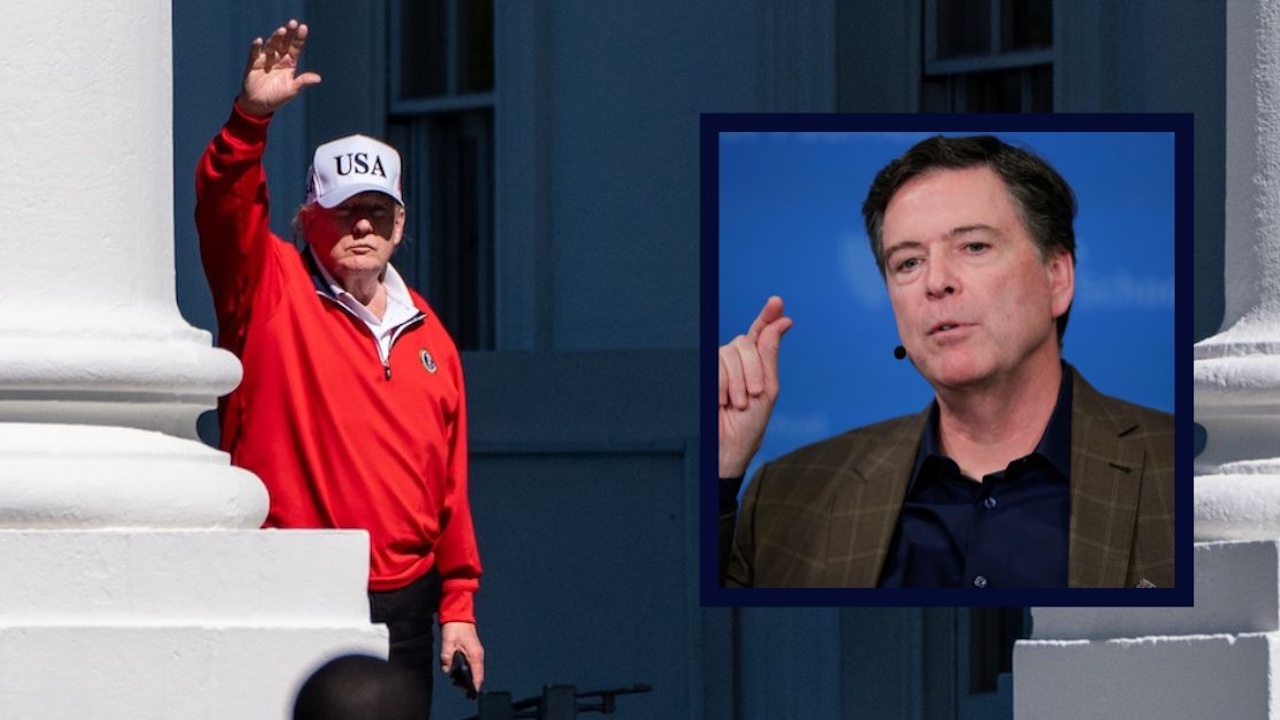
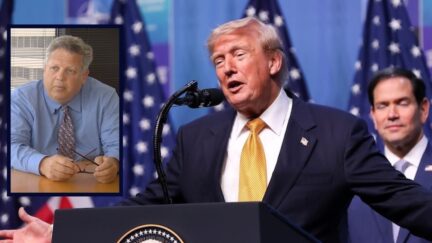
Main: President Donald Trump waves as he arrives at the White House, Sunday, May 31, 2026, in Washington (AP Photo/Alex Brandon). Right inset: Former Director of the Federal Bureau of Investigation James Comey speaks at Harvard University's Institute of Politics' JFK Jr. Forum in Cambridge, Mass., Feb. 24, 2020 (AP Photo/Charles Krupa, File).
James Comey's lawyers already implored a federal judge to permanently dismiss the ex-FBI director's "8647" seashells threat prosecution on the merits, but a new filing in North Carolina says President Donald Trump's "vindictive motive" is a separate reason the case has necessarily reached a "dead end."
In a 20-page reply memorandum on Tuesday, Comey followed Kilmar Abrego Garcia's road map, asking U.S. District Judge Louise Flanagan to find that a "presumption of vindictiveness" entitles him to an evidentiary hearing where the prosecution must rebut the presumption.
A federal judge in Tennessee dismissed the wrongfully deported Garcia's criminal human smuggling case in May, noting that the government did not rebut the defendant's "prima facie showing of some evidence of a realistic likelihood of vindictiveness."
The DOJ continues to appeal that decision to the 6th U.S. Circuit Court of Appeals, asserting the judge "erred" and opened the door to "dangerous[]" and "unwarranted probing of the mental states and motivations of government officials" — "inviting courts to usurp the prosecutorial discretion constitutionally committed to the Executive Branch." It is also appealing the dismissal last year of Comey's false statements indictment in Virginia.
In the meantime, Comey is using those dismissals to his advantage, arguing that President Trump's "voluminous record of public statements" and "personal animus" toward him "caused this vindictive prosecution" and should end it.
"[I]t is well established that a defendant may demonstrate that 'the prosecutor acted with genuine animus toward the defendant' by showing either that the prosecutor himself 'harbored genuine animus toward the defendant' or that the prosecutor 'was prevailed upon to bring the charges by another with animus such that the prosecutor could be considered a 'stalking horse,'" the filing said, before citing the dismissal of the Garcia case. "District courts have thus recently recognized that the animus of current DOJ officials can be imputed to federal prosecutors."
The defendant said that history is relevant to the court's consideration.
"This case expresses that animus: it arose after the President's prior attempt at retaliation collapsed when the district court for the Eastern District of Virginia dismissed an indictment because it was obtained by the President's personally selected and unlawfully appointed prosecutor," the filing said, referring to Lindsey Halligan.
Asserting that the prosecution is overreaching, Comey's team said it's no accident that the government relies on claims about his novel "FDR Drive," which "had not yet been published" at the time of his seashells Instagram post but which "was only five days from public release."
After all, former U.S. Attorney General Pam Bondi and eventual AG Todd Blanche reportedly found the evidence "weak," among other issues, the filing said.
"Shortly after the Secret Service opened the investigation—and undertook steps that its participants described as 'overkill' and 'legally questionable,'—the Secret Service categorized the case as 'non-referred," Comey said. "Moreover, according to unrebutted reporting, both Ms. Bondi and Mr. Blanche believed the resulting evidence and case against Mr. Comey were weak. That evidence supports the inference that the government placed this investigation on the back-burner while it pursued the Virginia prosecution, which Ms. Bondi believed was stronger."
"It was only after Mr. Comey prevailed in the Virginia case—and the President increased pressure on Mr. Blanche to 'audition' for the Attorney General role—that the government suddenly reinvigorated this investigation and indicted Mr. Comey," the filing said, asking the judge to order up discovery if she doesn't toss the case with prejudice.
In May, Blanche said the case is "not just about a single Instagram post" but "about a body of evidence that was collected over the series of about 11 months" and "presented to the grand jury."
Even if the vindictive prosecution motion fails, the government has to show that Comey's Instagram post of the "cool shell formation" he saw "on [his] beach walk" with his wife Patrice one year earlier actually was a "true threat" against a political rival.
So far, the government has not persuaded the courts that posting or displaying "86" necessarily amounts to a true threat.
Comey's legal team has said the administration's interpretation of "86" defies dictionary definitions, "context, precedent, and common sense," even submitting an affidavit from a former mob prosecutor to argue "there is literally no support for the central allegation on which the case rests."
Follow Law&Crime:

Comments