
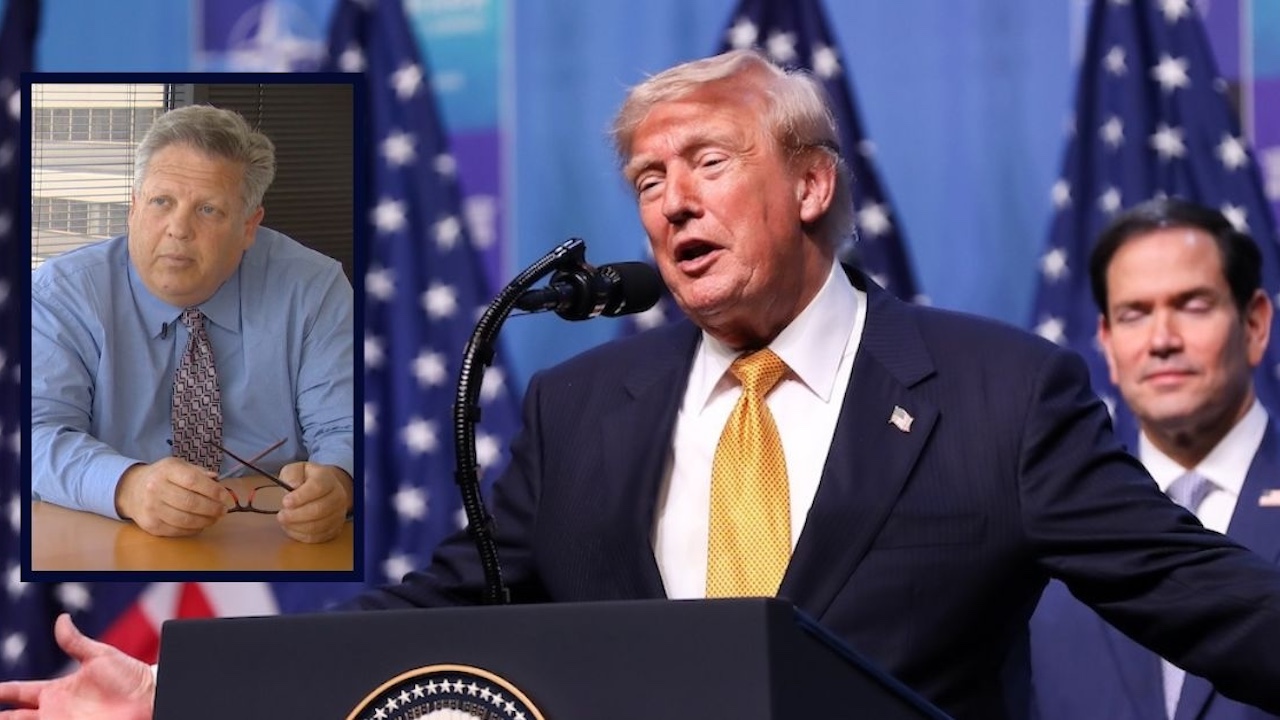
Left inset: Roger Rogoff sits for an interview about his firing on July 15, 2026 (KING). Main: Donald Trump, president of the United States, and Marco Rubio, United States Secretary of State, attend a press conference at the NATO Summit at the Presidential Complex in Ankara, Turkey, on July 8, 2026 (Photo by Klaudia Radecka/NurPhoto via AP).
For more than a year, courts around the country have repeatedly found the Trump DOJ's approach to installing interim or acting U.S. attorneys to be an unlawful circumvention of the U.S. Senate's advice and consent. On several occasions, courts wielded their own authority to appoint top prosecutors in times of vacancy, but those appointees were promptly fired. Now the long-unresolved dispute over President Donald Trump's authority to override the courts' 28 U.S.C. § 546(d) appointments has arrived.
In July, Trump fired court-appointed U.S. Attorney Roger Rogoff in the Western District of Washington less than an hour after the prosecutor was sworn in, following the same playbook as when courts saw fit to replace Alina Habba, John Sarcone and Lindsey Halligan. This time, however, the ousted prosecutor filed a lawsuit challenging his removal as unconstitutional.
On Thursday, a federal judge emphatically agreed, so much so that the DOJ responded with lightning speed, immediately filing a notice of appeal to the 9th U.S. Circuit Court of Appeals.
Chief U.S. District Judge Stanley Bastian, a Barack Obama appointee sitting in the Eastern District of Washington, interpreted 28 U.S.C. § 546(d) to mean that Rogoff can keep serving as U.S. attorney until the vacancy his appointment addressed is filled by a permanent, Senate-confirmed successor.
"[W]hile the President has the power to remove executive officer whom he has appointed, see Trump v. United States, it does not follow he has authority to remove executive officers that he has not appointed. Notably, while Defendants argue the President has constitutional removal powers, they have not provided any legal support or citation to prove their premise," Bastian said, ordering the Executive Office of the President and Attorney General Todd Blanche not to "obstruct" Rogoff from "his ability to carry out the duties of the U.S. Attorney for the Western District of Washington."
"Plaintiff is likely to succeed on the merits because section 546(d) precludes his firing by the President. This case starts and ends with the U. S. Constitution and the central principle of the separation of powers," Bastian added. "The President cannot unilaterally fire a U.S. Attorney appointed by the Court."
The judge named the "rightful holder" in unmistakable terms:
1. Roger Rogoff is the U.S. Attorney for the Western District of Washington and has been the rightful holder of that office since July 15, 2026.
2. Simon Peter Serrano is not the U.S. Attorney for the Western District of Washington because he has only been nominated but not confirmed by the Senate.
3. Charles Neil Floyd is not the U.S. Attorney in the Western District of Washington because the Court had already acted prior to the President's Order, and Mr. Floyd has not been either nominated or confirmed.
To allow Trump to fire the court-appointed Rogoff "would upend the framework created by the Constitution and the statutory framework, which together balances the President's right to appoint and the Senate's right to confirm," the jurist continued, issuing a preliminary injunction.
The DOJ's notice said "all defendants hereby appeal" to the 9th Circuit. As recently as August, the appellate court affirmed that then-Attorney General Pam Bondi did not lawfully appoint Sigal Chattah as acting U.S. attorney in Nevada.
The executive branch has already asked the U.S. Supreme Court to reverse multiple "incorrect" decisions, and the Rogoff case may ultimately end up in the same place.
Follow Law&Crime:



Comments