
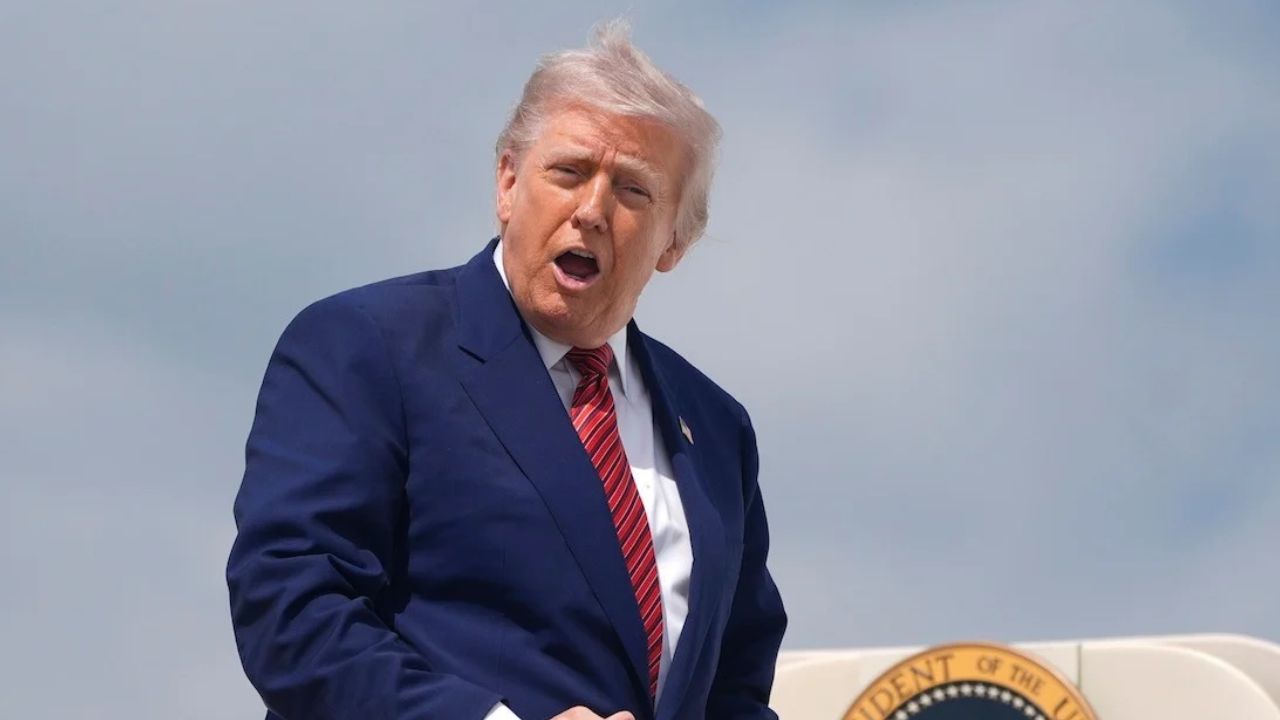
President Donald Trump boards Air Force One to depart Joint Base Andrews, Md., Friday, May 23, 2025 (AP Photo/Manuel Balce Ceneta).
A Marine combat veteran in Arizona who threatened to blow away President Donald Trump with an M16 rifle — saying he would do it with "rounds targeting the head, not the ear" — learned his fate this week.
Rene Ortiz, of Casa Grande, was sentenced on Tuesday to 38 months in federal prison after being convicted in June of threats against the president following a four-day trial in Phoenix. The U.S. Attorney's Office for the District of Arizona had recommended a sentence of at least 36 months, noting that Ortiz's "threats were serious" but also possibly the result of his "documented mental health challenges," according to court documents.
"The language he used to threaten to execute either candidate was frightening," federal prosecutors said in an Oct. 6 sentencing memo. "Defendant also suffered from specific mental health conditions that may have contributed to his behavior."
Ortiz was arrested in early 2025 for allegedly hurling assassination threats against Trump in November and December 2024, when he was the president-elect. Ortiz threatened Trump in documents left at federal courthouses in Phoenix and Tucson, first asking the courts to "execute the newly elected POTUS by firing an M-16A2 Service Rifle with a magazine of 6 rounds" before threatening to do it himself if his demands weren't met, according to a federal complaint.
"The execution shall commence 3 days upon notice to the Defendants to this action," Ortiz said, noting how the "6 rounds to be shot will be from 300 or 500 yards away from the target," per the complaint.
"ANY REFUSAL OF ANY RIGHT, MR. Ortiz will be entitled to shot THE INCOMING FRAUDULENT ELECTED POTUS FROM 300 OR 666 YARDS AWAY WITH 666 ROUNDS FOR AN M-16A2 SERVICE RIFLE AT THE INAGURATION," Ortiz threatened, adding that he had an "Expert Badge" in marksmanship.
Federal agents questioned Ortiz about the threats on Dec. 5, 2024, at the Secret Service Phoenix field office. During the interview, Ortiz admitted to making them.
"When asked if Ortiz plans to shoot [Trump], Ortiz responded, 'If my demands are not met,'" according to the complaint. "Ortiz explained his grievance is with the Department of Veterans Affairs. Ortiz explained while employed at the VA they promised to pay for his schooling if he quit working for them. Ortiz quit working at the VA and began school but has not been reimbursed for his education."
During his trial, Ortiz's family said he was upset after being fired from the Department of Veterans Affairs, according to the Tucson Sentinel. He began drafting lawsuits to challenge his termination and hand-delivered documents to the courthouses with help from family members, who drove him and said they had no idea what he was actually saying in the documents.
"Mountains and mountains of paperwork," Ortiz's oldest son, Ryun Ortiz, reportedly testified.
Ortiz's public defenders argued that he did not mean what he said about harming the president and insisted no danger was ever actually present, per court filings and testimony. They also claimed he suffers from schizoaffective disorder and borderline personality disorder. Ortiz's defense filed a motion on June 5 to declare a mistrial.
In it, Ortiz's lawyers claimed there is a "manifest necessity" for a mistrial because the court "limited defense counsel's questioning" of defense witness Deputy U.S. Marshal Vladimir St. Louis, according to the U.S. Attorney's response to the filing. St. Louis investigated similar threats to the U.S. Attorney's Office in central California that Ortiz allegedly made two months before his arrest for the Trump threats.
For the California threats, U.S. Marshals decided not to arrest Ortiz because they believed he likely suffered from mental health issues. The judge overseeing his Trump threats case, however, refused to let St. Louis be questioned about the decision after federal prosecutors argued that it would "elicit irrelevant hearsay," according to court filings.
"The questions were improper and testimony inadmissible," prosecutors said in a June 8 response to Ortiz's motion to declare a mistrial, which was filed on June 5. "There is no reason, much less a manifest necessity, to declare a mistrial here and now."
The U.S. Attorney's Office described Ortiz's Arizona threats as "specific and violent in nature" in the Oct. 6 sentencing memo.
"The threatening language included detailed descriptions of what he intended to do (execute the winner of the election with an M-16 service rifle) and when and where he planned to do it (at the January 20 presidential inauguration)," prosecutors said. "He also specifically referenced his prior weapons expertise so that readers would take his threat seriously. The result of these repeated threats included a significant expenditure of government resources to investigate and protect the president and former vice president from acts of violence. And although defendant may have wanted to draw attention to his other grievances, his motive does not justify his conduct."
Prosecutors added that while Ortiz's mental health issues "cut both ways in determining an appropriate sentence," his issues have remained uncontrolled and he has engaged in criminal conduct despite receiving treatment.
"Even today, defendant does not appear to have expressed any remorse for his conduct, and declined to participate in a presentence interview," prosecutors noted.




Comments