
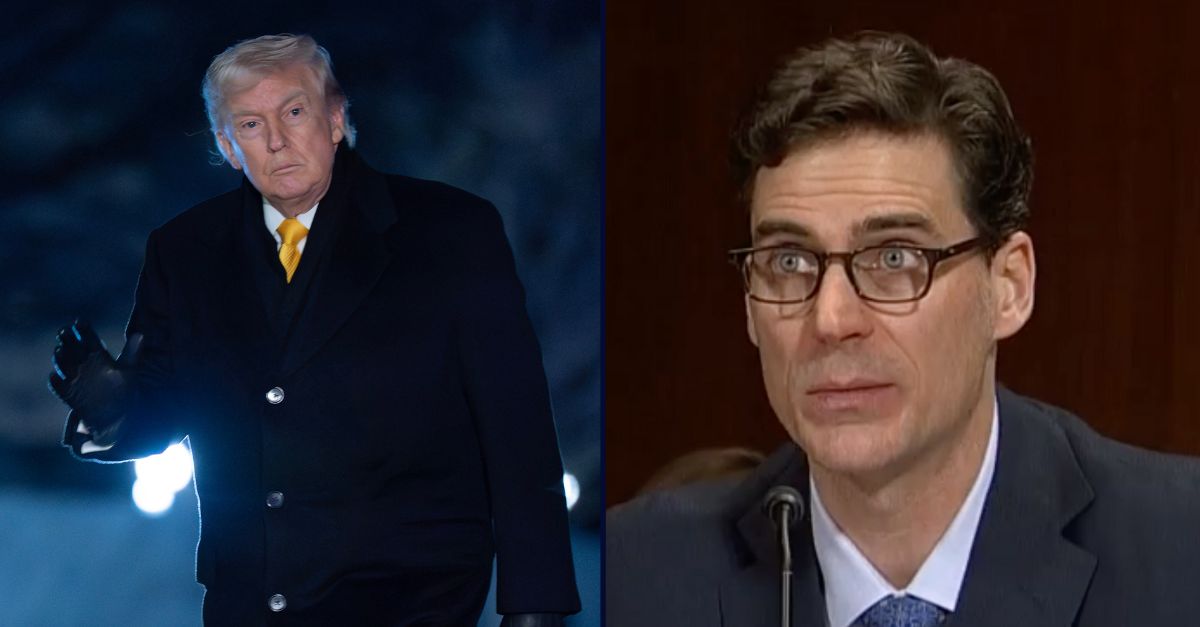
Left: President Donald Trump waves to the media as he walks on the South Lawn upon his arrival to the White House, Monday, Feb. 9, 2026, in Washington (AP Photo/Jose Luis Magana). Right: U.S. District Judge J.P. Boulee pictured during a Senate Judiciary Committee hearing on Nov. 13, 2018 (CSPAN).
Fulton County told a federal judge that the DOJ "became impatient" with a civil lawsuit and wanted to "improperly leapfrog" discovery, so it sought a search warrant based on potential violations it "cannot prosecute" to further investigate Georgia's handling of the 2020 election.
On Saturday, U.S. District Judge J.P. Boulee, a Donald Trump appointee, ordered the docket's unsealing and told the DOJ to file its search warrant affidavit by Tuesday as he considers Fulton County's motion for the return of 2020 election ballots, ballot images, tabulators, and voter rolls.
The unsealing also revealed Fulton County Attorney Y. Soo Jo's Thursday arguments on behalf of Fulton County Board of Commissioners Chairman Robb Pitts that the affidavit underlying the warrant signed by a judge failed to establish probable cause to seize "approximately 656 boxes containing the original versions of 2020 election-related materials from the Fulton County Clerk of Superior Court."
The warrant was signed by U.S. Magistrate Judge Catherine Salinas on the afternoon of Jan. 28.
When Pitts publicly reacted to the FBI's raid of Fulton County Elections Hub, he said that DNI Tulsi Gabbard's unusual presence on scene suggested "something sinister" is "going on," and that Trump was using the county as a testing ground for his push to "nationalize" elections.
Pitts' memo supporting the return of the election materials referenced Gabbard and accused her of participating in a "callous" trampling of the First Amendment and intimidation operation.
"The Warrant was executed in a manner seemingly designed to intimidate; both the Director of National Intelligence, Tulsi Gabbard, and the FBI Deputy Director, Andrew Bailey, were on site for the search," the filing said. "The records seized included personal voter data and documents that could identify who voted for which candidate. Respondent's seizure, resulting in the federal government being in possession of sensitive voter data, was in callous disregard of such First Amendment considerations."
The memo, pointing out that the DOJ had been actively suing Fulton County Clerk of Courts Ché Alexander for 2020 election records, surmised that the Trump administration "became impatient" with having to go through the civil discovery process and decided to "improperly leapfrog" those limitations.
Just last Friday, the DOJ asked another judge to halt the lawsuit "until criminal proceedings have been resolved," as the records DOJ sought were already seized.
Fulton County said the "timing" of the search warrant and the move to "circumvent" discovery "reveal" an "abuse of the criminal process."
"Although parallel civil litigation does not automatically invalidate a search warrant seeking overlapping evidence, in the circumstances of this case, using the criminal process to improperly leapfrog and moot active civil litigation is an end-run around judicial supervision that reflects callous disregard for the procedural safeguards against unlawful search and seizure," the filing said.
The county added that it is "appropriate" for the Trump administration to hand over the affidavit because it "appears" the search is "based upon claims that have been repeatedly investigated and rejected as baseless" and "unfounded" regarding systemic, election-altering voter fraud in 2020.
Meanwhile, the DOJ "callously disregards the Fourth Amendment" because it "cannot prosecute" the records-related "violations" it "cited as the basis of the Warrant," as too much time has passed, the filing stated.
"Respondent based its Warrant on a potential violation of a records retention statute, 52 U.S.C. § 20701, and on a criminal penalties provision for voter intimidation and voter fraud, 52 U.S.C. § 20511. Section 20701 requires retention of records for 22 months. Section 20511 is subject to a five-year statute of limitations. Petitioners are well beyond both the retention period and the limitations period for the cited statutes. Thus, there is no basis for prosecutions under these statutes for claims related to 2020 election records."
Fulton County's legal team said that as a result it was "difficult to imagine how the affidavit supports probable cause[.]"
"Given the lengthy history of widely debunked voter fraud theories, there is little reason to have confidence that the affidavit establishes probable cause," the memo concluded. "Respondent's own investigative history and the public record negate the very fraud theories on which probable cause appears to rest."
Follow Law&Crime:







Comments