
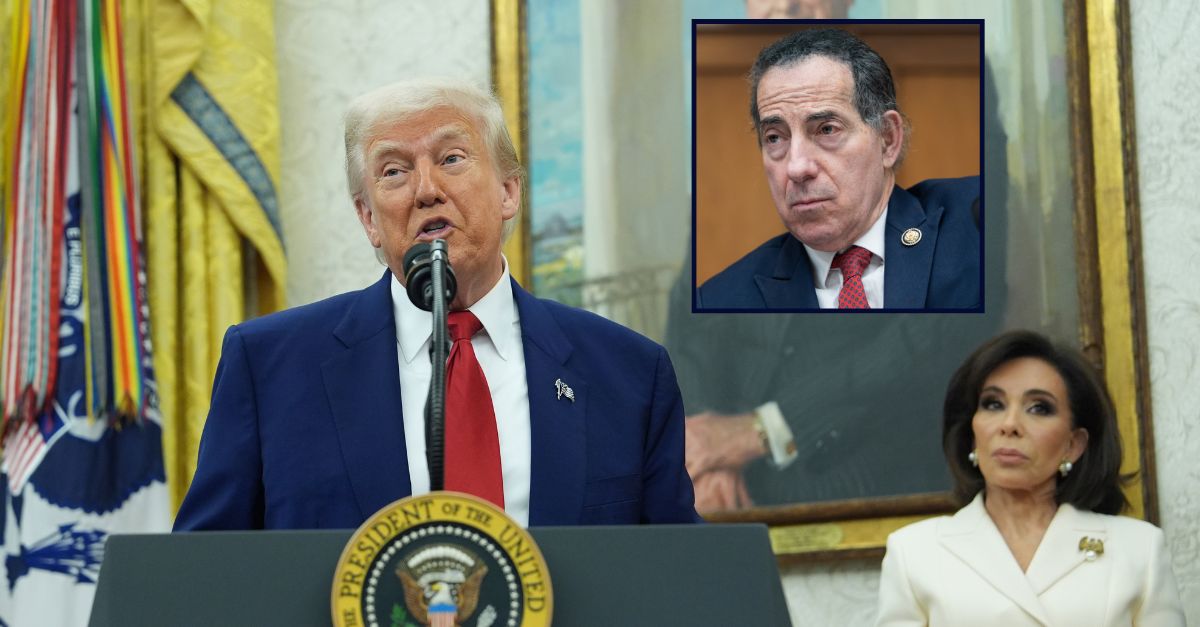
Inset: United States Representative Jamie Raskin (Democrat of Maryland) during a House Judiciary Committee hearing in Washington, D.C., on Thursday, May 14, 2026 (Sipa via AP Images). Background: President Donald Trump speaks during a swearing-in ceremony for interim U.S. Attorney General for the District of Columbia Jeanine Pirro, right, in the Oval Office of the White House, Wednesday, May 28, 2025, in Washington (AP Photo/Evan Vucci).
A federal court of appeals has allowed one voice of dissent to weigh in as the Trump administration seeks to have the seditious conspiracy convictions of several Proud Boys and Oath Keepers dismissed.
In a two-page order on Thursday, a three-judge panel from the U.S. Court of Appeals for the D.C. Circuit granted Rep. Jamie Raskin, a Maryland Democrat, amicus curiae status, known as a friend of the court.
The Old Line State Democrat famously served as the manager of the second effort to impeach Donald Trump during his first term in office – over the then-president's role in the riot that sought to preserve his status in the White House after he lost the 2020 election to Joe Biden.
The terse order directed the court to file Raskin's previously submitted amicus brief, which opposes the government's forthcoming efforts to have the underlying indictments dismissed.
In one fell swoop, the panel also vacated the judgments issued by district courts in numerous consolidated cases, with instructions on remand to consider all arguments.
The cases against Proud Boys members Ethan Nordean, Dominic Pezzola, Joe Biggs, and Zachary Rehl, as well as numerous members of the Oath Keepers, took up the better part of several years as the Department of Justice aggressively prosecuted organizers of the Jan. 6 attack on the U.S. Capitol.
Even President Trump's blanket pardons upon taking office for the second time did not reach the group's leaders.
But in April, the DOJ moved to vacate their convictions.
"The government's motion to vacate in this case is consistent with its practice of moving the Supreme Court to vacate convictions in cases where the government has decided in its prosecutorial discretion that dismissal of a criminal case is in the interests of justice — motions that the Supreme Court routinely grants," prosecutors wrote in a filing signed by U.S. Attorney for Washington, D.C., Jeanine Pirro.
In procedural terms, because the government filed the motions to vacate in each of the 12 total cases, the motions were "unopposed."
By allowing Raskin to act as an amicus in opposition to the dismissal requests, the congressman will make arguments typically supplied by prosecutors as the DOJ effectively plays the role of defense attorneys.
So, the D.C. Circuit will allow the process to play out at the district court level while seemingly insisting that there is at least some argument. And Raskin's brief certainly offers as much.
The congressman refers to the defendants as "leaders of two extremist groups" who were convicted by "unanimous juries" of "serious crimes" after trials that lasted for months in some cases.
"They amassed weapons, established paramilitary chains of command, recruited and marshaled their insurrectionist followers, and personally led the breaches of the Capitol that resulted in 140 law enforcement officers being beaten, crushed, sprayed with chemical agents, wounded, and hospitalized," the brief recalls. "Even this President, who pardoned nearly 1,600 other January 6 defendants upon taking office, declined to pardon these defendants."
To hear Raskin tell it, the principles of prosecutorial discretion do not apply when a defendant has been convicted after a jury trial. Rather, he says, discretion is only used when the prosecution is pending.
The congressman noted that prosecutors sometimes get things wrong and have, on occasion, been willing to admit their errors to help a defendant obtain post-conviction relief through the court system. Raskin says that is not the lay of the land here.
"[H]ere, the Government's motions concede no error at all," the amicus brief goes on. "They identify no legal or factual defects in the verdicts, no intervening changes in law, and no new evidence; they instead rest solely on a threadbare invocation of prosecutorial discretion. If [precedent] requires courts to examine a substantive confession of error, it certainly requires them to examine the type of completely barren request the Government makes here."
In other words, Raskin is asking the district courts to ignore the arguments for the underlying dismissal requests and instead turn the proceedings into an interrogation of the DOJ's requests. The congressman makes clear he believes the DOJ's motivations are suspect.
Again, the amicus brief, at length:
The circumstances of the Government's motions here make them seriously suspect of pretext. By erasing the convictions for precisely the defendants that the President carved out of his day-one mass pardon, the Government's motions, if granted, would achieve a political result the President wants but lacks the will to effectuate himself through clemency. The Department's political leadership has been unusually candid about the undeniable political motivation at work: a Department spokesperson described the motions as "end[ing] these years-long, Biden-era weaponized prosecutions" and confirmed that "President Trump demanded we stop the two-tiered injustice—and we are delivering. No more rigged system."
"Those are flagrantly political and partisan motivations, and an amicus is needed to assess the motions' legal merits," Raskin continues.
As a secondary argument, the congressman recounted the crimes committed to extol the virtues and sanctity of the underlying criminal convictions – and the processes that generated them.
"The verdicts under attack here vindicated the most solemn public interest a constitutional republic has: its interest in punishing organized violence against its own democratic processes and institutions," the brief goes on. "This Court should not allow these convictions to be vacated and erased."



Comments