
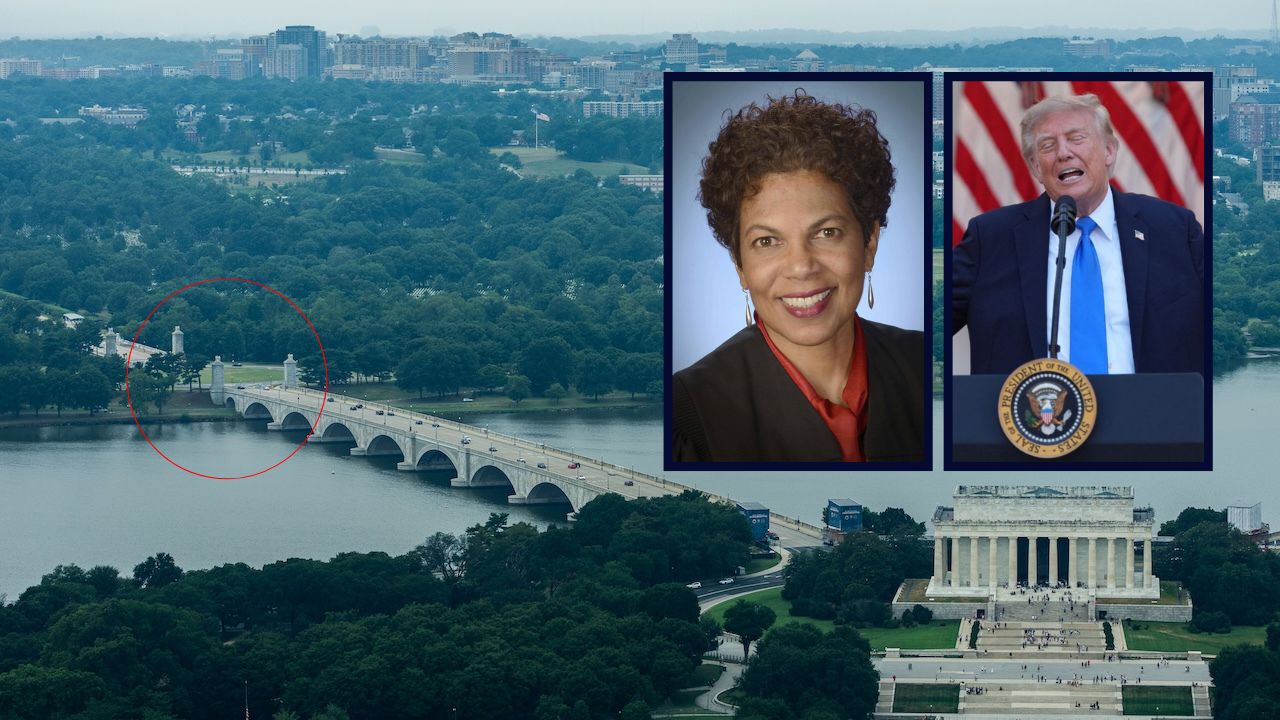
Main: Memorial Circle, where President Donald Trump has proposed building an arch to commemorate the United States' 250th anniversary, the Arlington Memorial Bridge and the Lincoln Memorial are seen from the Washington Monument, Thursday, July 9, 2026, in Washington (AP Photo/Julia Demaree Nikhinson). Left inset: U.S. District Judge Tanya Chutkan (U.S. District Court for the District of Columbia). Right inset: President Donald Trump speaks during an event with Republican lawmakers in the Rose Garden of the White House, Wednesday, Sept. 2, 2026, in Washington (AP Photo/Alex Brandon).
Vietnam War veterans asked a federal judge in Washington, D.C., to keep her "48 hours' notice" requirement in place so the administration can't simply press forward with construction of President Donald Trump's "Great Triumphal Arch" at Memorial Circle.
U.S. District Judge Tanya Chutkan, a Barack Obama appointee who presided over special counsel Jack Smith's since-tossed Jan. 6 prosecution of then-candidate Trump, issued the order a week and a half ago, as architectural historian and military veteran plaintiffs worried that the executive branch would steamroll their case, in a potential replay of the president's ballroom saga.
Veterans Michael Lemmon, Shaun Byrnes, Jon Gundersen, and architectural historian Calder Loth sought a temporary restraining order (TRO) and pointed Chutkan to Interior Secretary Doug Burgum's own words from a Sept. 3 post that the administration is "preparing to start over the next two-week period" — and absent congressional authorization — "the excavation work necessary for the Great Triumphal Arch and Military Observation Deck, at Memorial Circle on Columbia Island between the Lincoln Memorial and Arlington National Cemetery."
The plaintiffs, who "regularly visit the area to admire the reciprocal views between the cemetery and the Lincoln Memorial," said that the arch "will inflict profound harm […] by interfering with a symbolic landscape that holds great personal meaning" — "destroy[ing]" an "unobstructed view" of a sight line "designed to represent the unification of the Nation following the Civil War[.]"
The day after Burgum's post, Chutkan said she considered the motion for a TRO and decided to order the government to provide two days' notice before breaking ground.
"Defendants shall provide the court with 48 hours' notice," the judge's minute order detailed, "before engaging in any activity on Memorial Circle other than on-site information gathering 'regarding any archaeological resources that may be present at the site, below the level of the fill materials that make up the present-day surface of Columbia Island, necessary to comply with the National Historic Preservation Act and other applicable statutes.'"
"Defendants are reminded that any construction or demolition in preparation for construction before the National Park Service issues final agency action authorizing construction or without 14 days' notice would be a violation of this Order and the previous Consent Order," Chutkan added.
In the week that followed, however, the DOJ filed a motion for the judge to either "dissolve" her order or "clarify" it, claiming it has "already interfered with public safety and park maintenance."
"The Court should dissolve its unlawful and unwarranted 48-hour hold on routine agency actions that cause no harm to Plaintiffs and in the meanwhile disturbs the Executive Branch's prerogatives to maintain property under its jurisdiction and control," the government said.
On Friday, the plaintiffs fired back, urging the judge not to let the DOJ "avoid the consequences" of Burgum's "announcements," noting that the difference between this case and the ballroom case is that construction of the arch "has not yet begun[.]"
"Contending that the exigent situation that prompted this Court's intervention was manufactured by Plaintiffs, Defendants ask this Court to dissolve the order's 48-hour notice requirement or to 'clarify' it in a way that would leave it without force," the plaintiffs stated. "Defendants' arguments are meritless, and this Court should deny their motion."
Follow Law&Crime:






Comments