
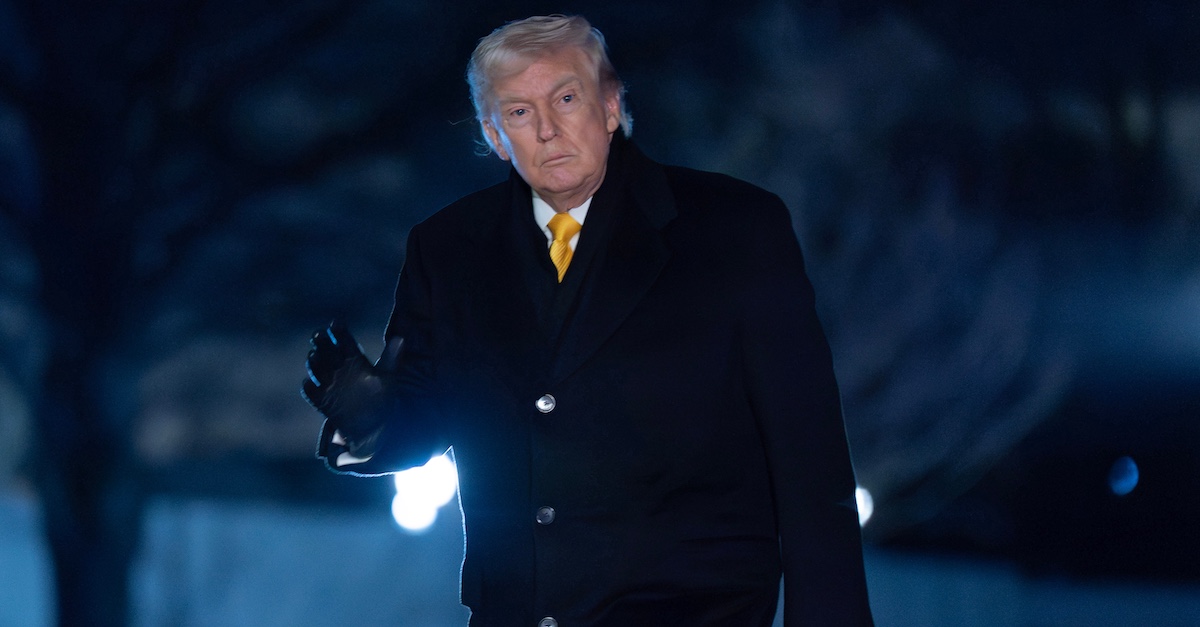
President Donald Trump waves to the media as he walks on the South Lawn upon his arrival to the White House, Monday, Feb. 9, 2026, in Washington. (AP Photo/Jose Luis Magana)
A federal judge in Texas has ordered the Trump administration to release a college student born in Mexico in a "public place" by the first day of next month – and not to detain him again unless the government can show he is dangerous or a flight risk during a hearing.
The 18-page order comes amid a recent deluge of rulings blocking controversial efforts to reshape how Immigration and Customs Enforcement (ICE) classifies immigrants in order to detain them.
In the case, the petitioner, Jose Alberto Gomez-Gonzalez, won habeas corpus relief by convincing Senior U.S. District Judge David Alan Ezra, a Ronald Reagan appointee, that his "detention is unlawful" due to violations of "his right to procedural due process under the Fifth Amendment of the United States Constitution."
Gomez-Gonzalez and his family "entered the country legally" when he was 12 years old, the judge explains. He is currently 24 years old and, prior to being detained, was enrolled at Texas State University in San Marcos – a medium-sized city in the broader Austin metro area.
The petitioner and his family first legally entered using border crossing cards, were detained anyway, asked for asylum, and then were subsequently granted humanitarian parole and placed into removal proceedings, the order notes. Then, in 2015, an immigration judge administratively closed the family's deportation case.
Over the intervening years, Gomez-Gonzalez went to and graduated from high school, the order says. He was set to graduate from Texas State in December 2025 and had a job in government waiting.
Then came the Trump administration's new directive.
"On August 14, 2025, nearly ten years after his removal proceedings were administratively closed and over ten years after his parole expired without action by the government, Petitioner was re-detained by Immigration and Customs Enforcement officers without notice or warning," the order reads.
The judge goes on to describe how a seemingly innocuous traffic stop in Concho County quickly became an immigration case:
That day, Petitioner had been driving to visit his parents before the college semester started when he was pulled over by law enforcement for driving a couple miles over the speed limit. Although Petitioner provided the officer with a valid Texas Driver's License and insurance, the officer inquired into Petitioner's immigration status. When Petitioner told the officer that he was not a U.S. Citizen but was lawfully present in the country, the officer contacted ICE, detained Petitioner, and transported him to the county line, where an ICE agent was waiting.
"Since Petitioner's detention began on August 14, 2025, he has been held without the opportunity for a bond hearing," the order goes on. "Due to his continued detention, he has been unable to graduate college, was forced to breach the lease on his apartment, has lost job opportunities, has lost his liberty, and has lost money."
On Jan. 30, attorneys for Gomez-Gonzalez filed his petition for the writ of habeas corpus, alleging constitutional violations as well as violations of the Immigration and Nationality Act (INA) and Administrative Procedure Act (APA).
The case was originally assigned to U.S. District Judge Orlando L. Garcia. On Feb. 2, Garcia ordered the government to "show cause within five days of service as to why the petition should not be granted."
Later that same day, the case was reassigned to Ezra.
Despite the raft of claims leveled against the government, the court decided the case solely on the merits of the Fifth Amendment claim.
This analysis diverts from a recent series of similar cases in which detained immigrants have won habeas corpus relief by challenging the Trump administration's novel interpretation of the INA.
Over the past eight months, in hundreds of district court disputes, judges have considered the interplay and applicability of two distinct INA statutes that outline the government's detention authority. Many judges have rephrased those statutes using language from a 2018 U.S. Supreme Court ruling penned by Justice Samuel Alito.
In short, the government claims ICE has the authority to subject immigrants to mandatory detention under 8 U.S.C. §1225(b), which applies to "aliens seeking entry into the United States."
Conversely, advocates for immigrants — as well as most judges who have ruled on the matter — have instead turned to 8 U.S.C. §1226(a), which applies to "aliens already present in the United States."
Here, however, the court quickly took note of the government's use of §1225(b) and found its argument "inapposite."
The judge also manages to elide a recent decision by the U.S. Court of Appeals for the 5th Circuit, which ruled "the government's position is correct" when it comes to deciding which INA statute ICE can use — vindicating the Trump administration's plans for indefinite detention under §1225(b).
To hear Ezra tell it, the government's argument – as well as the 5th Circuit's prior ruling – only has to do with the statue on its face.
Meanwhile, Gomez-Gonzalez is challenging "the constitutionality of the mandatory detention statute" as applied to him in terms of the Fifth Amendment's due process guarantee. This, the judge says, is a different issue entirely.
"While it is true as a matter of statutory construction that §1225 permits mandatory detention, the question remains as to what process is due to people detained under that statute," the judge muses. "It is for the courts to decide whether the constitutional protections afforded pursuant to a given statute are adequate. The mere existence of some protections under a statute does not relieve the Court of its responsibility to ensure that those protections are indeed constitutionally sufficient."
In other words, while most judges have rejected the indefinite detention policy out of hand under the INA – by saying the government is reading the statute incorrectly – Ezra says the INA allows for some kind of detention but offers a workaround.
That is, judges can free detainees in any event if courts determine constitutional rights have been violated, according to the order.
And, in the present case, the court found the government had, in fact, violated the petitioner's rights by keeping him "in custody for nearly six months, without the possibility of release on bond."
"Here, there is a high risk of erroneous deprivation of Petitioner's liberty since he is being detained without the opportunity for an individualized bond hearing, depriving him of the ability to contest the reasonableness of his detention," the order goes on. "Petitioner's detention without an opportunity to challenge his detention through an individualized assessment violates his right to procedural due process under the Fifth Amendment."
The judge, in a voluble aside, also takes the government to task for its anti-immigrant rhetoric in a footnote, at length:
The Administration, in widely publicized statements, has said its enforcement efforts target violent criminals and the "worst of the worst." Clearly, the Petitioner in this case, who entered the country as a child, has no known criminal history, and who is simply trying to finish his college degree is not the violent criminal or danger to the community to which the Administration refers.
In an earlier footnote, Ezra also suggests the original traffic stop was less than aboveboard – crediting an allegation made by the petitioner about pretext – and notes the government does "not contest" this claim.





Comments