
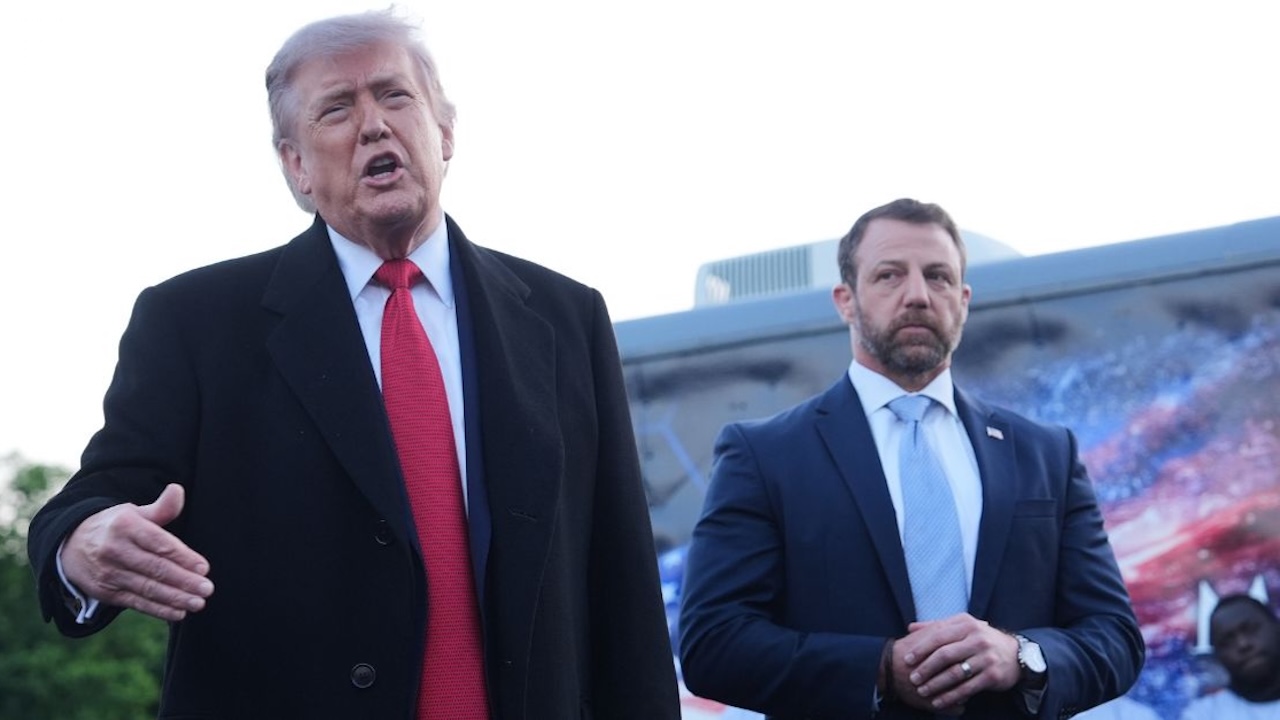
President Donald Trump speaks as he visits the Lincoln Memorial Reflecting Pool to see the new blue protective coating being applied as part of a renovation project, Thursday, May 7, 2026, in Washington, as Homeland Security Secretary Markwayne Mullin listens (AP Photo/Mark Schiefelbein).
It took about half a year, but a federal lawsuit brought by a prominent podcaster has revealed that the legal "determination" purportedly empowering agents in certain circumstances to enter homes without a warrant signed by a federal judge stems from an ICE lawyer's email.
Allison Gill is a U.S. Navy veteran who was fired from her U.S. Department of Veterans Affairs job during President Donald Trump's first term after she was identified as the "staunch advocate for the resistance" behind the "Mueller, She Wrote" social media account and podcast.
Gill's company, MSW Media, is currently the plaintiff in a Freedom of Information Act (FOIA) lawsuit against the Department of Homeland Security, a case that aims to smoke out the "legal justification" underpinning then-Acting ICE Director Todd Lyons' "secretive memo," which the Associated Press and whistleblowers exposed in January.
In that memo, Lyons stated DHS "has not historically relied on administrative warrants alone to arrest aliens subject to final orders of removal in their place of residence," but that the DHS Office of General Counsel "recently determined that the U.S. Constitution, the Immigration and Nationality Act, and the immigration regulations do not prohibit relying on" I-205 administrative warrants "for this purpose."
Earlier this week, the government revealed that ICE Deputy Principal Legal Advisor Adam Loiacono on Feb. 25, 2025, sent an "Administrative Warrants Analysis" to acting DHS general counsel Joseph Mazzara.
DHS' letter to plaintiff's attorney Kel McClanahan, however, revealed nothing at all of Loiacono's "privileged" advice on Monday, as Gill first reported on her website.
Instead, all the email shows is "Good evening, Joseph-" and "Of course, we welcome any feedback or additional direction. And, we are available to discuss at your convenience."
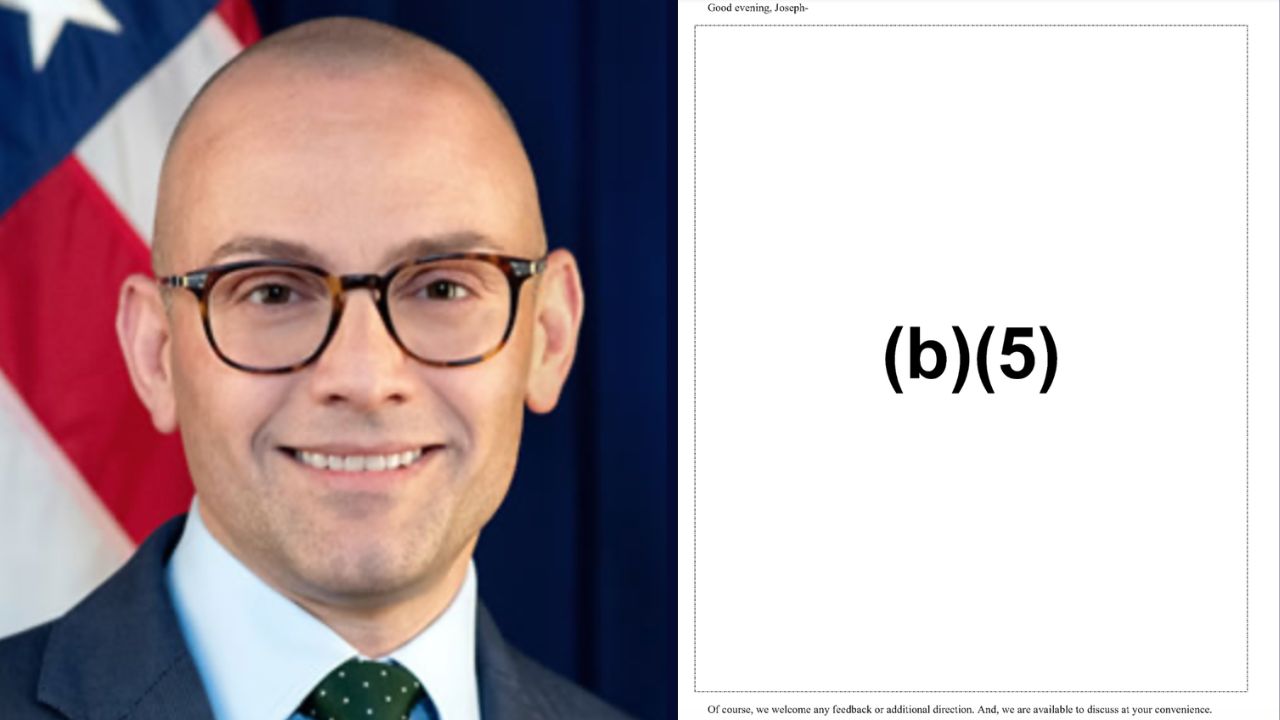
Left: ICE Deputy Principal Legal Advisor Adam Loiacono (ICE photo). Right: Loiacono's redacted emailed legal analysis on administrative warrants (DHS docs).
The (b)(5) displayed in the email where Loiacono's advice would be is the FOIA exemption the government cites to avoid disclosure of "inter- or intra-agency documents that are normally privileged in the civil discovery context" due to the "deliberative process privilege, the attorney work-product privilege, and the attorney-client privilege."
That means that Gill's lawsuit must continue if it is to unearth the inner workings of Trump's mass deportation campaign.
Gill told Law&Crime that the government can't hide behind the asserted "privilege" to "redact the entirety of its legal 'determination.'"
That ship sailed as soon as Loiacono's advice was "adopted as working law," she said.
"Agencies aren't allowed to keep secret legal opinions they expressly adopt, so we'll be looking at all our legal options to continue fighting for the release of this email," Gill said. "The Fourth Amendment guarantees '[t]he right of the people to be secure in their persons, houses, papers, and effects, against unreasonable searches and seizures,' and the public deserves to know what legal justification the agency is using to circumvent these constitutional protections."
Follow Law&Crime:



Comments