

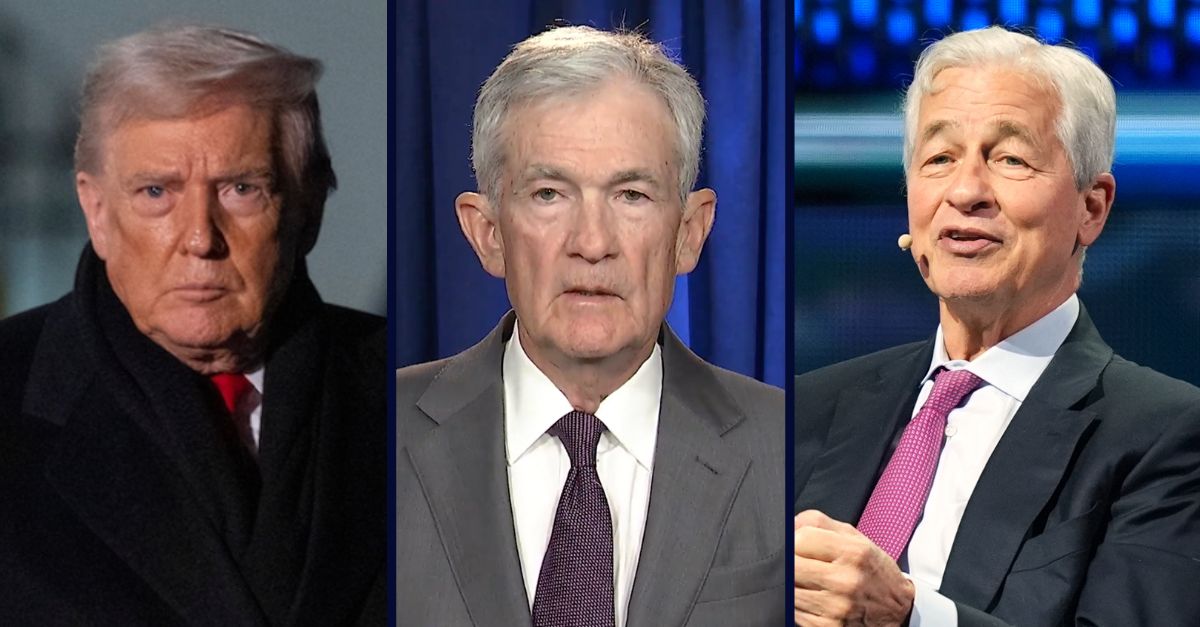
Left: President Donald Trump speaks with reporters before departing on Marine One from the South Lawn of the White House, Tuesday, Jan. 20, 2026, in Washington (AP Photo/Alex Brandon). Center: Federal Reserve Chairman Jerome Powell addresses the nation on DOJ grand jury subpoenas on Jan. 11, 2026 (Federal Reserve/X). Right: Jamie Dimon, CEO of JPMorgan Chase, speaks at the America Business Forum, Thursday, Nov. 6, 2025, in Miami (AP Photo/Rebecca Blackwell).
Not long after the CEO of the largest bank in America spoke out against the Trump administration's threat to the independence of the Federal Reserve, President Donald Trump has sued Jamie Dimon and JPMorgan Chase for "at least" $5 billion in damages over something that happened nearly five years ago.
The 26-page complaint was filed in the 11th Judicial Circuit Court, within Miami-Dade County, Florida, by attorney Alejandro Brito, a lawyer known for filing multiple billion-dollar defamation suits on Trump's behalf, whether against the Wall Street Journal or the New York Times.
As those cases are ongoing, Brito has filed a new one, this time claiming that Chase and Dimon, in the aftermath of Jan. 6 and in a "woke" move, "unilaterally debanked" or shuttered Trump's accounts in an act of "political discrimination," causing the then-former president and his family to "suffer considerable financial and reputational harm[.]"
According to the complaint, the defendants in February 2021, "without warning or provocation," decided to "forever alter[] the dynamic of the parties' relationship" and informed Trump that several accounts "would be closed just two months later[.]"
"JPMC did not provide Plaintiffs any recourse, remedy, or alternative—its decision was final and unequivocal," the complaint continued, blaming the bank for "harm and losses" that followed, like "being forced to reach out to other financial institutions in an effort to move their funds and accounts, making it clear that they had been debanked by JPMC."
The lawsuit alleges that Chase punished Trump for his "conservative" views.
"Plaintiffs are confident that JPMC's unilateral decision came about as a result of political and social motivations, and JPMC's unsubstantiated, 'woke' beliefs that it needed to distance itself from President Trump and his conservative political views," court documents said. "In essence, JPMC debanked Plaintiffs' Accounts because it believed that the political tide at the moment favored doing so."
The Trump suit further claimed recent knowledge that Chase put the Trump Organization and the Trump family "on a blacklist for any wealth management accounts that they have title to," and that Dimon "authorized" the blacklisting.
"Dimon's direction, instruction, and/or authorization to JPMC to proceed with publication of the names of President Trump, the other Plaintiffs, the Trump Organization and its affiliated entities, and/or the Trump family on this blacklist was an unfair and deceptive trade practice because it maligned their reputations and induced any other federally regulated bank in [t]he United States, all of which can access this blacklist, from dealing with President Trump, the other Plaintiffs, the Trump Organization and its affiliated entities, and/or the Trump family," the lawsuit said.
Just nine days ago, Dimon joined a chorus of bankers around the world in condemning the DOJ's investigation of Federal Reserve Chairman Jerome Powell.
"While I don't agree with everything that the Fed has done, I do have enormous respect for Jay Powell, the man," Dimon reportedly said.
"Everyone we know believes in Fed independence," the Chase CEO reportedly stated, and "anything that chips away at that is probably not a good idea."
In additional reported remarks, Dimon said that the probe "will have the reverse consequences" and "will probably raise inflation expectations."
Powell had days earlier revealed that the executive branch — at a time the DOJ was set to argue at the U.S. Supreme Court that Trump has the power to fire Federal Reserve Board governor Lisa Cook based on the "appearance" of fraud and via Truth Social posts — had launched a criminal investigation against him.
Trump has persistently dubbed "Too Late" Powell for declining to cut interest rates, the Fed having been concerned that cutting them too soon would undermine efforts to curb inflation.
In an extraordinary video statement recorded for the world to see, Powell, a Trump appointee who was reappointed by President Joe Biden and whose term as chair is set to expire in May, revealed the DOJ served the Fed with grand jury subpoenas, "threatening a criminal indictment related to my testimony before the Senate Banking Committee last June."
"That testimony concerned in part a multi-year project to renovate historic Federal Reserve office buildings," Powell said, adding that the "unprecedented action should be seen in the broader context of the administration's threats and ongoing pressure."
Powell bore witness to that "ongoing pressure" on Wednesday, attending a Supreme Court oral argument in person as the DOJ argued in favor of Trump forcing out the chair's interest rates-setting colleague Cook based on mortgage fraud allegations, unrelated to her time in office, that have not been charged or tested in court.
Justice Brett Kavanaugh played a starring role in spelling out the real-world consequences of signing off on a president's ability to oust Federal Reserve members at will, under the cover of a judicially unreviewable determination of what "cause" for firing means.
"Your position that there's no judicial review, no process required, no remedy available, very low bar for cause that the president alone determines, that would weaken if not shatter the independence of the Federal Reserve," Kavanaugh said.
Now Trump has ratcheted up the pressure on Chase and Dimon, with a lawsuit that the bank reportedly finds regrettable and without "merit."
Follow Law&Crime:



Comments